

Acts 17:16-34
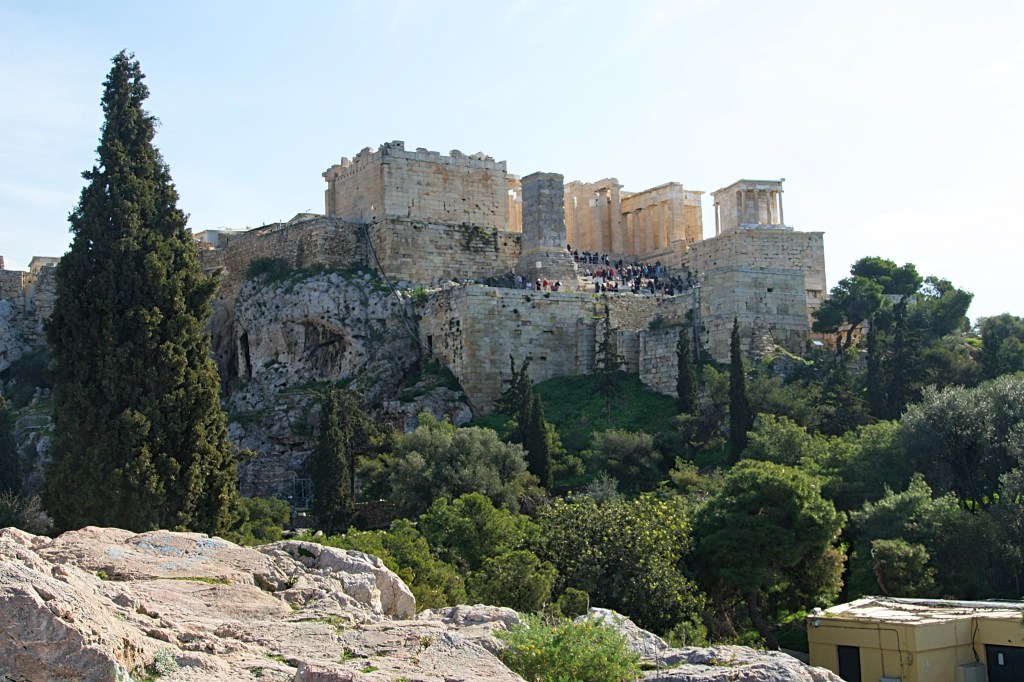
Most of you know that we had the chance to visit Greece during the past couple of weeks and visited Athens. While there we visited the famous Acropolis, saw the ancient ruins located there, as well as the Areopagus (sometimes referred to as Mars Hill) which is located just below the Acropolis. At present, the Areopagus is just a large outcropping of rock…that tourists can climb up on. But in ancient times it was thought to be the foundation for a number of official buildings that made up the center of government, as well as a courthouse where trials were conducted. It was here that the Apostle Paul is said to have delivered a speech to the elders, philosophers, and other teachers who were interested in hearing his message. (Acts 17) Today I want to look briefly with you at that sermon that Paul delivered. (above is the Acropolis, with the remains of the Parthenon most clearly observed….the photo below shows the present day rock – you can see tourists on it – where the Areopagus and its buildings once stood.)

Context
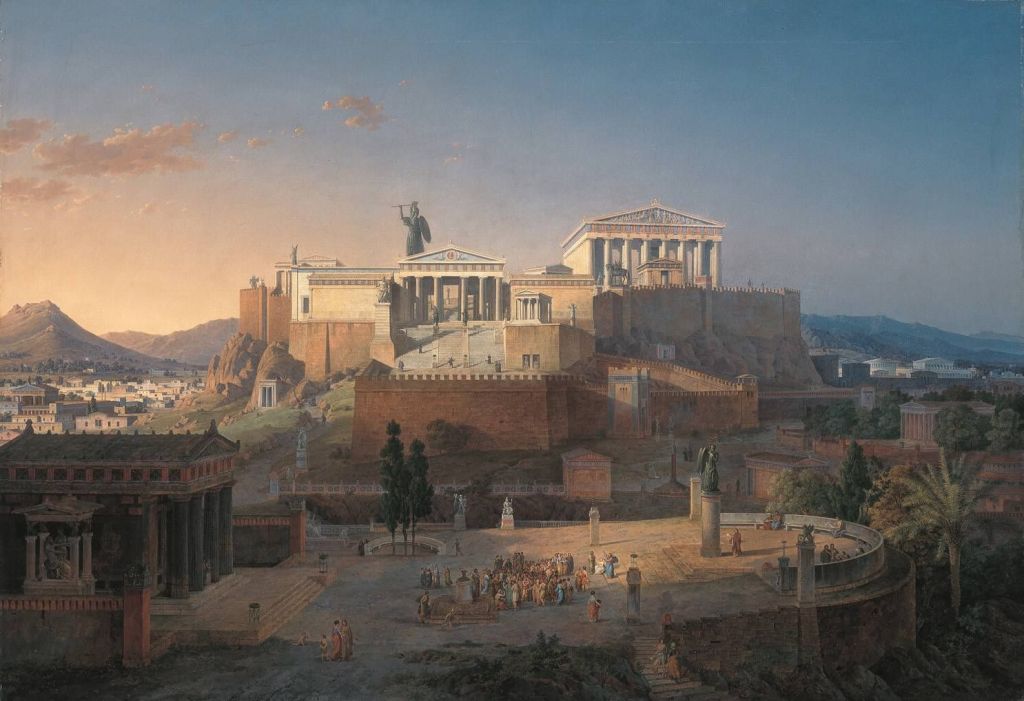
In the Biblical account Paul, along with his companions Silas and Timothy, had run into trouble in both Thessalonica and Berea after preaching about Jesus Christ. They decided to split up for safety reasons, and Paul was brought to Athens, while Silas and Timothy remained in Berea. The plan was for Silas and Timothy to eventually catch up with Paul there in Athens. Paul had not planned an evangelistic trip or message in Athens. He was simply there, in some respects, as a tourist just looking around. (The picture below is an artist’s rendering of the Areopagus – the courthouse and large patio area in foreground – as well as the Parthenon and other temples – higher on the Acropolis – as it may have appeared during the time of Paul.)
Location
We have three locations listed where Paul was preaching and witnessing. First, in the synagogue, or the church. Second, in the marketplace. And last, he was invited to the areopagus.
- Synagogue – where the Jews were gathered to worship, study the law.
- Marketplace – where the Athenians were busy congregating, doing business, discussing various topics. (Schools, stores, public politics, etc.)
- Areopagus – the political and philosophical center. At the time Paul gave this sermon there was already a history of 4-500 years of areopagus “rule”. Not a monarchy, and not yet democracy. But a group of leaders.
Today, we often think of the church in old testament terms. A holy place, meeting together at a holy time (Sunday a.m.) with holy people (pastor) wearing holy clothes (gowns and stoles) and doing holy things. However, this is really based on a concept of Solomon’s temple rather than on any church we see in the new testament accounts.
We don’t need to deny our buildings or land. They have been given to us by God. But they must serve the purpose of reaching OUT into our society. They are a base of operations. A place of preparation…in order that we might be sent out to the marketplace. We cannot wait merely for people to come to us, as if this is the only location where the Holy Spirit is working. We must see that our main work and witness is out THERE, in the public square.
Ian Thomas said: “The measure of a healthy church is not in the seating capacity – how many can gather on a Sunday morning – but on the sending capacity – how many are sent out during the week.” So while Paul was speaking in the local synagogue (church)…he is also out in the marketplace.
Audience
While part of his Athenian audience appeared to be fellow-Jews (at least in the Synagogue), his audience at the Areopagus were non-Jews, leaders of Athens, i.e., those outside the faith.
Content (Acts 17:19-34)
What does Paul preach? How does he say it? Paul does not berate them for their idolatry, even though he was troubled by it. He instead looks for those points of commonality. He recognizes that although the Athenians have not yet known or met Christ, they desire to seek for power and spirituality that is bigger than themselves. They may be merely superstitious, but they are nevertheless seeking. It’s clear that Paul chooses to speak with gentleness and an obvious respect for his listeners. His attitude is one of humility and his desire is to find common ground. (the photo below is the view of the ancient ruins of the Acropolis as seen from the present day areopagus rock.)
The content of his sermon may be summarized as follows:
- God is a creator God. He has made everything! He doesn’t live in buildings built by man’s hands. (At this point it’s not hard to imagine that Paul may even have pointed towards the Parthenon, the massive stone temple which would have towered above them on the nearby Acropolis.)
- God gives everyone breath and life…He is the source of life. So God really doesn’t need anything from human hands.
- All humanity comes from one source – God – through Adam, and we are all one family, not many.
- God did this so that people would seek him and perhaps reach out for him and find him, though he is not far from each one of us.
- We are all God’s children!
- If God made us (we being created) how can things that we then make with OUR hands (idols of silver, gold, stone) be equated somehow with GOD??! They may be historical, they may be beautiful, they may seem worthy of our attention…but something to be worshipped?? NO!
So far, the Athenians – and perhaps even most people today – could agree with Paul’s sermon. But the sermon closes in verses 30-31.
- In the past God overlooked such ignorance, but now he commands all people everywhere to repent.
- For he has set a day when he will judge the world with justice by the man he has appointed. He has given proof of this to all men by raising him from the dead.
Pauls’ conclusion brings in the truth about Jesus Christ and his resurrection. When he concluded, what were the results of his sermon? It appears that the results were mixed.
- Some just outright laughed at Paul when he spoke of resurrection, considering it nonsense.
- Others appeared somewhat interested, saying “let’s hear some more later.”
- Some believed. (Two that are mentioned – Dionysius, a member of the Areopagus Council, and Damaris, a woman who was present at Paul’s appearance.) Interestingly enough, even today, a stone plaque – memorializing Paul’s sermon – is still at the Areopagus, and a large Avenue name after Dionysius still runs near the site and handles a large volume of traffic!
So what can we learn from Paul’s message and appearance at the Areopagus?
- Paul had met the risen Christ…and it had completely changed his life! He spoke boldly and courageously wherever he went. While we all have different personalities and gifts (we certainly are not all like Paul!), we are encouraged by the words in John’s first letter – “For we tell you about what we have seen and heard.” Yes, witnessing for Christ is not a technique, a program, a style, and certainly not a personality…. We are simply encouraged to tell others about that which “we have seen and heard.” This of course makes it necessary to meet and hear from the risen Christ regularly…
- We must approach our kingdom work with HUMILITY and respect for others, seeking common ground as Paul so clearly did here in Athens.
- We must see our real work as OUT THERE in the marketplace, rather than confined merely to the synagogue (our own church building.)
- Believe that God is CLOSE to all of our family and friends (v.27). Do we really believe that God is CLOSE to all people? That he made us and loves us and is right nearby? Lord, forgive us for thinking that so many are FAR from you!
(the above is a summary of the message shared during worship on February 23, 2025.)
 Japanese Congregational Church