
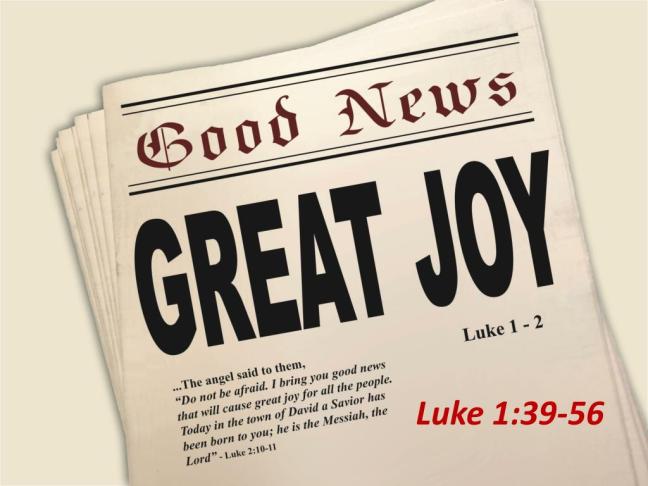
Luke 1:39-56
39In those days Mary set out and went with haste to a Judean town in the hill country, 40where she entered the house of Zechariah and greeted Elizabeth. 41When Elizabeth heard Mary’s greeting, the child leaped in her womb. And Elizabeth was filled with the Holy Spirit 42and exclaimed with a loud cry, “Blessed are you among women, and blessed is the fruit of your womb. 43And why has this happened to me, that the mother of my Lord comes to me? 44For as soon as I heard the sound of your greeting, the child in my womb leaped for joy. 45And blessed is she who believed that there would be a fulfillment of what was spoken to her by the Lord.”46And Mary said, “My soul magnifies the Lord, 47and my spirit rejoices in God my Savior, 48for he has looked with favor on the lowliness of his servant. Surely, from now on all generations will call me blessed; 49for the Mighty One has done great things for me, and holy is his name. 50His mercy is for those who fear him from generation to generation. 51He has shown strength with his arm; he has scattered the proud in the thoughts of their hearts. 52He has brought down the powerful from their thrones, and lifted up the lowly; 53he has filled the hungry with good things, and sent the rich away empty. 54He has helped his servant Israel, in remembrance of his mercy, 55according to the promise he made to our ancestors, to Abraham and to his descendants forever.” 56And Mary remained with her about three months and then returned to her home.
Earlier in the chapter, Gabriel, the angel, appeared to Zechariah and announced that his wife, Elizabeth, would give birth to John the Baptist. This was going to be a miracle child, since both were well advanced in age, and Elizabeth was barren – just like it was for Abram and Sarai in Genesis.
Six months later, Gabriel announced another miracle birth. He appeared to Mary and told her that she would give virgin birth to Jesus, the long-awaited Messiah.
The twelve tribes of Israel existed as a confederation of tribes until around 1020 BCE, when it became a united kingdom under Saul. Then in 930 BCE, 90 years later, it split into the northern kingdom of Israel and the southern kingdom of Judah.
In 722 BCE the northern kingdom of Israel was conquered by Assyria and ceased to exist. Then in 597 BCE the southern kingdom of Judah was conquered by Babylon and was under their rule for about 60 years, until the Persians defeated Babylon. After that, Judah was under Persian rule for about 200 years. Then came the Greeks, who ruled them for 165 years.
They won their independence in 140 BCE, which lasted for about 77 years, until the Romans took over, about 60 years before Christ was born.
After Assyria conquered the northern kingdom of Israel, but while Judah was still independent, the prophet Micah wrote, “But you, O Bethlehem of Ephrathah, who are one of the little clans of Judah, from you shall come forth for me one who is to rule in Israel, whose origin is from of old, from ancient days.” This was interpreted to be a prophesy of the coming messiah and his eternal rule.
The remaining remnant of the united kingdom of Israel was tired of being under gentile rule and was hoping that the promised Messiah would arrive soon, so that they could be freed from Roman rule and become an independent and strong nation again. The prophecies about the Messiah said that he would establish his rule and that it would last forever. It is understandable that any news of the arrival of the messiah would be welcomed with joy.
There is much joy in Zechariah and Elizabeth’s household when the pregnant Mary arrives for a visit. John, still in the womb, recognizes Jesus’ presence in Mary’s womb and leaps for joy. Through this, Elizabeth is made aware that the child inside Mary’s womb is the long-awaited Messiah.
Mary is joyful of being chosen for her role in giving birth to the Messiah. There is much wonder, anticipation and joy.
However, at this point in time, they had no idea how God’s plans would play out. They could not anticipate that John would be beheaded by Herod or that Jesus would be executed on the cross. Nor could they have guessed that even though the Messiah did arrive, the establishment of His eternal kingdom on earth would still not have arrived some two thousand years in the future.
For the disciples and others that believed that Jesus was the Messiah, they welcomed Him with joy with the anticipation of a revival of the nation of Israel. But that did not happen. Many of them ended up dying for their faith. The world continued on without a visible kingdom of Israel with the Messiah on the throne.
After His resurrection, Jesus returned to heaven but told them that He would come back to rule for eternity at the end of this age.
We now know that the reason the Messiah came to earth the first time was to bring salvation to all of mankind. By dying on the cross to take the penalty that we all should pay for our sins, all we have to do to be saved is to accept Jesus Christ as our Lord and Savior. And if we do this, then we can wait for His Second Coming, not with fear that this world is ending, but with joy that our redemption is drawing near.
The Christmas season is a magical one – a joyous celebration. Family gatherings, Christmas carols, candlelight services, gift exchanges, children opening their presents with delight. But for some, it is a difficult and lonely time. They might be missing loved ones or having no one with whom to celebrate. Or they may have lost their jobs or houses or found out that they have a serious disease.
Many people dread the Christmas season, because they know that their experience will not match the expectations of a magical season. Why is that? Christmas has become a secular celebration. It has become a reason for spending money on presents and gathering as friends and families. Even though it started out as a celebration of Christ’s birth, now….even those who dislike Christ and Christians celebrate it with great joy. People often celebrate Christmas, rather than Christ’s birth.
If we think back on memories of past Christmas gatherings with family and friends, we might find that time spent on the topic of Christ’s birth is miniscule compared to the time we spend catching up, opening presents, talking about past gatherings, future plans, etc. We may also have fallen into celebrating Christmas, rather than celebrating Christ’s birth.
However, even though the joy and the hope that Elizabeth, Mary and the disciples had for the eternal reign of the Messiah did not materialize, the birth of Jesus is worthy of a celebration. It is the only recorded time in history that humans witnessed the heavenly hosts celebrating.
Instead of the nation of Israel coming back to life as an independent state, through Jesus Christ, God had given humanity, not just for Israel, but for all of humanity, a chance to be part of God’s kingdom. Through what Jesus did on the cross, our sins can be forgiven and our eternity assured.
The Bible teaches us that we live in the period before the end, and we have been saved so that we can continue to be witnesses for Jesus until our time on earth is done. We who have been saved have experienced the joy that God gives us. In turn, we have the responsibility to point others to that joy. Even though this life is not easy and it has its hard parts, especially as we get older, there is still joy and hope, all because Jesus was born in Bethlehem, some two thousand years ago. So go celebrate Christmas with friends and family. Or celebrate it in a quiet way. But let us not just celebrate the holiday of Christmas but actually celebrate the birth of Christ. And offer true joy to those who do not yet have the joy of God in their lives by telling them about Christ and the meaning of his birth!
(The above is a summary of the message shared by Pastor Shun Takano at our worship on December 14, 2025.)
 Japanese Congregational Church