
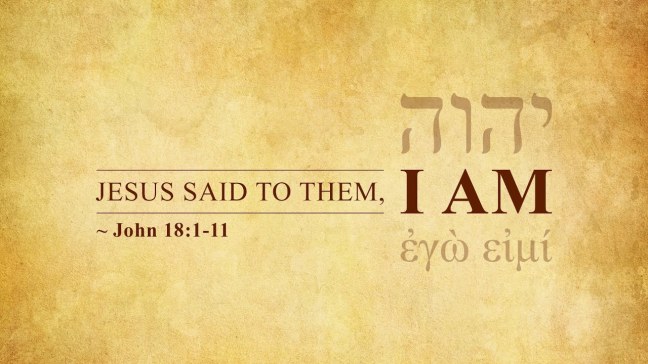
John 18:1-11
1After Jesus had spoken these words, he went out with his disciples across the Kidron valley to a place where there was a garden, which he and his disciples entered. 2Now Judas, who betrayed him, also knew the place, because Jesus often met there with his disciples. 3So Judas brought a detachment of soldiers together with police from the chief priests and the Pharisees, and they came there with lanterns and torches and weapons. 4Then Jesus, knowing all that was to happen to him, came forward and asked them, “Whom are you looking for?” 5They answered, “Jesus of Nazareth.” Jesus replied, “I am he.” Judas, who betrayed him, was standing with them. 6When Jesus said to them, “I am he,” they stepped back and fell to the ground. 7Again he asked them, “Whom are you looking for?” And they said, “Jesus of Nazareth.” 8Jesus answered, “I told you that I am he. So if you are looking for me, let these men go.” 9This was to fulfill the word that he had spoken, “I did not lose a single one of those whom you gave me.” 10Then Simon Peter, who had a sword, drew it, struck the high priest’s slave, and cut off his right ear. The slave’s name was Malchus. 11Jesus said to Peter, “Put your sword back into its sheath. Am I not to drink the cup that the Father has given me?”
In less than two weeks, the season of lent will start. It is supposed to be a time of contemplating our shortcomings and why Jesus had to go to the cross and die for our sins. And to prepare our hearts to thank and celebrate Jesus’ resurrection on Easter. So, it is appropriate timing that we are at the final portion of John’s gospel.
As was mentioned when we first started this series on John, the author pointed out why he was writing this book. John 20:30-31 – “Now Jesus did many other signs in the presence of his disciples, which are not written in this book. But these are written so that you may come to believe that Jesus is the Messiah, the Son of God, and that through believing you may have life in his name.”
John focuses on the deity of Christ. John is not ignoring the fact that Jesus was 100% human, but he wants to emphasize that Jesus is also 100% God. This scene, where Jesus is arrested, has some elements that are unique to this gospel, consistent with John’s approach.
The scene where Jesus prays to the Father that, if possible, the bitter cup of having to go to the cross be taken away, is skipped by John. The reference to the cup comes in verse eleven, where Jesus is certain of His way forward. Even though He has the power to defeat His enemies, He allows Himself to be arrested and taken away. He tells Peter and the others not to resist.
The narrative of Jesus’ arrest in the garden is a familiar one to us, but probably for most of us, we tend to remember it from the other gospels. We remember that Jesus is distressed and prays to the Father and He asks His disciples to also pray. We remember how Judas betrays Jesus with a kiss. But these elements are not included in John’s account.
There is one easily missed or ignored scene that only John includes. This is found in verse six. Jesus asks those who came to arrest Him whom they were looking for; they respond that they are looking for Jesus of Nazareth. And when Jesus answers, “I am He”, they all step back and fall to the ground. What made them to do that?
We must go back to our series on Moses to understand what is going on here. Moses was born in Egypt at a time when the enslaved Hebrews (descendants of Abraham through Isaac) were increasing in numbers so fast that this worried the Pharaoh, who issued a command to kill all male Hebrew infants. To protect her infant son, Moses’ mother puts him in a basket and floats him in the River Nile. He is picked up by a daughter of Pharaoh who adopts him and Moses spends the first forty years of his life as a prince of Egypt.
After killing an Egyptian in defense of a Hebrew, Moses flees and spends the next forty years as a shepherd in Midian. One day, he sees a burning bush and hears a voice calling to him. The voice explains that He is the God of Moses’ ancestors and is now sending Moses to Egypt to obtain freedom for all the Hebrew slaves. When Moses asks for God’s name, God tells him, “I am who I am”, or “I am”.
Even though scholars believed for a long time that this name was pronounced “Jehovah”, they now believe that the actual pronunciation is “Yahweh”. The reason they were not sure was because of the second commandment, the Israelites concluded that the best practice would be to never mention His name.
Those who came to arrest Jesus were Jews. And when they heard Jesus say, “I am”, they all fell to the ground. Through Jesus’ words, they must have been reminded of Yahweh and they must have felt the power of Jesus at that moment. Otherwise, they would have either just stood there or lashed out at Jesus. But they all fell to the ground.
Back in John 13, after telling the disciples that one of them will betray Him, Jesus said that He is telling them in advance so that when this happens, they will know that He is the Messiah. John 13:19 – “I am telling you this now, before it takes place, that when it does take place, you may believe that I am he.”
This is in line with John’s intent to highlight the deity of Christ. This also makes it clear that Jesus was not a victim. He was not powerless. He was not without choice. Jesus had the power to save Himself. Instead, He chose to hold back His power and let the men arrest Him. As we shall see in the next few weeks, Jesus will be put on trial, declared “innocent”, and yet be put to death on the cross.
God so loved the world that He sent His only Son to the cross so that He could pay the penalty for our sins. And anyone who accepts Jesus as Lord and Savior will be granted eternal life with God and other believers.
This is the good news that we are to share with others who have not heard or who have heard but not yet accepted.
(the above is a summary of the message shared by Pastor Shun Takano during our worship on February 8, 2026.)
 Japanese Congregational Church