I Am He

John 18:1-11

1After Jesus had spoken these words, he went out with his disciples across the Kidron valley to a place where there was a garden, which he and his disciples entered. 2Now Judas, who betrayed him, also knew the place, because Jesus often met there with his disciples. 3So Judas brought a detachment of soldiers together with police from the chief priests and the Pharisees, and they came there with lanterns and torches and weapons. 4Then Jesus, knowing all that was to happen to him, came forward and asked them, “Whom are you looking for?” 5They answered, “Jesus of Nazareth.” Jesus replied, “I am he.” Judas, who betrayed him, was standing with them. 6When Jesus said to them, “I am he,” they stepped back and fell to the ground. 7Again he asked them, “Whom are you looking for?” And they said, “Jesus of Nazareth.” 8Jesus answered, “I told you that I am he. So if you are looking for me, let these men go.” 9This was to fulfill the word that he had spoken, “I did not lose a single one of those whom you gave me.” 10Then Simon Peter, who had a sword, drew it, struck the high priest’s slave, and cut off his right ear. The slave’s name was Malchus. 11Jesus said to Peter, “Put your sword back into its sheath. Am I not to drink the cup that the Father has given me?”

In less than two weeks, the season of lent will start. It is supposed to be a time of contemplating our shortcomings and why Jesus had to go to the cross and die for our sins. And to prepare our hearts to thank and celebrate Jesus’ resurrection on Easter. So, it is appropriate timing that we are at the final portion of John’s gospel.

As was mentioned when we first started this series on John, the author pointed out why he was writing this book. John 20:30-31 – “Now Jesus did many other signs in the presence of his disciples, which are not written in this book. But these are written so that you may come to believe that Jesus is the Messiah, the Son of God, and that through believing you may have life in his name.”

John focuses on the deity of Christ. John is not ignoring the fact that Jesus was 100% human, but he wants to emphasize that Jesus is also 100% God. This scene, where Jesus is arrested, has some elements that are unique to this gospel, consistent with John’s approach.

The scene where Jesus prays to the Father that, if possible, the bitter cup of having to go to the cross be taken away, is skipped by John. The reference to the cup comes in verse eleven, where Jesus is certain of His way forward. Even though He has the power to defeat His enemies, He allows Himself to be arrested and taken away. He tells Peter and the others not to resist.

The narrative of Jesus’ arrest in the garden is a familiar one to us, but probably for most of us, we tend to remember it from the other gospels. We remember that Jesus is distressed and prays to the Father and He asks His disciples to also pray. We remember how Judas betrays Jesus with a kiss. But these elements are not included in John’s account.

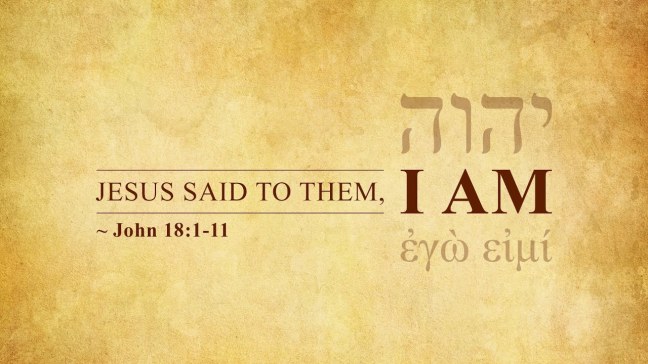
There is one easily missed or ignored scene that only John includes. This is found in verse six. Jesus asks those who came to arrest Him whom they were looking for; they respond that they are looking for Jesus of Nazareth. And when Jesus answers, “I am He”, they all step back and fall to the ground. What made them to do that?

We must go back to our series on Moses to understand what is going on here. Moses was born in Egypt at a time when the enslaved Hebrews (descendants of Abraham through Isaac) were increasing in numbers so fast that this worried the Pharaoh, who issued a command to kill all male Hebrew infants. To protect her infant son, Moses’ mother puts him in a basket and floats him in the River Nile. He is picked up by a daughter of Pharaoh who adopts him and Moses spends the first forty years of his life as a prince of Egypt.

After killing an Egyptian in defense of a Hebrew, Moses flees and spends the next forty years as a shepherd in Midian. One day, he sees a burning bush and hears a voice calling to him. The voice explains that He is the God of Moses’ ancestors and is now sending Moses to Egypt to obtain freedom for all the Hebrew slaves. When Moses asks for God’s name, God tells him, “I am who I am”, or “I am”.

Even though scholars believed for a long time that this name was pronounced “Jehovah”, they now believe that the actual pronunciation is “Yahweh”. The reason they were not sure was because of the second commandment, the Israelites concluded that the best practice would be to never mention His name.

Those who came to arrest Jesus were Jews. And when they heard Jesus say, “I am”, they all fell to the ground. Through Jesus’ words, they must have been reminded of Yahweh and they must have felt the power of Jesus at that moment. Otherwise, they would have either just stood there or lashed out at Jesus. But they all fell to the ground.

Back in John 13, after telling the disciples that one of them will betray Him, Jesus said that He is telling them in advance so that when this happens, they will know that He is the Messiah. John 13:19 – “I am telling you this now, before it takes place, that when it does take place, you may believe that I am he.”

This is in line with John’s intent to highlight the deity of Christ. This also makes it clear that Jesus was not a victim. He was not powerless. He was not without choice. Jesus had the power to save Himself. Instead, He chose to hold back His power and let the men arrest Him. As we shall see in the next few weeks, Jesus will be put on trial, declared “innocent”, and yet be put to death on the cross.

God so loved the world that He sent His only Son to the cross so that He could pay the penalty for our sins. And anyone who accepts Jesus as Lord and Savior will be granted eternal life with God and other believers.

This is the good news that we are to share with others who have not heard or who have heard but not yet accepted.

(the above is a summary of the message shared by Pastor Shun Takano during our worship on February 8, 2026.)

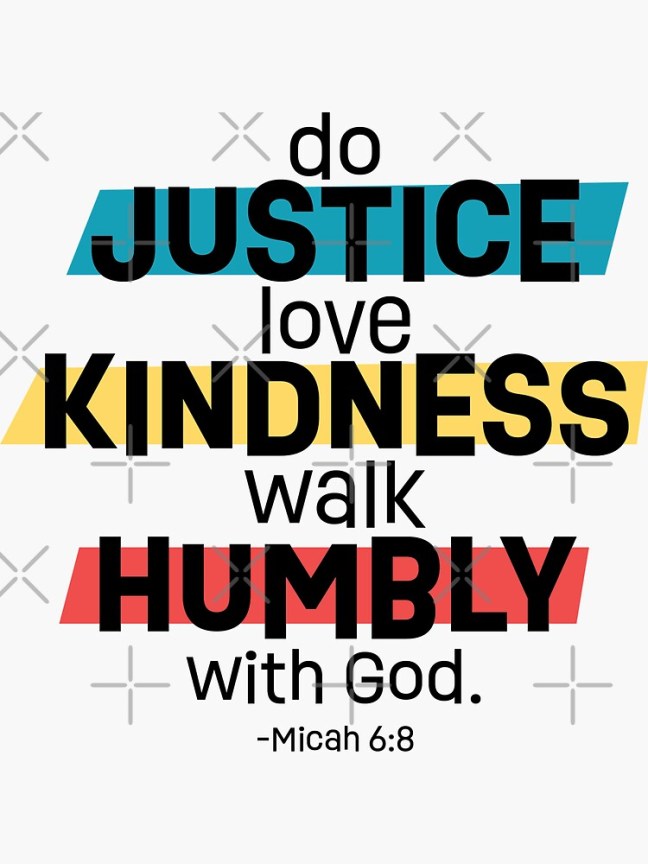
Do Justice, Love Mercy, Walk Humbly with God

Micah 6:1-8

1 Listen to what the LORD says: “Stand up, plead your case before the mountains; let the hills hear what you have to say. 2 Hear, O mountains, the LORD’s accusation; listen, you everlasting foundations of the earth. For the LORD has a case against his people; he is lodging a charge against Israel. 3 “My people, what have I done to you? How have I burdened you? Answer me. 4 I brought you up out of Egypt and redeemed you from the land of slavery. I sent Moses to lead you, also Aaron and Miriam. 5 My people, remember what Balak king of Moab counseled and what Balaam son of Beor answered. Remember [your journey] from Shittim to Gilgal, that you may know the righteous acts of the LORD.” 6 With what shall I come before the LORD and bow down before the exalted God? Shall I come before him with burnt offerings, with calves a year old? 7 Will the LORD be pleased with thousands of rams, with ten thousand rivers of oil? Shall I offer my firstborn for my transgression, the fruit of my body for the sin of my soul? 8 He has showed you, O man, what is good. And what does the LORD require of you? To act justly and to love mercy and to walk humbly with your God.

The scripture for today, particularly verse 8, is one of the most famous verses in the Bible.

“Do justice, love mercy, walk humbly with your God.” What does it mean? How should we interpret these words of the prophet? To understand better, we look at the verses preceding it: verses 1-7.

Here we have the prophet giving us an image of a courtroom. God appears to be the plaintiff and is  bringing charges against his people, the people of Israel.  “The Lord has a case against His people”….  (v.2)  Then God says in verse 3 –   “What have I done to ever trouble you?” Although God does not list any specific sins of Israel here….the inference is “Why do you behave like this?”  Later in verse 12 we do see that God accuses the people of some specific sins: “your wealthy are full of violence, your inhabitants speak lies.” 

God’s faithfulness to Israel seems contrasted with Israel’s unfaithfulness to God. In verse 4 and 5 we have God stating his many blessings to Israel:

  • Israel was led out of slavery in Egypt into freedom
  • They were provided with leaders: Moses, Aaron, Miriam
  • God even provided them protection through foreigners: Balak and Balam.
  • Protection and blessings during their travels from “Shittim to Gilgal” (the 40 years in the wilderness).

Then in verse 6 and 7 it’s Israel’s turn to defend itself. But they have no defense. They give no attempt to deny God’s accusations. Instead, they merely consider what they need to do in order to appease God. (“What will it take to get God off our backs?”) More sacrifices? Burnt offerings? Calves a year old? A thousand rams? 10,000 rivers of oil? Sacrifice our own children – our first born?

But then we have the punchline. We get the answer, from Micah:

“You already know what is right and good. You know what God requires. Do justice, love mercy, walk humbly with your God.”

Do any of you have a fitbit…or some other fitness tracker? A few years ago I was given a Garmin watch by my children. These devices can count our steps, measure our heartbeat, track various bodily functions like blood pressure, glucose count, etc. They’re getting more and more sophisticated. Consider the following scenario:

You buy one, read the instructions, and learn all about its functions. But then you leave it on the dresser, or in a drawer. You never use it. What would you say about that fitness device? There’s certainly nothing wrong with it! The problem is that you have never put it on your wrist and started to walk!  Just owning it will not help you maintain your health.

Micah is saying something similar to the people of Israel. You don’t need a better fitness tracker. You don’t need new rules or religious practices. God isn’t interested in all of your religious practices and structures. God isn’t interested in your “words only” religion – in lip service. This is what He desires: for you to return to the basics of your walk with God. Treat others fairly, show mercy and kindness (even when people don’t deserve it), stop depending on your own smarts…. Walk humbly with God, recognizing His presence in all things.

One more New Testament text may help us clarify these words from Micah. In Mark chapter 12, Jesus is asked “Of all the commandments, which is the greatest?”  His answer is a complete parallel to Micah 6:8. Jesus begins with the very same words as the prophet Micah.

“Shemah! Hear….listen! “Listen up!”  (v. 1 and 2 in our Micah text)

“Hear O Israel, the Lord our God, the Lord….is one. Love the Lord your God with all your heart, soul, mind, and strength. Love your neighbor as yourself.”

Easy to say, tricky to do. But Jesus says that it is the very ESSENCE of all of scriptural teaching. So think of Micah 6:8 and Mark 12:29-31 as the same message.

Do Justice…. Treat people fairly. Do unto others as you would have them do to you.

Love Mercy / Kindness …..treat people with lovingkindness…Do unto others ….

Walk Humbly with God …. Love God with all your heart

Micah did not give the people of Israel a simple check list. These are not items that are “one and done” This is a call to a lifestyle based on LOVE…rather than hate, and fear. We are called to do these things in the midst of our walking with God. Let us pray.

Faithful God,
You have never asked us to impress You,
only to walk with You.

Forgive us for the times
we have spoken the right words
but avoided the hard steps.

Teach us what justice looks like
in the way we treat others.
Teach us what mercy feels like
when it costs us something.
Teach us humility
that listens more than it speaks
and trusts You more than ourselves.

As we leave this place,
turn our faith into movement,
our worship into obedience,
and our love for You
into love for our neighbors.
We ask this,
not to earn Your favor,
but because You have already given it to us.
Amen.

(the above is a summary of the message shared during our worship on February 1, 2026.)

Unity

John 17:20-26

20“I do not ask for these only, but also for those who will believe in me through their word, 21that they may all be one, just as you, Father, are in me, and I in you, that they also may be in us, so that the world may believe that you have sent me. 22The glory that you have given me I have given to them, that they may be one even as we are one, 23I in them and you in me, that they may become perfectly one, so that the world may know that you sent me and loved them even as you loved me. 24Father, I desire that they also, whom you have given me, may be with me where I am, to see my glory that you have given me because you loved me before the foundation of the world. 25O righteous Father, even though the world does not know you, I know you, and these know that you have sent me. 26I made known to them your name, and I will continue to make it known, that the love with which you have loved me may be in them, and I in them.”

In the previous few chapters, Jesus has His last supper before His crucifixion, establishes the Lord’s supper, tells the followers that He will be betrayed and that He will be going away. He also tells them that the Holy Spirit will come to them and will help them to remember all the things that Jesus taught them. Jesus also teaches them to pray directly to the Father in His name.

And now in chapter 17, Jesus prays.

What is encouraging about this particular prayer is that He is not praying for the world in general, but specifically for his followers – Not just for the Twelve, but for us. If you look at verse 20, He specifically identifies us – “I do not ask for these only, but also for those who will believe in me through their word”.

What does He pray for us? That we would be in unity. Just as the Father and the Son have unity, we are to be one with the triune God – v. 21. And why is this unity with God important? So that the world may know that the Father sent Jesus out of love for the world – v. 22.

This is consistent with the new commandment that Jesus gave in John 13 – To love one another. We are to love one another so that others watching us will know that we are Christians.

The fact that Jesus had to give us a command to love one another tells us that we are capable of not acting in love. If our nature were genuinely loving, Jesus would not have to give us such a command.

Most of us remember the time before internet, email and texting became widespread. Home internet access in the U.S. surged after 1995, along with email. Then with the proliferation of mobile phones, texting became widespread in the mid 2000s.

Before this, the way we communicated with each other was face-to-face, telephone or via letters. In each case, we were usually on good behavior, especially with those we did not know well. We were more restrained when we disagreed.

Then things changed when social media became widespread – Facebook started in 2004. When it became possible to make comments instantaneously with no face-to-face interaction, and anonymously, using whatever username we wanted, then things started to turn a bit more abrasive and sometimes ugly. Our true nature started to surface. We became less restrained, less polite, even aggressive at times.

However, these are the times that we can be witnesses for God’s love by being peaceful and loving to others, especially towards other believers.

Ephesians 5:18 reminds us not to get drunk with wine but be filled with the Holy Spirit. And Galatians 5:22-26 reminds us how to live under the influence of the Holy Spirit:

22By contrast, the fruit of the Spirit is love, joy, peace, patience, kindness, generosity, faithfulness,   23gentleness, and self-control. There is no law against such things.   24And those who belong to Christ Jesus have crucified the flesh with its passions and desires.   25If we live by the Spirit, let us also be guided by the Spirit.   26Let us not become conceited, competing against one another, envying one another.

Jesus’ teachings all come together on this last evening before being arrested. We are to serve one another. We are to love one another. We are to have unity with God the Father, God the Son, and to one another. Jesus is going away but will send us the Holy Spirit so that we can remember everything He taught us, and so that we can witness to the fact that Jesus Christ is the Son of God and the Savior of the world.

To effectively witness to the world, we need the Holy Spirit to fill us and provide us with love and strength, because we cannot do so without God’s help.

And remember – Jesus is praying for us.

(the above is a summary of the message shared by Pastor Shun Takano during our worship on January 25, 2026.)

Complete Joy

John 16:16-24

16“A little while, and you will no longer see me, and again a little while, and you will see me.” 17Then some of his disciples said to one another, “What does he mean by saying to us, ‘A little while, and you will no longer see me, and again a little while, and you will see me’; and ‘Because I am going to the Father’?” 18They said, “What does he mean by this ‘a little while’? We do not know what he is talking about.” 19Jesus knew that they wanted to ask him, so he said to them, “Are you discussing among yourselves what I meant when I said, ‘A little while, and you will no longer see me, and again a little while, and you will see me’? 20Very truly, I tell you, you will weep and mourn, but the world will rejoice; you will have pain, but your pain will turn into joy. 21When a woman is in labor, she has pain, because her hour has come. But when her child is born, she no longer remembers the anguish because of the joy of having brought a human being into the world. 22So you have pain now; but I will see you again, and your hearts will rejoice, and no one will take your joy from you. 23On that day you will ask nothing of me. Very truly, I tell you, if you ask anything of the Father in my name, he will give it to you. 24Until now you have not asked for anything in my name. Ask and you will receive, so that your joy may be complete.”

Earlier in the chapter, Jesus tells the disciples that soon, there will be persecution and even executions by people who think they are doing it for God. He continues to tell them that He had not said these things before, because He was with them. But now, since He is going away, He needed to let the disciples know that these things will happen.

Jesus also tells them that it is better for them that He is going away, since He will be sending them the Advocate – The Holy Spirit. The Holy Spirit will make clear to the world about sin, righteousness and that Satan is as good as defeated.

Then in this morning’s passage, Jesus tells them that soon, they will no longer see Him, but then they will in a little while. He is talking about dying on the cross but coming back on the third day. The world will rejoice at His death, but the followers will be in pain. But that will soon reverse, and the pain will turn to joy when He is resurrected. He uses the example of giving birth to a child. There is necessary pain, but there will be joy in the end. So, as they go through the pain of Jesus’ death, they should know that it will turn into joy.

Jesus tells the disciples that they have not asked anything of the Father in Jesus’ name, but going forward, if they do ask in the name of Jesus, they will receive it, so that their joy may be complete.

Going on in vv. 25-28, Jesus further explains that asking in Jesus’ name does not mean that they must pray to Jesus and Jesus will intercede on their behalf. Instead, they are to directly ask the Father in Jesus’ name.

Does this mean that if we just add the phrase, “In Jesus’ name we pray,” we would be granted whatever we pray for? From experience, we know that is not what Jesus means. Otherwise, there would be no believers who have any lack in terms of health, wealth, etc.

The meaning is probably closer to “if you ask in my stead”. We are to pray for what Jesus would pray for. That is where the Holy Spirit will play a role. He will guide and teach us what Jesus would pray for. It is like we are representing Jesus for what we pray.

In Japanese culture, the traditional way to come to an agreement was not by signature, but by a stamp, called “hanko”. If we had the family hanko, then we represent our household. It is analogous to Jesus handing us His hanko for us to use it for the Kingdom.

When we read the Gospels and the Acts of the Apostles, we know that all of this came to pass. In the next chapter, Jesus is arrested. He is then put on trial and is executed on the cross, even though He had no sin. Deep sadness was felt by the followers, but it turned to joy on Easter morning, when Jesus came back from the dead. After teaching His followers for forty days, Jesus returns to heaven and promises to come back.

Then on Pentecost, the Holy Spirit arrives. And as the followers spread the gospel, under the influence of the Holy Spirit, and in the name of Jesus Christ, power, wisdom and love were given so that they could preach the gospel, and be witnesses that Jesus Christ is the Son of God and the Savior of the world. We see in Acts that Peter, Paul and others are able to escape captivity, heal, drive out demons, survive beatings and stoning. Even though life was not easy nor did they have wealth and health, they had complete joy.

In John 16, the disciples are feeling some doubt and anxiety, because Jesus told them that He is going away. Even though Jesus assures them that all the sadness will turn to joy, they are not sure that they can trust that hope.

When the Holy Spirit arrived, the world changed for them. They no longer had doubt about their final destiny and what they were to do until either they died or the Lord returned. They had motive to live and to hope and joy – Not through becoming rich or healthy or safe, but by serving Jesus and doing Kingdom work.

We are privileged to live in the post-Pentecost era, where as soon as we accept Jesus Christ as our Lord and Savior, the Holy Spirit enters into us. He guides us each day on what to pray, what to do, what to say. And if we follow the guidance of the Holy Spirit, it will give us joy complete.

(the above is a summary of the message shared by Pastor Shun Takano during worship on January 11, 2026.)

If the Lord Wills…

James 4:13-17

Now listen, you who say, “Today or tomorrow we will go to this or that city, spend a year there, carry on business and make money.” Why, you do not even know what will happen tomorrow. What is your life? You are a mist that appears for a little while and then vanishes. Instead, you ought to say, “If it is the Lord’s will, we will live and do this or that.” As it is, you boast and brag. All such boasting is evil. Anyone, then, who knows the good he ought to do and doesn’t do it, sins.

Happy New Year to all of you! 

How did you feel when you heard our text for this morning? Were you encouraged about the new year? What is James saying? It sounds like making business plans is foolish.  Is it also foolish to make New Year’s resolutions? If our lives are nothing more than a mist….are they without value?  How should we understand these words this morning? Let’s dig into this text together…

13 Now listen, you who say, “Today or tomorrow we will go to this or that city, spend a year there, carry on business and make money.”

What’s happening here?

  1. Today or tomorrow we will go to a certain town.
  2. We will stay there for a set amount of time (a year)
  3. We will engage in business
  4. We will make a profit

If we were going to engage in any kind of business this would be a MINIMUM kind of plan that must be in place in order for us to succeed.  So what’s missing? What’s wrong?

First, what is missing is a proper view of our life.

14 Why, you do not even know what will happen tomorrow. What is your life? You are a mist that appears for a little while and then vanishes.

  • Planning ahead is normal.  But don’t forget, your life IS LIKE A MIST!  (What do you feel when you hear this word?   Loneliness, worthlessness?)
  • James is not here speaking about the content of our lives, but is referring to the length of our lives.
  • From the day we are born until the day we die, we are not in control.  We didn’t decide when we would be born and we don’t decide when we will die.  James is saying YOU ARE NOT IN CONTROL OF YOUR OWN DESTINY. 
  • It’s true that we can take our own lives. But this never actually represents control, but instead a recognition that we are totally unable to change ourselves. It is a sign of hopelessness.

I am aging just like the rest of you. I see this in my body and health more than anything else. I hurt, I don’t move as easily. I can’t see without my glasses.  I am coming to see that my life is on the declining slope! It is because our lives are so short and unpredictable while on earth that we must be careful to have a proper understanding of the content and value of our lives.

In Psalm 90, verses 9,10,12, and 17 we have the following:

All our days pass away under your wrath; we finish our years with a moan. The length of our days is seventy years– or eighty, if we have the strength; yet their span is but trouble and sorrow, for they quickly pass, and we fly away. Teach us to number our days aright, that we may gain a heart of wisdom. May the favor of the Lord our God rest upon us; establish the work of our hands for us– yes, establish the work of our hands.

When we truly understand that our lives here are temporal, short, like a mist, we will be able to accurately count our days and make wise decisions.  Knowing that our lives are like a mist will change our lifestyle, our decisions, and our priorities.

Secondly, what is missing is a correct view of God.

15 Instead, you ought to say, “If it is the Lord’s will, we will live and do this or that.”

  • If the Lord wills, we will live.    

Here we recognize that God is in fact the one who gave us life and sustains that life. He is the one who knows us better than anyone, who wishes to give us all good things. He is the one who controls our birthing and dying. He decides where and when we are born and how long we will live on this earthHe controls the length of our lives.

  • If the Lord wills, we will do this or that.  

Here we recognize that even the things we do and accomplish are in God’s hands. Of course we are free to do many things that are wrong and hurtful. We are free to sin and we cannot claim that these are God’s plans.  But if we accomplish anything of value or good it is to the extent that God has allowed it and gifted us to do it.  Again, we look to God for his help.  He controls all of our accomplishments in life.

What difference does this make?   

It means that we plan boldly…but with humility. We place our lives and our plans in God’s hands!

16 As it is, you boast and brag. All such boasting is evil.

Here we see that to not understand these things is arrogance and pride.  These are what the Bible calls sin.  To believe that we are here because of our own work and effort, that we can control our lives…..this is what James calls arrogance.  And so James is today telling us to humble ourselves before God.

A similar passage from Proverbs 3:5-6:

Trust in the LORD with all your heart and lean not on your own understanding; in all your ways acknowledge him, and he will make your paths straight.

James 4:17

17 Anyone, then, who knows the good he ought to do and doesn’t do it, sins.

James concludes with the statement that to understand these things and not act on them is sin. It is our old sin of pride and “get by on my own.”

This week, let’s pause to consider:

  1. Our lives are like a mist (and therefore precious!)
  2. Humbly submit our lives to Him 
  3. Humbly submit our plans and dreams and New Year’s Resolutions to Him.

This is a teaching about the necessary balance in our lives that is required when “planning”.  But the same could be understood in our lives of “prayer”.

Pray for everything, ask for whatever you want, don’t be afraid of asking inappropriately!

But, remember Jesus’ prayer in Gethsemane….   “Father, this is what I want….. but, in the end, it’s not my will but YOUR will that I desire.”

(the above is a summary of the message shared during our worship on January 4, 2026.)

The Lord’s Command

John 15:12-17

12“This is my commandment, that you love one another as I have loved you. 13No one has greater love than this, to lay down one’s life for one’s friends. 14You are my friends if you do what I command you. 15I do not call you servants any longer, because the servant does not know what the master is doing; but I have called you friends, because I have made known to you everything that I have heard from my Father. 16You did not choose me but I chose you. And I appointed you to go and bear fruit, fruit that will last, so that the Father will give you whatever you ask him in my name. 17I am giving you these commands so that you may love one another.”

In the first section of this chapter, Jesus likens himself to the main branch of a grape plant, and God the Father to a vine grower. He likens us to the branches that grow from the main trunk. It is God’s intent to make each of the branches as fruitful as possible.

Jesus further talks about how unless one is attached to the main branch, one cannot be fruitful. The only way we can be fruitful is to abide in Christ. As Jesus abided in the Father’s love by keeping the Father’s commandments, we are to abide in Jesus’ love by keeping His commandments. And the result of abiding in Jesus’ love is joy. Quoting Jesus from v. 11 – “I have said these things to you so that my joy may be in you, and that your joy may be complete.”

Then Jesus proceeds to tell us what His command for us is in verse 12 – “This is my commandment, that you love one another as I have loved you.” And the greatest expression of this love, according to verse 13, is to lay down one’s life for one’s friend.

Jesus explains that masters do not divulge to their servants what they are doing. Jesus chooses to tell us what He and His Father are all about, treating us not as mere servants, but as if we are His friends.

Through Jesus’ teachings and the rest of the New Testament, we know what God’s plan for humanity is. Not being able to save ourselves, due to our sinful nature, God sent His Son to the cross to pay for our sins. By accepting this fact and accepting Jesus as our Lord and Savior, we are saved. We are saved so that we can be witnesses for Jesus until we either die or Jesus comes back again.

The interesting thing about verse 15 is that although we might think that we chose Jesus, the truth is that He chose us. He chose us to work for Him and to bear much fruit. We do not know why He chose us, but we do know what He chose us for. Ephesians 2:10 tells us that, “For we are what he has made us, created in Christ Jesus for good works, which God prepared beforehand to be our way of life.” We should consider it an honor that He chose us for this work.

There are also those out there that are not aware of the fact that they have been chosen, and part of our work is to point people to Christ, so that they too can fulfill the role God has chosen for them.

Jesus uses growing grapes as an example, and since I know nothing about that, I looked it up. There needs to be one woody branch that is going to be the main branch, and give it support so that it will grow tall and sturdy. Then you use a structure to “train” the vines to spread out. For it to be as fruitful as possible, many of the branches must be pruned. If they are not pruned, then you get lots of leaves and few grapes. Now, it is true that there are uses for grape leaves, but most people who grow grapes do so for the fruit, and not for the leaves.

It probably is not a pleasant thing for the grape plant to have a bunch of vines pruned, but it is necessary for it to be fruitful.

It is similar for us. For us to be as fruitful as possible, things need to be pruned. It might be dealing with sins in our lives. It might be mending relationships. It might mean letting go of some money or belongings. It might mean giving up some precious time doing what we like to do. It might mean instead of going to our favorite vacation spot, going somewhere where we can help in Kingdom work.

Probably, we will not be called upon to do what Jesus considers the greatest act of love – to lay down our lives for our friends. But if we are willing to do that, as Jesus commands, then we should be able to show love to others in less drastic ways.

As I look back on the year 2025, I can think of all the time and energy I used in doing Kingdom work – Preparing to teach from the Bible, preparing for sermons, preparing to play on a worship team, help put together the liturgy to be used on Sunday morning, etc. Then I am reminded of Jesus’ conclusion that the widow who contributed two pennies gave more than the wealthy who put in more. His reasoning is that the widow gave all she had and left nothing for herself, while the wealthy kept much for themselves. Jesus is consistent in His teachings in that what he considers the greatest act of love is to lay one’s life for a friend – not keeping anything for oneself.

Using this accounting method, in 2025, I kept much more time and resources for myself, compared to what I did for the Kingdom. I could have done much more. Maybe it is the same for some of you.

But there is no reason to beat yourselves about this, since there is nothing we can do to change the past. However, we can use it as a catalyst to be willing to do a little more for the Kingdom in 2026, to show love to others. Be willing to be more fruitful, even if it means that we go through a little pain in being pruned by our Lord.

(the above is a summary of the message shared by Pastor Shun Takano during our worship on December 28, 2025.)

“Prepare Him Room – JOY!”

Luke 1:39-56

39In those days Mary set out and went with haste to a Judean town in the hill country, 40where she entered the house of Zechariah and greeted Elizabeth. 41When Elizabeth heard Mary’s greeting, the child leaped in her womb. And Elizabeth was filled with the Holy Spirit 42and exclaimed with a loud cry, “Blessed are you among women, and blessed is the fruit of your womb. 43And why has this happened to me, that the mother of my Lord comes to me? 44For as soon as I heard the sound of your greeting, the child in my womb leaped for joy. 45And blessed is she who believed that there would be a fulfillment of what was spoken to her by the Lord.”46And Mary said, “My soul magnifies the Lord, 47and my spirit rejoices in God my Savior, 48for he has looked with favor on the lowliness of his servant. Surely, from now on all generations will call me blessed; 49for the Mighty One has done great things for me, and holy is his name. 50His mercy is for those who fear him from generation to generation. 51He has shown strength with his arm; he has scattered the proud in the thoughts of their hearts. 52He has brought down the powerful from their thrones, and lifted up the lowly; 53he has filled the hungry with good things, and sent the rich away empty. 54He has helped his servant Israel, in remembrance of his mercy, 55according to the promise he made to our ancestors, to Abraham and to his descendants forever.” 56And Mary remained with her about three months and then returned to her home.

Earlier in the chapter, Gabriel, the angel, appeared to Zechariah and announced that his wife, Elizabeth, would give birth to John the Baptist. This was going to be a miracle child, since both were well advanced in age, and Elizabeth was barren – just like it was for Abram and Sarai in Genesis.

Six months later, Gabriel announced another miracle birth. He appeared to Mary and told her that she would give virgin birth to Jesus, the long-awaited Messiah.

The twelve tribes of Israel existed as a confederation of tribes until around 1020 BCE, when it became a united kingdom under Saul. Then in 930 BCE, 90 years later, it split into the northern kingdom of Israel and the southern kingdom of Judah.

In 722 BCE the northern kingdom of Israel was conquered by Assyria and ceased to exist. Then in 597 BCE the southern kingdom of Judah was conquered by Babylon and was under their rule for about 60 years, until the Persians defeated Babylon. After that, Judah was under Persian rule for about 200 years. Then came the Greeks, who ruled them for 165 years.

They won their independence in 140 BCE, which lasted for about 77 years, until the Romans took over, about 60 years before Christ was born.

After Assyria conquered the northern kingdom of Israel, but while Judah was still independent, the prophet Micah wrote, “But you, O Bethlehem of Ephrathah, who are one of the little clans of Judah, from you shall come forth for me one who is to rule in Israel, whose origin is from of old, from ancient days.” This was interpreted to be a prophesy of the coming messiah and his eternal rule.

The remaining remnant of the united kingdom of Israel was tired of being under gentile rule and was hoping that the promised Messiah would arrive soon, so that they could be freed from Roman rule and become an independent and strong nation again. The prophecies about the Messiah said that he would establish his rule and that it would last forever. It is understandable that any news of the arrival of the messiah would be welcomed with joy.

There is much joy in Zechariah and Elizabeth’s household when the pregnant Mary arrives for a visit. John, still in the womb, recognizes Jesus’ presence in Mary’s womb and leaps for joy. Through this, Elizabeth is made aware that the child inside Mary’s womb is the long-awaited Messiah.

Mary is joyful of being chosen for her role in giving birth to the Messiah. There is much wonder, anticipation and joy.

However, at this point in time, they had no idea how God’s plans would play out. They could not anticipate that John would be beheaded by Herod or that Jesus would be executed on the cross. Nor could they have guessed that even though the Messiah did arrive, the establishment of His eternal kingdom on earth would still not have arrived some two thousand years in the future.

For the disciples and others that believed that Jesus was the Messiah, they welcomed Him with joy with the anticipation of a revival of the nation of Israel. But that did not happen. Many of them ended up dying for their faith. The world continued on without a visible kingdom of Israel with the Messiah on the throne.

After His resurrection, Jesus returned to heaven but told them that He would come back to rule for eternity at the end of this age.

We now know that the reason the Messiah came to earth the first time was to bring salvation to all of mankind. By dying on the cross to take the penalty that we all should pay for our sins, all we have to do to be saved is to accept Jesus Christ as our Lord and Savior. And if we do this, then we can wait for His Second Coming, not with fear that this world is ending, but with joy that our redemption is drawing near.

The Christmas season is a magical one – a joyous celebration. Family gatherings, Christmas carols, candlelight services, gift exchanges, children opening their presents with delight. But for some, it is a difficult and lonely time. They might be missing loved ones or having no one with whom to celebrate. Or they may have lost their jobs or houses or found out that they have a serious disease.

Many people dread the Christmas season, because they know that their experience will not match the expectations of a magical season. Why is that? Christmas has become a secular celebration. It has become a reason for spending money on presents and gathering as friends and families. Even though it started out as a celebration of Christ’s birth, now….even those who dislike Christ and Christians celebrate it with great joy. People often celebrate Christmas, rather than Christ’s birth.

If we think back on memories of past Christmas gatherings with family and friends, we might find that time spent on the topic of Christ’s birth is miniscule compared to the time we spend catching up, opening presents, talking about past gatherings, future plans, etc. We may also have fallen into celebrating Christmas, rather than celebrating Christ’s birth.

However, even though the joy and the hope that Elizabeth, Mary and the disciples had for the eternal reign of the Messiah did not materialize, the birth of Jesus is worthy of a celebration. It is the only recorded time in history that humans witnessed the heavenly hosts celebrating.

Instead of the nation of Israel coming back to life as an independent state, through Jesus Christ, God had given humanity, not just for Israel, but for all of humanity, a chance to be part of God’s kingdom. Through what Jesus did on the cross, our sins can be forgiven and our eternity assured.

The Bible teaches us that we live in the period before the end, and we have been saved so that we can continue to be witnesses for Jesus until our time on earth is done. We who have been saved have experienced the joy that God gives us. In turn, we have the responsibility to point others to that joy. Even though this life is not easy and it has its hard parts, especially as we get older, there is still joy and hope, all because Jesus was born in Bethlehem, some two thousand years ago. So go celebrate Christmas with friends and family. Or celebrate it in a quiet way. But let us not just celebrate the holiday of Christmas but actually celebrate the birth of Christ. And offer true joy to those who do not yet have the joy of God in their lives by telling them about Christ and the meaning of his birth!

(The above is a summary of the message shared by Pastor Shun Takano at our worship on December 14, 2025.)

Prepare Him Room – Setting the Table

You prepare a table before me in the presence of my enemies. You anoint my head with oil; my cup overflows. Surely goodness and love will follow me all the days of my life, and I will dwell in the house of the LORD forever. Psalm 23:5-6

Then I heard what sounded like a great multitude, like the roar of rushing waters and like loud peals of thunder, shouting: “Hallelujah! For our Lord God Almighty reigns. Let us rejoice and be glad and give him glory! For the wedding of the Lamb has come, and his bride has made herself ready. Fine linen, bright and clean, was given her to wear.” (Fine linen stands for the righteous acts of the saints.) Then the angel said to me, “Write: `Blessed are those who are invited to the wedding supper of the Lamb!'” And he added, “These are the true words of God.” Revelation 19:6-9

We are in our 2nd week of Advent. As we learned last Sunday, Advent is a time of waiting and preparation.  What are we waiting for?

  • The arrival of Jesus, the true light of the world!

Each year, Advent involves consideration of a Past, Present, and Future arrival of Jesus.

  • We remember his first arrival 2,000 years ago, as a human baby
  • We wait for his coming NOW, today, in a new and fresh way, into our broken world.
  • Finally, we look forward to his 2nd coming, a future arrival of the King!

So Advent is a time of hopeful and expectant WAITING. But we don’t JUST wait…. This is also a time of preparation. We are preparing for his arrival. But, how do we do that?

Our theme for this year is “Prepare Him Room”

Last week, we talked about preparing room by “clearing things out…making space”

That may involve getting rid of unnecessary items, or quitting bad habits that waste time and distract us. It may mean sweeping out the dirt, or in spiritual terms – returning to God’s Word and prayer, confessing our sins, etc.  In short, making space and time for God.

This week we are challenged to prepare room for Jesus by using an image of “setting the table.” What does this mean?

Consider the following examples:

The Grandmother’s Table

A grandmother always set the table hours before the family arrived for holiday meals. The house could still be messy—presents unwrapped, dishes in the sink—but the table was always ready. She said, “The table reminds me who I’m expecting. If the table is set, my heart is set.” One year a winter storm threatened to cancel the gathering. But she still put out the good plates and the candles. When asked why—knowing the family might not even make it—she smiled and said,  “Setting the table is an act of faith. It means I’m expecting someone I love.” That evening the storm cleared, and the family arrived to a glowing table of welcome. Advent invites us to “set the table” for Jesus—not when everything is perfect, not when the house of our life is spotless, but as an act of faith, expectation, and love.

The Restaurant Before Opening

Before a restaurant opens each day, there is a quiet ritual called “front-of-house prep.” Servers wipe tables, fold napkins, polish glasses, light candles, and place every chair with intention. The chef prepares ingredients long before anyone orders a meal. They prepare the space before the guests arrive. The careful setting of the table is a sign that hospitality is coming, that someone valued is expected. Advent calls us into that same rhythm. We prepare the “front-of-house” of our soul. We arrange our priorities. We soften our hearts. We intentionally make room because the Guest we’re expecting is the King.

In our scripture texts for today, we read about two different tables that have been prepared for us.

The Psalmist sings of the table prepared for us by God. “You prepare a table before me, in the presence of my enemies. You anoint my head with oil, my cup overflows. Surely goodness and mercy will follow me all the days of my life…and I will dwell in the house of the Lord forever.”

Then in Revelation John describes a final feast – a final table around which we will all gather. This too has been prepared for us. 9 Then the angel said to me, “Write: `Blessed are those who are invited to the wedding supper of the Lamb!'” And he added, “These are the true words of God.”  

In the gospels, there are many stories of Jesus, sitting around a table, sometimes with Pharisees, sometimes with tax collectors. And of course, on the night before he was crucified, Jesus himself prepared a table for his 12 disciples. A special Passover feast.

We set the table for Jesus, because he first set the table for us.

And then there’s the verse we shared last week: Rev. 3:20  “Behold I stand at the door and knock…..if anyone hears my voice and opens the door, I will come in and eat with them, and they with me.”

Yes, we’re waiting for Jesus to arrive. And we’re waiting to share this wonderful meal together. And if that’s true, we want to set the table, make preparations.

How will you set the table for Jesus this Advent season? What table-setting step is God inviting you to take this week? 

If “clearing out space” was a quick, big motion – “setting the table” may involve some smaller, more precise, yet important steps. Here are a few possibilities:

  • Reordering our priorities
  • A conversation of forgiveness 
  • A quiet space for prayer
  • A return to Scripture
  • A restored relationship
  • A simple act of kindness or hospitality

All of these may be ways in which we prepare the table for our welcoming of Jesus. Can you think of others?

(the above is a summary of the message shared during our worship on December 7, 2025.)

Prepare Him Room…Clearing Space

Isaiah 64:1-9

Today is the first Sunday of Advent. Advent means to come…..and it is the season of waiting for the coming of God into our world. Of course, we celebrate this each year while remembering that first Christmas, when God arrived in our world in the form of a little baby! But we also pray for today….that God would once again come afresh into our lives, into our broken world. And finally, it is a season when we pray “Come, Lord Jesus” as we await his second coming.

Last week I decided to clean out our garage. I have been putting that task off for at least a year and a half. Boxes were stacked all over. There were lots of items that weren’t even mine; junk that had been left from the previous owners when we moved in 5 years ago. There were old, half-filled paint cans of an unknown color, as well as broken items.  There were also lots of good and valuable items – like tools – that I could never find when I needed them because things were so cluttered and disorganized. Anyway, although I did not finish the task yet, I’ve made some good progress and feel encouraged to continue.

Why did I suddenly decide to take on this task now?  The truth is that I would probably continue procrastinating indefinitely except for the fact that we want to do something new with the garage. We’re considering adding a second floor, or maybe  even tearing it all down and building something new in its place. The point is that we can’t proceed with any new plans until we first clear out all the junk.

Our theme for this year’s advent is “Prepare Him Room.”  Before we can welcome Christ into our world, into our hearts, into our “room”, we need to prepare that room. How should we do that?

Just like our garage was filled with all sorts of junk and things that we don’t need, our lives and homes are also filled with items that are not only unnecessary but may actually keep us from fully welcoming Jesus.

  • Possessions that take up our time
  • Bad habits that steal our strength and waste our time
  • Distractions that keep us from seeking Jesus, that keep us from prayer and God’s word.

Our text that we read earlier was from Isaiah chapter 64. This text is usually understood to be the cry of the people of Israel. It is thought to be Israelites who have finally returned to Jerusalem after 70 years of captivity in Babylon. They had come with high hopes. But instead found a city still in ruin, poverty, lack of hope for the future, and discouragement on all sides. Their expectations and the reality they encountered were so different.

  • So they cry out to God in verses 1-3.

“O, that you would rend the heavens and come down! Please come down and help us!”  

We, too, are crying out to God. We see our world in shambles, war, and famine. We see our nation torn apart. “God, please come into our world!”

  • Next, in verses 4-7 they admit their sin.

They wonder if God is hiding His face from them.  In verse 5 we read But when we continued to sin against you, you were angry. How then can we be saved? All of us have become like one who is unclean, and all our righteous acts are like filthy rags.”

Advent invites us, too, to admit our sins, and to seek God’s forgiveness.

  • Finally, in verses 8-9 they remember who God is.

“You are the potter, and we are the clay. we are all the work of your hand. Do not be angry beyond measure, O LORD; do not remember our sins forever. Oh, look upon us, we pray, for we are all your people.”

Our hope is not in ourselves…..but in God’s character.

So in Isaiah we see that we are like the people of Israel:

  • We cry out to God to come down!
  • We confess our sins and seek healing.
  • We recognize that we are God’s…that he is the potter, we are the clay, and that we are all his people.

In light of that, how can we prepare our room today? How can we clear space? How can we make room?

  • What are the things in your life that keep you from completely welcoming Jesus in?
  • What are the things that need to change?
  • What are the items that need to be jettisoned?
  • What junk needs to be thrown out?

I love the verse in Revelation 3:20, with the invitation from Jesus himself:

“Behold, I stand at the door and knock. If anyone hears my voice, and opens the door, I will come in, and I will eat with them, and they with me.”

Wouldn’t it be a shame if we heard Jesus’ voice…and opened the door, only to realize that he couldn’t come in because there were so many boxes and so much junk stacked up inside that he couldn’t enter?? Or worse yet, that we couldn’t even hear his voice because of all the junk and unnecessary stuff cluttering our home?

We can experience a fresh presence and coming of Jesus this Advent! Let’s make room for Him….by clearing out space!

(the above is a summary of the message shared during our worship on November 30, 2025.)