
Here is the most recent news and Christmas greeting from Anna Rosengren, our missionary in Japan. Please read it….and maybe even consider joining her support team!
NEWS from ANNA

Here is the most recent news and Christmas greeting from Anna Rosengren, our missionary in Japan. Please read it….and maybe even consider joining her support team!

Genesis 41:14-36
In our prior studies as we’ve moved through Genesis, we see that Joseph, who has been falsely imprisoned, remains in prison. Even though God had been with him and made him successful inside the prison, Joseph is not free. The initial pair of dreams that he was given that he would rule someday has not yet been fulfilled. Joseph had hoped that the cupbearer that he helped would have put in a good word to the Pharaoh, but the cupbearer promptly forgot about Joseph, and Joseph remained imprisoned.
But two years later, the Pharaoh receives an unsettling pair of dreams, and is troubled. He gathers the wisest men in Egypt, but they were clueless as to what the dreams meant. So, the all-powerful king of Egypt was feeling powerless. This is when the cupbearer remembered Joseph, and how Joseph’s God had interpreted the dream the cupbearer had. He tells the Pharaoh about Joseph.
We now come to this morning’s passage. We see that the Pharaoh summons Joseph and tells him that he had two dreams, and no one has been able to tell him what they mean. Joseph declares that God can and will interpret the dreams. Pharaoh describes the two dreams to Joseph.
Joseph tells Pharaoh that both dreams mean the same thing. There will be seven years of plenty and seven years of drought, and the drought will be severe, and no one will remember the times of plenty once it hits. Joseph further explains that this is something that God is going to make happen, and the fact that there were two dreams with the same message means that this is fixed, and that God will shortly bring it about. There is nothing anyone can do to prevent it.
Joseph also adds a recommendation on how Pharaoh and Egypt can survive the approaching famine. He suggests that a wise man be selected to implement a program of putting enough food in storage during the seven years of plenty, to act as a reserve during the seven years of famine.
The fact that the first dream included the Nile must have shaken Pharaoh. The Nile is the life-giver of the whole area. It provides water and nutrients for Egypt to thrive, but now it is being associated with famine and death. Pharaoh believes what Joseph told him and decides to appoint Joseph in charge of the program to save Egypt through the coming seven years of famine.
Back in Genesis 37, Joseph was given a pair of dreams that told him that one day he would be a ruler and that even his brothers and father would bow before him. The brothers tried to destroy the dreams by selling Joseph into slavery, but unwittingly were pushing Joseph towards the dreams’ fulfillment.
It was not apparent to Joseph how the dream was going to come true, especially when he ended up in Egypt and in prison. But now the time of fulfillment had come. In later chapters, we will see how Joseph will reunite with his family.
We see through this narrative that God has His plans and earthly powers cannot stop them. However, this does not mean that we should just stand by and let things unfold. When we are given insights into God’s plans, then we should act with that in mind. That’s what Joseph did. Instead of just letting it be Egypt’s problem and letting them suffer and die, Joseph suggests a way to navigate within God’s plans. We are not to be spectators when we have been privy to God’s plans.
We might think that we have not been privy to God’s plans, but that is not true. We have been given God’s plans through the Bible. We may not know all the details, but we know enough. Sooner or later, this age is going to end, and a new earth and new heavens are going to be provided. This will happen after Jesus Christ returns. At that point, judgement will be rendered and all those who had accepted Jesus as Lord and Savior will go onto eternity with God, while the others will not. Although there is nothing we can do to prevent this from happening, with this knowledge, we know what we need to do. Instead of just letting this happen, we need to tell people what is going to happen and what they can do about it – That if they will believe and accept Jesus, they too can have their sins forgiven and have eternity with God and other believers assured.
With Thanksgiving done, we are headed to the advent season. There will be opportunities to witness to people – Inviting them to church, telling them about the real meaning of Christmas, telling them about what God has done for us.
Through the Bible, we know the reason Jesus was born on Christmas morning, died on the cross, and was resurrected. We know that Jesus is coming back, and when He does, it will be the end of this age, and at that point, each person’s eternal destination will be set. The time that this can still be changed is now, and we have been given a role to play — To be witnesses to the fact that Jesus Christ is the Son of God and the Savior of the world. Let us learn from Joseph and act boldly when the time for action comes.
(the above is a summary of the message shared by Shun Takano at our worship service on November 26, 2023.)

We just received this Thanksgiving greeting from Anna. Please take time to read it….and then let’s continue praying regularly for her as she finishes her time in the U.S., completes the raising of necessary funds in order to serve another 4 years with SEND, and finally….as she returns to Japan on January 9th!
Just click HERE to see the November Update.

Genesis 40:9-23
In our last message we saw Joseph in prison, after being falsely accused by Potiphar’s wife. But the LORD was with Joseph and brought him success even in prison – He impressed the chief jailer so much that Joseph was basically running the prison.
One day, both the chief cupbearer and the chief baker offended the king of Egypt and were thrown into prison. The captain of the guard put Joseph in charge of them. Then one night both had troubling dreams. It was apparent to Joseph that something was bothering the cupbearer and the baker, so he asked them what was upsetting them, and they confided to Joseph that they both had had troubling dreams, and they had no idea what they meant. Joseph convinced them that God was able to interpret dreams, so they agreed to tell their dreams to Joseph.
The interpretation of the chief cupbearer’s dream was that he would regain his former position. The interpretation of the chief baker’s dream was not so positive – that Pharaoh would have him executed.
To the chief cupbearer, Joseph requested that when he had been restored to his former position and things were well with him, he would remember Joseph and plead his case with Pharaoh to let him out of prison. But when the time came, the chief cupbearer promptly forgot about Joseph, so Joseph remained in prison. In fact, we learn in the next chapter that he would remain in prison for two more years.
Even though Joseph was falsely imprisoned, the LORD continued to bless him and those around him. Joseph does not know when help is going to come for him, but we get a sense that he is doing his best to hang onto God’s promise. He takes his job seriously and excels at it – We can see that in the fact that the chief cupbearer and the chief baker trusts Joseph enough to tell him their dreams.
Joseph also makes it clear that it is God who can do great things, and that he serves this God. He does not declare that he can interpret dreams, but that God can. This implies that Joseph serves this God that can interpret dreams.
In the interpretation of the chief cupbearer’s dream, Joseph senses a chance to get out of prison, so he requests that when the chief cupbearer is restored, that he tells Pharaoh about what Joseph has done, in hopes that he would be able to get out.
We may conclude that the chief cupbearer was self-centered and promptly forgot about Joseph. Seems like an ungrateful type of person. But chapter 41 will tell us that this would be a wrong assumption. When an incident happens that reminds the chief cupbearer about Joseph, he regrets that he had not spoken about Joseph to Pharaoh for two years. We also can see that had he spoken about Joesph earlier, it probably would not have gotten him out of prison. Chapter 41 is the perfect time for Joseph to be remembered as someone who serves the God that can interpret dreams.
Often, things do not go according to our plans. We may think that we have done everything we can to get the results we want, but nothing happens – Especially when we believe that we are in God’s will. We forget that God has His timeline for things to happen, but we are often impatient.
Although Joseph believed that God was going to get him out of prison someday, he probably got a little impatient waiting, and so when he realized that the chief cupbearer’s dream meant that he was going to get released, Joseph took the opportunity to ask the chief cupbearer to put in a good word to the king for him. But God had a different timing for Joseph’s release.
Once I was asked to pick up from the airport a missionary to Japan who was on home assignment. When she found out that I was just starting my seminary studies and was taking a class on world missions, she asked me who the professor was. When I told her his name, she shared with me that this professor used to be on the board of the mission society that she had applied to, and was the one who had rejected her application for candidacy. The man’s opinion was that she was not quite ready to go out on the field, and that she should shore up her knowledge base, and suggested that she enroll in a program at a Bible college.
She was a bit perplexed and disappointed. She was sure that God had called her into missions and to the Japanese. Since she kept hearing that there was a great need for more missionaries, she assumed that they would welcome her in and send her to Japan after some training.
She also shared that looking back, she realized there was God’s timing in all of this. Even though she was not happy with the assessment, she did go to Prairie Bible Institute, and she felt that the knowledge she gained there and more importantly the lifelong friendships she formed with others who would end up in missions were valuable and necessary.
What about us? Are there things that we are getting a little impatient about while waiting for God to act? Just know that He knows the perfect timing for things to happen. It is not for us to try to hurry God or force Him to act. Like Joseph, we need to focus on our immediate situation and act in ways that God commands – With integrity, with honor, and in faithful service to God.
Or are there people who seem to be getting in our way of serving God for no reason? It is quite possible that God is influencing them so that God’s plan will be done in His timing, and not ours.
Like Joseph, there will come times that we are a little impatient, but like Joseph, we need to hang our hopes on God’s promises.
Instead of getting impatient with God and acting like He needs our help, we need to remind ourselves that there is nothing impossible with God, and He certainly can make His promises come true without our advice on when or how.
When we acknowledge God and His power and wisdom, it will help us to be more patient while we wait for His timing. It will also help us when God invites us to do things that we do not think we can do – With God providing His Holy Spirit to help us, we can be confident that He will get us through any tasks He assigns us. This is the lesson that Joseph is learning. And this is the lesson that we too can learn from Joseph.
(the above is a summary of the message shared by Shun Takano during our worship on November 12, 2023.)

Psalm 139:7-10
Where can I go from your Spirit? Where can I flee from your presence? If I go up to the heavens, you are there; if I make my bed in the depths, you are there. If I rise on the wings of the dawn, if I settle on the far side of the sea, even there your hand will guide me, your right hand will hold me fast.
Psalm 139 is one of the best known and loved psalms. It’s a song that expresses the wonder of God’s presence in our lives. It expresses the wonder of being known intimately by God. The psalmist sings “You know me intimately…” “You are always with me. You will never leave me.” “You created me…You have always known me.”
The thoughts I share with you today come from verses 9-10: “Though I settle on the far side of the sea…even there your hand will guide me.”
In 1989 Andrea and I took our first trip together to the “far side of the sea”, traveling from our home in the U.S. to a new home in Japan. We had been married for three years. We had finished seminary and completed our assignment of working together at a church outside of Chicago. We were filled with hope and dreams for what our life in Japan might be. Of course, there was some anxiety as well… but mostly we were excited.
Little did we know….that we would continue to live and work there for almost 30 years. During that time, we had both joyful events (welcoming 4 children into our family, 3 by adoption, 1 biologically), as well as difficult events (losing one of our daughters at the age of 8). We saw God give us many wonderful Japanese friends and ministry opportunities…. We also experienced some deep disappointments – like when we had to close down one of the congregations that we had worked so hard to plant. Sometimes we felt very separated from family back here in the States…and like we were truly living on the far side of the sea.
Yet, in looking back, I can truly say that God was leading us and guiding us throughout that journey.
In 2014 we returned to the U.S. for what we thought would be a 1-year home assignment. But something was changing in our hearts. We felt God was talking to us and we wanted to hear His voice correctly. One year turned into two… and finally at the end of that 2nd year we felt clearly that we were to stay in the U.S. and not return to our ministry in Japan. There were family issues…and aging parents who needed us. This was an incredibly difficult decision. That “far side of the sea” had now become our home. Our children had wanted to return to Tokyo to continue their schooling there among old friends. We both resigned from the mission in August of 2016, not realizing how difficult it would be to find jobs and get re-settled on “this side of the sea”. In fact, it felt like we were once again traveling to “the far side of the sea” from where we had become accustomed to living.
Yet, in looking back, I can truly say that God was leading us and guiding us throughout that journey.
We can hardly believe that 9 years have passed since we left Japan. But truly, no matter what side of the sea we are on…God is with us and guiding us. He has provided us with everything we’ve needed. Meaningful work, new relationships, the chance to live in proximity to our children. I thank God for providing this JCC family to me. You have been a great encouragement to me – as well as a chance to continue serving as a pastor. Through ups and downs…joys and trials, God has been there with us.
In the past two weeks we had a chance to travel across the sea again. Of course, this was just a brief trip and yet… it gave Andrea and me another chance to reflect on this Psalm. Another chance to visit with Japanese friends with whom we’ve shared life and ministry. Another chance to be reminded of God’s faithfulness to us. I encourage you this week to take time to read Psalm 139 in its entirety…and to reflect on how God has been with YOU, even when you’ve been “on the far side of the sea.”
(the above is a summary of the message shared during worship on October 29, 2023. The photo at the top is of “Kagami no Ike” or “Mirror Pond” in Togakushi, Nagano.)

Genesis 39:7-20
7And after a time his master’s wife cast her eyes on Joseph and said, “Lie with me.” 8But he refused and said to his master’s wife, “Look, with me here, my master has no concern about anything in the house, and he has put everything that he has in my hand. 9He is not greater in this house than I am, nor has he kept back anything from me except yourself, because you are his wife. How then could I do this great wickedness, and sin against God?” 10And although she spoke to Joseph day after day, he would not consent to lie beside her or to be with her. 11One day, however, when he went into the house to do his work, and while no one else was in the house, 12she caught hold of his garment, saying, “Lie with me!” But he left his garment in her hand, and fled and ran outside. 13When she saw that he had left his garment in her hand and had fled outside, 14she called out to the members of her household and said to them, “See, my husband has brought among us a Hebrew to insult us! He came in to me to lie with me, and I cried out with a loud voice; 15and when he heard me raise my voice and cry out, he left his garment beside me, and fled outside.” 16Then she kept his garment by her until his master came home,
17and she told him the same story, saying, “The Hebrew servant, whom you have brought among us, came in to me to insult me; 18but as soon as I raised my voice and cried out, he left his garment beside me, and fled outside.” 19When his master heard the words that his wife spoke to him, saying, “This is the way your servant treated me,” he became enraged. 20And Joseph’s master took him and put him into the prison, the place where the king’s prisoners were confined; he remained there in prison.
At the beginning of the chapter, we find Joseph in the service of Potiphar, who bought Joseph from the Ishmaelites. Joseph was given increasing responsibilities and did well in all of them. Joseph did so well that Potiphar trusted him with everything – To the point where Potiphar only had to worry about what food he was going to eat.
Potiphar’s wife was attracted to Joseph and asked him to sleep with her, but Joseph, being a man of integrity, refused. Later, the wife tried to seduce Joseph, but Joseph refused again and escaped, but lost his coat in the process (Joseph seems to have a knack for losing coats). The wife then accused Joseph of trying to rape her, and Potiphar sends Joseph to prison.
In prison, Joseph again does well in whatever tasks he is given, and soon he is running the prison.
Although we know that Joseph was chosen by God to carry the dream, he does not have it easy. He is betrayed and sold by his brothers to be a slave. He ends up in Egypt and does his best and finds some success, but then he is falsely accused by his master’s wife and is put into prison. Even then, he continues to do his best and finds success.
Potiphar understood that Joseph was somehow special and put all his trust in Joseph. Potiphar’s wife was attracted to Joseph for his success as well as his good looks. She misunderstood the source of Joseph’s success and tried to seduce him. But Joseph is a man of integrity and refused to sin against God and against his master. In anger, the wife lied to her husband that Joseph tried to rape her. Potiphar must have been especially angry thinking that he had been fooled and betrayed by the man he trusted, and in anger, put Joseph in prison.
On the surface, this might sound like a story of a talented man with integrity that can find success anywhere, under any circumstances, and yet, keeps running into adversities.
But we know that is not the reality. Joseph’s success was because the Lord was with him (v.2; v.23). Joseph was chosen by God to be the one to keep the dream – The dream of a great nation that will be a blessing to the world. To Joseph’s credit, he did the best he could under the circumstances and kept his integrity in difficult situations. He hung on to the dreams that God had given him.
There are things we can learn from Joseph. Even though we have not been chosen to build a great nation, we have been chosen to do God’s Kingdom work on earth. Each of us has unique set of tasks that God has entrusted to us. Like Joseph, we need to know that any successes we experience are because the LORD is with us. And in times of things not going the way we would like, we need to keep in mind the promises from the LORD – Mainly, the forgiveness of our sins, eternal life, and the fact that we have Kingdom work for which we are responsible.
The Seattle Mariners missed out on the playoffs this year by two games. Had just two of the seventy-four losses been wins, they would have been in the postseason. Their main problem was not scoring enough runs. They had enough runners on base, they just could not drive them in. Seems that their mostly young players got too excited when chances came, and they kept striking out. The type of player they needed in those times were those who did not get too excited or too distressed by the situations they were in.
This is how Joseph was. It seemed that whether the times were good or bad, he kept an even keel. He was aware of the dreams he was given by God. He was aware that the LORD was with him, which led to his success. When things got bad, he held onto the dreams, hoping that the LORD would help him out.
We also need to keep in mind that when we have successes, it is because the LORD is with us. And since we have been given assurance of salvation and eternal life when we accepted Jesus as our Lord and Savior, when things are not going the way we want, we should take comfort in the LORD’s promises.
We also saw that even though Joseph was the chosen of God, he lived in the middle of a culture that did not share his values, and there are always temptations around to get us off course. Yet, Joseph chose to not give into temptation and hung on to his integrity.
We too have many temptations around us that can take us off course. We need to be strong in our convictions and live the way the LORD would want us to live. To love God and love others – Focusing on how to be a blessing to others, rather than just chasing our own needs and wants.
Joseph refused to do wicked things and sin against God. In these current times when people seem to do wicked things on an everyday basis, we need to keep in mind that we should keep away from sinning against God. We see on the news and social media people acting in ways that would not have been acceptable just a few years ago. It is easy enough to get desensitized to these behaviors and we stop getting shocked over them. But we need to keep in mind that what God considers sins against Him have not changed with the time. We need to make sure that we do not get carried by the flow of the world towards lawlessness and loss of civility. We need to be even more of a light and salt to this world.
So let us be like Joseph in this chapter. Let us know and acknowledge that all good things in our lives are there because the Lord is with us. Let us be aware that just because we are part of God’s people, we are not immune to experience hardships. And when we do go through hardships, hang onto the promises of God and live in hope, while keeping true to God’s commands – To love God and love others so that others will be blessed through us.
(the above is a summary of the message shared by Shun Takano during our worship on October 22, 2023.)

Genesis 37:1-11
1Jacob settled in the land where his father had lived as an alien, the land of Canaan. 2This is the story of the family of Jacob. Joseph, being seventeen years old, was shepherding the flock with his brothers; he was a helper to the sons of Bilhah and Zilpah, his father’s wives; and Joseph brought a bad report of them to their father. 3Now Israel loved Joseph more than any other of his children, because he was the son of his old age; and he had made him a long robe with sleeves. 4But when his brothers saw that their father loved him more than all his brothers, they hated him, and could not speak peaceably to him. 5Once Joseph had a dream, and when he told it to his brothers, they hated him even more. 6He said to them, “Listen to this dream that I dreamed. 7There we were, binding sheaves in the field. Suddenly my sheaf rose and stood upright; then your sheaves gathered around it, and bowed down to my sheaf.” 8His brothers said to him, “Are you indeed to reign over us? Are you indeed to have dominion over us?” So they hated him even more because of his dreams and his words. 9He had another dream, and told it to his brothers, saying, “Look, I have had another dream: the sun, the moon, and eleven stars were bowing down to me.” 10But when he told it to his father and to his brothers, his father rebuked him, and said to him, “What kind of dream is this that you have had? Shall we indeed come, I and your mother and your brothers, and bow to the ground before you?” 11So his brothers were jealous of him, but his father kept the matter in mind.
The rest of Genesis will deal with Joseph’s story. He was born to Rachel, Jacob’s favorite wife, probably about thirteen years after his oldest brother, Reuben. He wasn’t old enough to do full work, so he was a helper to the sons of Bilhah and Zilpah – Dan, Naphtali, Gad and Asher.
Whether he was bored or jealous that he was not allowed to do “real” work, he would tattle about his brothers to Jacob. Jacob makes no secret of his affinity for Joseph and gives him a special robe. It was obvious to the brothers that Jacob loved Joseph more than he loved them, and that made them hate Joseph.
Things got worse when the LORD gave Joseph a dream and how to interpret it — That one day, his older brothers would bow to him. Joseph bragged about it to his brothers.
Things got worse when the LORD gave Joseph a second dream and interpretation, which implied that not only his brothers, but also his father would one day bow down to him. For this, even Jacob rebuked him, and his brothers were jealous of Joseph, as well as hating him.
The chapter continues to tell us that Jacob sent Joseph to Shechem to see how the brothers were doing so that Joseph could report back to Jacob. Once Joseph got to Shechem, he found out that his brothers were at Dothan, so Joseph headed there.
When the brothers saw Joseph coming, some of them schemed to kill him, throw him into a hole and claim that a wild animal ate him. Reuben convinces them not to kill him, but just to throw him into a pit, where he planned to rescue him later. So, the brothers took the fancy robe and threw Joseph into a pit.
While Reuben was away, Judah convinced the other brothers that they should just sell Joseph. So, they sold Joseph to some Ishmaelites for twenty pieces of silver, and the traders took Joseph to Egypt.
When Reuben returned, he learned that Joseph was gone. So, they dipped Joseph’s robe in some goat blood, and told their father that a wild animal had devoured Joseph. Jacob is grief stricken and mourns for many days and could not be comforted.
Jacob believes that Joseph is dead, but we are told differently. Joseph is alive and was sold again – This time to one of Pharaoh’s officials, the captain of the guard.
We know that the two dreams and their interpretations that Joseph had were legitimately from God. However, Joseph chose to use them to elevate himself above his brothers, and this ends up aggravating his relationship with his brothers. Later, we will see that Joseph has learned from this and he uses dreams and interpretations as God intended. Dreams will end up not only saving Joseph and his family but preserve God’s plan to make a great nation out of the descendants of Abraham.
We have heard about pastors who considered themselves prophets and that claim that they were given dreams and visions from God of certain things that ended up not coming true. These include those who proclaim the winner of presidential election, or that the results of elections will be overturned, or when certain end time prophesies will come true. These people are either looking to gain fame or favor, and their dreams and visions are just made up or are wishful thinking. We know if dreams and visions are from God – They will come true.
Does God give us dreams and interpretations of them? If so, we must be guided by the Holy Spirit as to how to use them. It will rarely be for our profit alone.
There are many things in the Bible that the world might consider as just made-up stuff. The world has a hard time believing in a loving God, especially when they see the sinful acts of people and the conditions around them that are less than idyllic. A God that is powerful enough to create the universe, loving mankind enough to send His Son to earth to die for mankind’s sins – just by believing – sounds like a pipe dream to the world.
I believe that the LORD had given the two dreams and their interpretations to Joseph to give him hope to hang on to through the ordeals that he will go through. When things get tough, the dreams would remind him that he will see his family again and that he has a big role to play in God’s plan for Israel.
We do not need to receive any special dreams from God to give us hope for the future. We have the Bible. The Bible tells us that by accepting Jesus Christ as our Lord and Savior, our sins will be forgiven and that we are assured of life eternal with Christ and all His followers. But we also know that we have been created and saved to do the good works of God that he has planned for each of us since the beginning of time.
So, let us move forward with the tasks God has given us, with hope in our hearts. Not “I hope this will happen” type of hope, but a hope that God assures us will come true. There are many in this world living without much hope – And each one of us know at least a few. We can give these people the assured hope by telling them that Jesus of Nazareth is the Son of God and the Savior of the world.
(the above is a summary of the message shared by Shun Takano during worship on October 15, 2023.)

Matthew 21:23-32
Our text for today is Matthew 21:28-32 but there is some necessary context to understand:
“By what authority are you doing these things?… and who gave you that authority?” Jesus answers them with a question of his own. “I’ll ask you a question. And if you answer me, I’ll tell you by what authority I’m doing these things.”
“John’s baptism – where did it come from? Was it from heaven…or of human origin?”
The leaders plead the 5th. They don’t want to incriminate themselves. If they say “it was from heaven” Jesus will ask them, “then why didn’t you believe John and repent?” If they say it was merely of human origin, the people would riot and become angry – because they all respected John as a prophet from God. So they say “we don’t know” and Jesus replies “then I won’t answer you either.”
And that brings us to our parable for today: the story of the two sons. Now in the English it says the “first” and “second” son…In Japanese it says the older and younger son.
In the English it is the first son that says “I won’t” but later goes and works. It’s the other son who says “I will” but doesn’t go. When the leaders are asked who did the father’s will….they then answer “the first one”.
Jesus is clearly calling out the leaders as “the son who says yes, but doesn’t go”. He is also pointing to the tax collectors and prostitutes as examples of the son who says “No, I don’t feel like it.”…but then later goes.
The parable is a challenge to each of us today. Which son (or daughter) are we?
To be honest, I wish there was a third option! I don’t really want to be a hypocritical priest…or, a repenting prostitute. I want to be a “third kind of son” – one who says “yes” and then does what I promise!
And of course, by God’s grace, that’s the kind of son or daughter that we’re becoming. But for the sake of this parable lets think about these two options. Which one are we?
Most likely we are both…. at one time or another. At times we’ve been the child who says yes, but doesn’t follow through. And at other times we’ve said “No”, but later had a change of heart and did what we should.
The tough teaching here is: “Actions speak louder than words.” Do we just say “Yes” to Christ, but never follow through? Are we constantly just “saying…but never doing”? Are we just “words….but no actions”?
It’s not the person who says they’re a Christian, but the person who actually follows Christ that is a true believer.
This statement is true, but it doesn’t feel very much like the gospel. If I sent you home only with that truth…you may simply be discouraged. Because there’s ALWAYS a gap between our best thoughts and motives and our actions.
But here’s the teaching from the parable that feels like gospel to me: It doesn’t matter how many times you’ve goofed up in the past. It doesn’t matter if you’ve betrayed Jesus three times like Peter (which was pretty extreme!). It doesn’t finally matter that you haven’t been a “successful” Christian in the past. You always have a chance TODAY….to repent, to change your mind, and to start fresh! God always welcomes a repentant sinner! When Jesus told this parable of two sons, the religious leaders were angry….others were thrilled. Which are we?
(the above is a summary of the message shared during worship on October 1, 2023.)

Psalm 40:1-3
I waited patiently for the LORD; he turned to me and heard my cry. He lifted me out of the slimy pit, out of the mud and mire; he set my feet on a rock and gave me a firm place to stand. He put a new song in my mouth, a hymn of praise to our God. Many will see and fear and put their trust in the LORD.
In this short passage we see a pattern of faith. A faith cycle. In the Old Testament we see another common cycle. The people of Israel fall into trouble, cry out for help, God saves them, the people rejoice, but soon forget about God and go back to their old ways. Here however, we have a pattern that David describes and that should be an example for all of us. We may describe this cycle in six steps.
Step 1 Our condition – stuck in the mud…in a miry pit
David is clearly describing a situation where one simply cannot escape, cannot get out of this predicament with only one’s own strength.
Maybe someone here today feels like this? Out of work? In a difficult relationship? No matter what you do, things look hopeless? Out of patience? Three crying children…no help in sight?
Falling into the pits is not unusual. It is what we are good at. Troubles will always be with us. Even Jesus told his disciples, “In this world you will have trials.”
What we do in this situation however is very important. For a faithful pattern we turn to David again – for the next step.
Step 2 Cry out to the Lord
“He turned to me and heard my cry”
The inference here is that David is stuck….and realizing his helplessness, he cries out to the Lord for help. Crying out is also quite natural. People do this rather instinctively. The problem is that we often don’t know where or who to cry out to.
Although verse 4 was not part of our reading this morning, David says there, ”blessed is the man who trusts in the Lord and not in the proud or deceitful.” In other words, if you are going to cry out…make sure you cry for help from the Lord who can help you…and not just to anyone.
An example of going to the wrong place is King Asa in the chronicles of the kings. In II Chronicles 16:12 we have the following short statement: “In the thirty-ninth year of his reign Asa was afflicted with a disease in his feet. Though his disease was severe, even in his illness he did not seek help from the LORD, but only from the physicians.” Obviously, the problem was not seeking help from physicians. It was in completely ignoring the true source of healing.
Step 3 Wait patiently
God does not always answer when we wish. Waiting in humility and with patience shows our complete trust in the Lord. When will he come? When will he help me? We wait in trust.
We all have cases where we have prayed for years, and still no answers or results. Has God forgotten us?
NO.
Step 4 God saves us!
And then, God shows up! Have you experienced this? Have you ever felt saved by God? We probably all have at some time. That sense of relief, that sense of peace. Everything is all right after all. Of course, we’re aware of the theological truth of our eternal salvation – made righteous by the sacrificial death of our Lord Jesus Christ on the cross. But I mean… saved in smaller and daily ways?
Once when I was swimming in Hawaii, I felt like I almost drowned, suddenly pulled out about 100 meters from shore by a strong rip tide. With much struggle and after swallowing a great deal of sea water I was able to get back to the shore. But I clearly remember the sense of being miraculously protected, even amidst the feeling of fear, embarrassment, and relief. Each of us no doubt has a similar story.
So God saves us. What’s next? Do we simply fall back into another pit of trouble….and cry out for help again, continuing this short cycle? Not according to David. In fact, it’s these last two steps that are so unusual and life-changing.
Step 5 God puts a new song in our hearts!
Sometimes we can force our worship. Occasionally, even when we don’t feel like it, if we begin to praise God, that very act can change our moods and hearts. I’ve experienced that many times. However, David speaks of something even more amazing than our hearts being changed by singing. He seems to indicate that salvation itself produces a sense in which God puts a new song in our mouths. Not a song that we have to struggle to sing, or that we have to practice…but one that flows naturally from our mouths and hearts.
In Acts 3 and 4 we have the account of Peter and John miraculously healing the man who had been lame his whole life. Because it happens on the sabbath, the Jewish leaders are not happy about this – and drag Peter and John before the council. In the end, the leaders whip the disciples and command that they stop speaking about this Jesus of Nazareth. However, Peter responds, ”we can’t help but talk about Jesus.” In other words, even if they wanted to stay silent, they couldn’t! Their experience of the risen Lord , as well as the indwelling power of the Holy spirit that they had received at Pentecost was so life changing that their testimony…their new song… simply flowed naturally from their mouths.
After being saved, we can’t help but sing praise to our God.
Step 6 Others will be watching and come to know God!
This completes the cycle. We don’t just jump into trouble again. Here we see that when God saves us, it is not just to benefit us, but to benefit others as well! God’s acts on our behalf are also meant as a blessing to others. Just as God meant to bless all nations through blessing Israel, God means to bless our neighbors through blessing us.
It’s common knowledge to say “no pain, no gain”. Everyone knows that troubles and trials can sometimes produce growth. But this last step is completely startling. Have you ever considered that your struggles and trials may not just benefit you, but those around you as well?
OUR TRIALS TODAY MAY LEAD TO OUR NEIGHBORS’ SALVATION TOMORROW.
At the end of this passage the Psalmist says that others will be watching us. What will they see?
Just like the prisoners were watching Paul and Silas in that cold prison in Philippi…and listening as they sang praises to God at midnight, those around us will be watching. What will they see?
They will see that we as Christians, are not shocked by trials. We have them too! They will watch as we patiently turn to the Lord and pray. They will watch as God saves us. They will notice that we will not take credit but give glory to God through our new song. This will lead many to see that there is something different about our faith.
Can you see the power of this faith cycle?
(the above is a summary of the message shared during worship on September 24, 2023.)
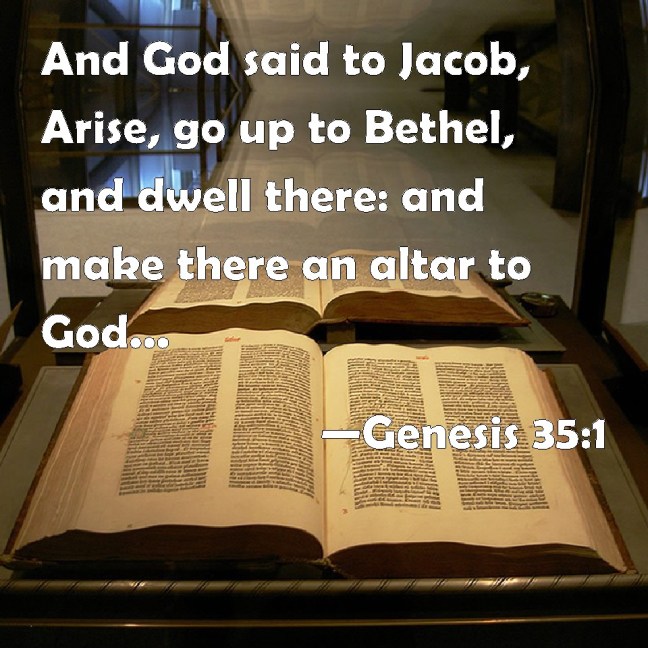
Genesis 35:1-15
After the wrestling match with the mysterious stranger, Esau finally arrives with his four hundred men. Contrary to Jacob’s fears of Esau’s anger and retaliation, Esau runs to Jacob, genuinely happy to see his younger brother. Esau too has been blessed with wealth and is no longer angry with Jacob. Jacob refused all offered help from Esau and promises to meet later in Seir. But Jacob still has no desire to spend any more time with Esau and proceeds to Succoth. Then he moves on to Shechem.
In Genesis 34, we read about sordid events surrounding Dinah, the daughter between Leah and Jacob. While she was visiting the women of the area, she is raped by Shechem, son of Hamor, who sold Jacob his land. Shechem ends up falling in love with Dinah and wants to marry her.
Hamor and Shechem meet with Jacob’s sons to negotiate an agreement where Shechem would marry Dinah. The sons of Jacob tell them that this could only happen if every male in the city is circumcised. If they would do that, then they would not only allow Shechem to marry Dinah, but they would become part of that community. This sounded good to Hamor and Shechem and they convince the men of the city that this would be beneficial to them. They agree and all the males are circumcised.
Two of the sons of Jacob, Simeon and Levi, had no intention of becoming part of the community nor letting Shechem marry Dinah. While the men of the city were still in pain from the circumcision, Simeon and Levi entered the city with a sword and killed all the males. Then the other brothers joined in and plundered the city, taking all the women, children, flocks and wealth.
We now come to this morning’s passage. God tells Jacob to go to Bethel and settle there. They were also to make an altar to God, who appeared to Jacob when he was fleeing from his brother Esau. Before going to Bethel and building an altar to God, Jacob has the people put away all the foreign gods, purify themselves, and change their clothes.
God put a terror upon all the cities around so that no one dared attack them on the way to Bethel, which at the time was called Luz. God appears to Jacob and blesses him. Jacob is to be called Israel from now on. God promises to give Jacob the land that He promised to Abraham and Isaac. He also promises to give Jacob’s offspring the land. In response, Jacob sets up a pillar where God had spoken to him and named the place Bethel.
The narrative then goes on to describe how Rachel dies giving birth to Benjamin. It also tells of Reuben, the oldest son, sinning by sleeping with Bilhah, his father’s concubine. Then it tells of how Isaac died at the age of one hundred eighty years and how Esau and Jacob together buried him.
But before moving on to the story of Joseph, all of chapter thirty-six is devoted to Esau and his descendants. It even points out that several of Esau’s descendants become kings over their lands, before Israel ever had a king. Looking back, it is surprising how sympathetically and generously Esau is depicted. All the trickery and cheating are attributed to Jacob, the elected one, rather than Esau. It is a good reminder that when the narrative focuses on the line of Abraham that leads to the nation of Israel (and to Jesus Christ), it is not like He only cares about Israel.
Besides the unexpected focus on Esau, it is also curious that the whole sordid episode of Dinah is preserved, as well as the account of Reuben sleeping with Bilhah. We see that Genesis is not a whitewashed version of Israel’s past.
When God calls to Jacob to go back to Bethel, without being commanded, Jacob feels the need to cleanup before he goes there – Putting away idols, purifying themselves and changing their clothes. This most likely comes from the fact that Jacob’s sons had used circumcision, the sign of the covenant with God, to commit mass murder and plunder. They needed to cleanse themselves before going on.
Once an altar to God is built, God reiterates the new name that is given to Jacob – Israel – As well as the promise of a great nation through Jacob.
What these last two chapters point out is that Israel cannot leave the promised land, but also, it cannot eliminate the other inhabitants. They will need to live among other peoples, and they will need to figure out how not to defile God’s name and how to be a blessing to others.
It is the same for us. Once we have accepted Jesus Christ as our Lord and Savior, our lives need to show devotion to God and to the Lord’s commands of loving God and loving others. Among us will always be others who are not part of God’s kingdom. We too will need to figure out how to avoid defiling God’s name and at the same time be witnesses to those around us.
It can be difficult at times, since we are inundated with temptations of chasing after things that are not of God. We constantly sin through our actions, inactions, words and thoughts. Like Jacob and his people, we need to purify ourselves and go meet God. We need to acknowledge our sins, confess them and ask for forgiveness. God will then forgive and refresh us so that we can go about doing the Kingdom work for which we were created and saved.
Bethel was the place of promise and hope for Jacob. After committing a great sin against his father and brother, God promised Jacob that he would return safely someday to this place. After the atrocity done to the city of Shechem, Jacob once again needed to go back to Bethel where God would give him another fresh start.
For us, Christ and the work He did on the cross is what gives us God’s forgiveness, the promise of eternal life, and the vocation of doing Kingdom work. We will often sin and fail, but we can always go back to the promises of God. When we turn to Him, even after a grave sin, He will forgive us and refresh us, so that once again, we go about doing His work – To be witnesses to those near and far that Jesus Christ is the Son of God and the Savior of the world.
(The above is a summary of the message shared by Shun Takano at our worship on 09/10/2023.)

