As I Have Loved You…

A new command I give you: Love one another. As I have loved you, so you must love one another. By this everyone will know that you are my disciples, if you love one another. John 13:34-35

Two weeks ago we looked together at the beginning of this chapter. Do you remember? In John 13: 3 it said that “because Jesus knew where he came from (his starting point) and because he knew where he was going (his destination)…and because he knew that God was with him….”

“He got up from the table, took off his outer garment, wrapped a towel around his waist, filled a basin with water, and began to wash his disciples’ feet.”

Following this foot washing, there was a conversation where Jesus indicated that one of them would betray him. Of course, it turns out to be Judas, the one to whom Jesus hands the bread after dipping it in the dish.

Our short text for today is directly following this.

“I’m giving you a new commandment. Love One Another….Just as I have loved You, you must also love each other. In fact, others will know that you are truly my disciples by this – that you truly love each other.”

So the obvious question becomes – “How, then, did Jesus love his disciples?” Once we understand that, we are told to do the same.

From the very beginning of this chapter …. we are told that Jesus loved his disciples completely and without holding anything back. But there are two parallel passages in these last few chapters of John that specifically give us hints as to “how Jesus loved his disciples.”

Parallel Passage #1

John 13:13-15

“You call me `Teacher’ and `Lord,’ and rightly so, for that is what I am. Now that I, your Lord and Teacher, have washed your feet, you also should wash one another’s feet. I have set you an example that you should do as I have done for you.”

1.  So here’s one way that Jesus has loved them – by washing their feet. He has taken the role of a servant (although he was their lord and master), lovingly performing this common and menial task for them.

Parallel Passage #2

A second parallel to these words will come in John 15:12-13:

“My command is this: Love each other as I have loved you. Greater love has no one than this, that he lay down his life for his friends.”

2.  Here’s a second way that Jesus will show love for his disciples – by laying down his life for them on the cross. He will quite literally give his ALL for them.

The love of which Jesus speaks, then, and which Jesus demonstrates in his life and death, is a love which extends from the “everyday” and mundane to the sacrificial and heroic – and includes every kind of self-giving act in between. Jesus tells his disciples that it is by this kind of love that everyone will know that they are his disciples.

Further, we note that this all-encompassing love of Jesus for his disciples was not based on their merit or on how well they had performed.

Just in chapter 13 we have several examples: Jesus demonstrates his love, even for Judas who will betray him, by washing his feet and offering him bread. He shows patience and love for Peter who will deny him, and shows love for all the disciples, even when he is aware that they will all desert him later that night. The love that Jesus demonstrates is certainly not based on the merit of the recipients, and Jesus commands his disciples to love others in the same way. AGAPE love…. Unconditional love!

People around us – the world around us – will not be impressed with our faith, or with Christianity in general, because of our theological correctness, our political correctness, our outstanding moral purity, and certainly not by the size or beauty of our church building. According to Jesus, it is on this ONE thing alone that our witness stands or falls – on whether or not we display love for each other through concrete actions – whether they be mundane, menial, and commonplace….. or whether they be sacrificial and heroic. The unconditional love and respect shown for each other, regardless of whether we share opinions or not – will be the absolute proof that our faith is real and not a sham.

Is it just me…. or does it seem that the media, and our society in general, have an impression of Christians and Christianity as being angry and grumpy….rather than loving and non-judgmental? Perhaps this is unfair. But would that impression be different if we as a CHURCH could demonstrate more acts of service and unconditional love toward those who are different than us?

How can we show this love toward others this week? Will it be by washing feet? Will it be by laying down our lives for another? Holy Spirit….move us into acts of service and love!

(the above is a summary of the message shared during worship on May 29, 2022).

Starting Point….and Destination…

John 13:1-17

3 Jesus knew that the Father had put all things under his power, and that he had come from God and was returning to God; 4 so he got up from the meal, took off his outer clothing, and wrapped a towel around his waist. 5 After that, he poured water into a basin and began to wash his disciples’ feet, drying them with the towel that was wrapped around him.

“Where do you come from?”

  • Have you ever been asked this question?
  • We can answer it simply: “I come from Washington….” or, “I was born in St. Cloud, MN…..” or , “I come from Spain”, etc.
  • Of course, this question can be taken on a deeper, philosophical level as well. “Where do we come from?” “What is our origin?”
  • Adopted children often sense these origin questions sooner than biological children. “Who were my birthparents?” “Where are they now?” “Why didn’t they want me?”
  • Even deeper would be the question of life. “How did we get here?” We know the biology…. We just don’t understand the mysterious life force…

Knowing where we come from can be a powerful thing…..

How about this question….

“Where are you going?”

  • Have you ever been asked that?
  • Again, we can answer simply: “I’m going to Tokyo”, or “I’m going to the store….” or “I’m going to CA to visit my son…”
  • But this question too, can have profound meaning: “Where are you heading?” “Where are you traveling to?” “What is your life goal?” “Where is your final destination?”
  • These are all difficult, some might say unanswerable, questions.

Yet, knowing our final destination can be a powerful thing……

Where we have come from….. where we are going……

Our Starting Point….. our Destination.

In verse three of today’s text, we read these words:

“Jesus knew that the Father had put all things under his power, and that he had come from God and was returning to God…”

He had come from God, he was returning to God, and in the meantime….he had the power of God with him.

What was the result?

Look carefully….the sentences are connected grammatically. Because he knew where he had come from, and because he knew where he was going, and because he knew that God had given him power for this work, Jesus got up, wrapped a towel around his waist, took a basin of water, and began to wash his disciples’ feet.

Because Jesus knew where he came from…. and where he was going…. and that the power of God was with him…. he was able to serve his disciples.

I challenge you today with the words here in verse 3.

They’re almost hidden. They almost slip by unnoticed. But I think they’re important.  If we truly want to love each other, if we truly want to serve each other…. as Jesus has commanded, then I think we need to understand the words of this verse.

So we’re back to the initial question.

Where do we come from?

Do we truly believe that our life…. the breath we breathe, the pumping of our hearts, the mysterious life within our bodies and souls are all a gift of God? Do we truly believe that our lives are not our own…. as scripture teaches?

Or, have we been fooled into thinking that the family into which we were born, the country in which we have citizenship, the health we presently enjoy, the food we so easily eat each day…. Have we been fooled into thinking that it’s by our own efforts and struggles that they have all become ours?

And how about that other pesky question.

Where are you going? Where is your destination?

Do we truly understand that since our lives are not our own, that in many ways we are NOT in control of how many years and days we will live. Do we see that our days, and the hairs on our heads, and the health of our bodies are… in many ways – not within our control? Of course because our bodies and lives are a gift and precious, we need to take good care of them. But even so…. our destination is in God’s hands. We will eventually return to Him. Do we believe this?

The reason this is all so important is that it gives us the power and steam to wash other peoples’ feet.

Without a clear sense of where we’ve come from…and where we’re going… and the fact that God has called us and given us power for this journey….we won’t have the ability to serve others freely as our Master has served us.

We will always be tempted to grasp, to collect, to hang on, to keep the best for ourselves, to store up earthly treasures….. and on and on.

Eventually we’ll just stop talking about serving each other….or living sacrificially for each other. We will instead use words like “rights” or “privileges” or begin to focus on “taking” rather than “giving”.

Church, we have been called to wash feet. We should be in the business of washing feet. How can we do that this week? Whose feet will we wash? What does that really look like? Of course, we are speaking metaphorically since we don’t actually have a custom of foot washing in our culture. But what does serving others look like?

“Now that I, your Lord and Teacher, have washed your feet, you also should wash one another’s feet. I have set you an example that you should do as I have done for you.” John 13:14-15

(The above is a summary of the message shared during worship on May 15, 2022.)

Corinth

Acts 18:1-11

After leaving Athens, Paul travels on to another large city, Corinth. There he meets a married couple, Aquila and Priscilla, who were tentmakers, just like Paul. They had been expelled from Rome by Claudius.

Historians put the expulsion of Jews from Rome sometime around AD 49. Suetonius the historian describes this event – “Since Jews constantly made disturbances at the instigation of Chrestus, he (the Emperor Claudius) expelled them from Rome.” Historians believe that the disturbances occurred when messianic Jews preached to try to convince other Jews that Jesus was the Messiah. It is possible that the reference to “Chrestus” is about Christ. Claudius died in AD 54, which allowed the Jews to trickle back into Rome.

Along with Luke in this chapter, Paul also mentions this couple, but uses the shortened version of Priscilla, Prisca. He refers to Prisca and Aquila in three of his letters – Romans, 1 Corinthians, and 2 Timothy.  It is apparent that the couple played an important role in starting the church in Corinth, as well as Ephesus, and then moved back to Rome by the time the Letter to the Romans is written, in which Paul asks the recipient to greet Prisca and Aquila for him.  To me, it is an indication that these events actually took place and that they were real people who existed in history. It helps to bring the New Testament to life.

If you recall, Paul was separated from Silas and Timothy, back in Acts 17. When they were in Beroea, Jews from Thessalonica came to disrupt their ministry. The believers feared for Paul’s safety and took him to Athens, with the plan that Silas and Timothy would join him later.

Athens and Corinth are about 50 miles apart, so we’re not sure how Silas and Timothy knew to find Paul in Corinth. Paul could have sent a letter to Beroea to let them know, or perhaps they went to Athens first and heard that Paul had traveled on to Corinth. However they found out, they rejoin Paul in Corinth.

Paul continues to preach to the Jews at the synagogue that Jesus is the long-awaited Messiah. They did not accept his message, and when they opposed and reviled him, he shook the dust from his clothes and left. Paul basically told them that he has told them the truth, and since they are rejecting the truth, the responsibility for their lives and salvation were on their own heads. He would now go to the Gentiles to proclaim the good news about Jesus Christ.

Paul ends up next door to the synagogue and he preached the good news. In contrast to the Jews, many Gentiles believed and were baptized. The Lord appeared to Paul in a vision and made it clear that he should continue to preach in Corinth, and he ends up staying there for one year and six months.

We see that Paul experienced many things, both good and bad on his journeys. He planned his travels as best as he could, but sometimes events happened that would change the course or timing of his journey. On other occasions, the Lord would make clear where and when to go through visions. One thing that was consistent about Paul was that he understood that his main occupation was to do the will of God. So, whether things went according to his own plans or not, he was sensitive to the Lord’s leading, and preached the fact that Jesus was the long-awaited savior of the world.

For most of us, our journeys are not so focused on doing the Lord’s work. Where we end up at any point of time is more about family, work or leisure. But it is important for us to remember that the Lord will also guide us through all that. Sometimes our travels go as planned, and at other times, things happen that are outside of our control and our travels do not go as planned. However, wherever and whenever we end up, we need to remember that the Lord may have planned for us to be there at that particular time. We need to remember that we were saved to do His work, so we should be on the lookout for opportunities to do the Lord’s work at any time.

Paul understood that no matter how things work out, God is in control, and that we should be willing to do His bidding. Our focus should be on what the Lord will have us do, rather than all the things that went according to plans or not, or whether we had success or not.  We can see that is how Paul operated, and that we too should follow suit.

There are so many people who need the Lord, both near and far from us, and God loves them too much to just leave them alone. So, however and wherever we end up at any given time and place, there is a good chance that the Lord has work for us to do. And it is a great privilege that the Lord is willing to entrust us to do His work on earth.

(The above is a summary of the message shared during our worship on May 8, 2022 by Shun Takano.)

Resurrection….and Recommission

John 21:1-14

Have you ever experienced a complete dead end?

There are different kinds of dead ends….

  • Some you can just turn around and re-route – find a new road.
  • Others just look like dead ends but with a little patience and perseverance, and on closer inspection, you are able to find some alternative actions.
  • However, some really are dead ends and you know that there is no way out on your own strength or resources. Ever felt like that? Have you ever felt that you were at a complete dead end?? Nowhere to go? No resources left? Out of imagination?  All out of steam?

Our text for today takes us back to the Sea of Galilee where several of the disciples have gathered by the lakeside…..and are, in a way, at a complete dead end in their lives and work.

  • Their master has been crucified. They’re still in shock. What were these past three years all about? Despite their promises to always stick with Jesus they had all fled in his hour of trouble.  They had all failed him. It’s true that he had appeared to them on two occasions following his resurrection……and while they expressed joy, they were also afraid. What did this all mean? What were they to do now??
  • Our text states that this was Jesus’ 3rd appearance to the disciples after his resurrection.
  • Peter decides to go fishing…..although we’re not told why. Others join him. 7 disciples (5 named, 2 unnamed) head out in the boat.
  • They fish all night but catch nothing.
  • From the shore a stranger (Jesus) suggests they throw their nets on the other side….
  • When they do so…..they catch a huge haul and John realizes that it must be Jesus (who else could it be?? It no doubt reminded them of their original calling and commissioning to be “fishers of men” – recorded in Luke 5).
  • They come ashore and eat breakfast with Jesus, who has prepared fish and bread over a fire.
  • He invites them to bring some of their fish and add it to the fish he has provided.
  • In the remaining portion of chapter 21 Jesus re-commissions Peter for service – as a shepherd to the “flock” as well as a “fisher of men and women”.

While the story begins in a dead end, we find the story ending with new possibilities. The disciples (and especially Peter) are invited back in…. are re-commissioned for fishing. They are not only forgiven but given meaningful work. “Take care of my sheep. Follow Me.” And so what began as a disaster, ends with an open door for continued fishing / service.

This account reminds me of the feeling that we often had in our work in Japan as church planters and missionaries. There was probably not a single ministry where we did not feel at times to be at a complete DEAD END. I’d love to stand here today and claim that we’d caught 153 big fish! But the truth is that we often felt as though we’d been fishing all night with zero results. How about you today??? Any dead ends?

While we’ve barely touched on this account today….. I hear three of Jesus’ statements ringing in my ears:

1. Keep fishing! (I’ve called you and I will be with you… whether you feel like you’re catching fish or not…)

2. Try something different! (Throw your nets on the other side….)

3. Bring some of the fish you’ve caught! (Let’s have breakfast together. Bring what you have….when added to what I provide, it will be enough!)

(the above is a summary of the message shared during our worship on May 1, 2022.)

Seeing & Believing

John 20:1-18

CHRIST IS RISEN!    HE IS RISEN INDEED!

主がよみがえられた!確かに、、、よみがえられた!

All around the world Christians celebrate Easter with this greeting.

  • It’s our faith confession. We are saying that death is not the final word. We are saying that Jesus was raised from the dead… and because of that, we too can experience resurrection. And not just life after death, or as some cynics have described the Christian belief – “Pie in the Sky By and By” – but abundant, inspired, joy-filled life – now, today!
  • How is your faith today? Many people – and not only at Easter – actually feel very inadequate in their faith. Maybe you feel that you don’t believe with quite enough conviction…. Or that your believing is somehow inferior to that of others. Maybe you worry that you just don’t understand enough. Or maybe some experience in your life has just caused you not to believe at all…. or even to want to believe.
  • I want you to know that you are more than welcome here this morning. In fact, the text that we just read from John 20 speaks directly to the fact that all of us will express our faith and believing in different ways and with various stages and timing.
  • This morning I would like to look with you at the three followers of Jesus who appear here in John chapter 20 – Mary, Peter, and John.

Mary

Mary visits Jesus’ tomb early in the morning. She sees the stone is rolled away…. and draws a conclusion. She hurries to Peter and the others saying “They have taken his body away…” Mary sees the empty tomb…. but does not yet believe. Later, Mary looks into the tomb and sees two angels. They ask her why she’s crying – she says “they have taken my Lord…” Then she turns and sees Jesus, but does not recognize him. She thinks it’s the gardener and speaks to him “Sir, if you’ve taken him away, tell me where you have put him, and I will get him.” Jesus then calls her by name – “Mary.” At this, she suddenly realizes it is Jesus, and everything changes. Later she tells the others “I have seen the Lord”.

While Mary sees a great deal, it takes a special encounter – Jesus calling her by name – in order for her to believe that Jesus was truly alive.

Peter

Alerted by Mary that the tomb is open – Peter and John run to the tomb. Although John arrives first, Peter rushes in and sees Jesus’ burial garments. Nothing else is said about Peter. He returns to where the other disciples are staying. As far as we are told, Peter does not yet believe or understand anything.

John

John runs with Peter to the empty tomb. Although he hesitates, he looks inside to see the strips of linen lying there. After Peter, John also goes inside the tomb and it says that “he saw and believed.” We’re not quite sure from this account exactly what he believed – that Jesus was alive? …. or only that Jesus’ tomb was empty?

Each individual experienced this Easter morning differently.

John sees …. and believes

Mary sees… but needs some help in believing (Jesus calls her name)

Peter sees…. And does not believe.

While each is different, there is a common thread that runs through all of their experiences. And that is, that eventually, each of them believed – not just from “seeing something” but from actually meeting, having an encounter with, the risen Christ.

Other Examples

Here are some other examples where “seeing and believing” were not so simple.

Two disciples on the road to Emmaus – they walk with Jesus….and see him, but don’t recognize him.

Later that night when Jesus appears to the disciples (Jesus walks through doors, appears to have an appetite, greets them, etc.) the disciples are glad, but also afraid. Thomas, who was missing, later states that he won’t believe what they’re saying….unless he sees Jesus with his own eyes and touches Jesus with his own hands.

A week later Jesus appears again, this time when Thomas is present. Thomas declares “My Lord, and my God.”

In John 21 Jesus appears to the disciples along the shores of the Sea of Galilee, while they are fishing. John recognizes him from the boat and they all rush ashore…. but seem shy and uncertain about how to relate to Jesus.

In each case, seeing Jesus (although usually not recognizing him) does not always result in believing. That usually involves a longer process. Jesus does not judge any of them. However, he offers special peace to each of them, and encourages them to believe.

Are you seeing…. and believing today?

Are you open to the possibility of resurrection?  Of abundant, rich, eternal life?

If you feel that your faith is not strong enough, can you imagine God accepting your faith just as it is?

As a church, we also have a need to believe and rely on God for resurrection life.

In every case, the disciples moved toward faith – not by forcing themselves to believe something – but through an encounter with the resurrected Christ.

Have you had such an encounter? Do you sense his presence in your daily journey?

Christ is risen! He is risen indeed!

(the above is a summary of the message shared during Easter worship on April 17, 2022.)

The Unknown God

Acts 17:22-31

22Then Paul stood in front of the Areopagus and said, “Athenians, I see how extremely religious you are in every way. 23For as I went through the city and looked carefully at the objects of your worship, I found among them an altar with the inscription, ‘To an unknown god.’ What therefore you worship as unknown, this I proclaim to you. 24The God who made the world and everything in it, he who is Lord of heaven and earth, does not live in shrines made by human hands, 25nor is he served by human hands, as though he needed anything, since he himself gives to all mortals life and breath and all things. 26From one ancestor£ he made all nations to inhabit the whole earth, and he allotted the times of their existence and the boundaries of the places where they would live, 27so that they would search for God£ and perhaps grope for him and find him—though indeed he is not far from each one of us. 28For ‘In him we live and move and have our being’; as even some of your own poets have said, ‘For we too are his offspring.’ 29Since we are God’s offspring, we ought not to think that the deity is like gold, or silver, or stone, an image formed by the art and imagination of mortals. 30While God has overlooked the times of human ignorance, now he commands all people everywhere to repent, 31because he has fixed a day on which he will have the world judged in righteousness by a man whom he has appointed, and of this he has given assurance to all by raising him from the dead.”

After leaving Lydia’s home in Philippi, Paul and Silas reached Thessalonica. They continue to preach about Jesus and things went well at first, but soon, the Jews chased them out.

They traveled on to Berea, and things were going well until the Jews from Thessalonica showed up and caused trouble for them. So, the believers sent Paul to Athens, and the plan was for Silas and Timothy to catch up with him there.

So, what is the story behind the altar with the inscription, “To an unknown god”?  In his book, “Eternity in Their Hearts”, Don Richardson writes of the story behind this.

About 500 years before, there was a terrible plague in Athens, and many were dying. They offered sacrifices to every known god and goddess, but to no avail. Out of desperation, they sought the help of a famous philosopher of Crete, named Epimenides.

Epimenides surmised that there is a god that they are not aware of that is more powerful than all the gods and goddesses to whom they offered sacrifices. And they can only hope that this powerful god would be willing to help if asked.

Epimenides instructed the Athenians to release a flock of sheep in the early morning, when they would be the hungriest. Wherever a sheep laid down instead of eating, they were to erect an altar and sacrifice the sheep to the unknown god. Numerous sheep laid down, and they were sacrificed, and the plague abated.  Over the years, appreciation for the unknown god became less and less, and most of the altars broke down. But there were those who remembered and thought it was important to preserve one. So they chose the best preserved one and maintained it.

Is it possible that Paul knew this story when he preached on Mars Hill?  It is probable, since we see in Titus 1:12, Paul quotes Epimenides: “It was one of them, their very own prophet, who said, ‘Cretans are always liars, vicious brutes, lazy gluttons.’”

In his message, Paul brings up the altar to the unknown god. He is reminding the people of the time when the unknown god that saved their ancestors from the terrible plague fiver hundred years previous – The god that was more powerful and merciful than any of the gods and goddesses they knew – Is none other than the God that Paul is preaching about. And now that Paul has revealed the identity of God, they can no longer continue to live in ignorance. They must repent of their sins and accept the grace that He is offering.

Paul’s message to the people of Athens was customized for them. This message would not have meant much to other people.  We too, when we are called to witness for the Lord, must try to know our audience and what is likely to connect with them. We need to spend time in prayer, asking that the Holy Spirit will reveal the best way to reach the audience to whom we are to witness.

John 12:12-16 is the normal passage to be preached from on Palm Sunday. It describes how a few days before Jesus is to be crucified, He enters Jerusalem, riding on a young donkey. It also specifically says that although people didn’t understand the meaning of this at the time, they will, once Jesus was resurrected. Jesus knew that the people who were following Him had wrong expectations of what the Messiah was going to do. So, He did and said things that might have been incomprehensible at the time, but would help them to understand what His mission was all about, once He was resurrected.  He knew His audience well.

So, let us be thankful for what Jesus did for us, to prepare us to understand the nature of His messiahship and why He had to die on the cross. Let us take Paul’s example of using the people’s memory of the altar to the unknown god to reveal God’s truth in a way that has the most impact for those particular people. What is most impactful is not going to be the same story or the same Bible verses every time we witness. It will be different, depending on the person. That’s how God works with us.  Each one of us has a unique story about what caught our attention that started our path to receiving God’s offer of forgiveness and salvation. And likewise, each person we are called to witness to, has a best way to be witnessed to. So let us pray and be guided by the Holy Spirit when we are called upon to witness for the Lord.

(the above is a summary of the message shared by Shun Takano at our Sunday worship on April 10, 2022.)

From One to Two

Acts 15:36-41

36After some days Paul said to Barnabas, “Come, let us return and visit the believers in every city where we proclaimed the word of the Lord and see how they are doing.” 37Barnabas wanted to take with them John called Mark. 38But Paul decided not to take with them one who had deserted them in Pamphylia and had not accompanied them in the work. 39The disagreement became so sharp that they parted company; Barnabas took Mark with him and sailed away to Cyprus. 40But Paul chose Silas and set out, the believers commending him to the grace of the Lord. 41He went through Syria and Cilicia, strengthening the churches.

Paul and Barnabas are about to go on their second missionary journey. Barnabas wanted to take Mark with them, but Paul did not.  For reasons not given, Mark had deserted them during their first missionary journey, so Paul thought it best that they not take him on their second missionary journey. The disagreement between Paul and Barnabas got so sharp, the two decided to go their separate ways. Barnabas took Mark and went to Cyprus, while Paul took Silas and went to Syria.

So, who was this Mark, who split up Paul and Barnabas?  According to Colossians 4:10, he was a cousin of Barnabas.  Mark’s mother, Mary, was apparently a prominent early Christian in Jerusalem, where she hosted worship and prayer meetings in their large home. Back in Acts 12, when Peter was miraculously released from prison, he knew to head to Mary’s house.

Whatever happened in his youth that made Mark desert Paul and Barnabas, he became a reliable Christian worker.  Peter was so fond of him, he referred to Mark as “son” (1 Peter 5:13). He also proved himself to Paul, since in 2 Timothy 4:11, Paul asks Timothy to bring Mark with him when he comes to visit Paul, “because he is helpful to me in my ministry”.

This is all happening after the Jerusalem Council. In Galatians 2, Paul talks about the reason for his rift between Barnabas as based on doctrine.  Luke apparently saw the main reason as a disagreement about what to do with Mark.  Paul did not want someone he felt he could not count on when things got tough. Perhaps because Mark was his cousin, Barnabas thought it best to give Mark another chance to prove himself as a reliable co-worker.

When there is a major disagreement between two prominent leaders, it often does not work out well for a church and its ministry.  Things can get personal, people take sides, and splits and fractures often happen, leading to hurt feelings and resentments.

But that is not what happened here.  Yes, Paul and Barnabas ended up splitting up, but the result was that a single ministry group became two, and both continued to pursue doing God’s work.  The result was that young churches and believers were strengthened by both groups.

Mark, given a second chance, made the best of it. Most scholars believe that this is the Mark who wrote the oldest of the four gospels, which both Matthew and Luke used as a source. Some believe that the young man who is caught but runs away as Jesus is being arrested is Mark inserting himself into the writing.

What made Mark desert Paul and Barnabas in the first place? The incident is recorded in Acts 13:13 but does not provide any reasons.  He was a young man who belonged to a wealthy family in Jerusalem, so he probably had a comfortable life.  Since his mother was a well-known believer, as was his cousin, Barnabas, he may have felt it was the right thing to do to join their first missionary journey, to accompany the famous Paul.  The hard conditions of travel as well as meeting oppositions might not have been what Mark was expecting. So, it could well have been a form of homesickness that caused him to head home, as many scholars have speculated.

We could also envision that his mother was not all that happy once he got home and realized that he had deserted Paul and Barnabas. That might have been the start of his turning his life around. These missionary journeys were important works for the Kingdom, filled with hardships and dangers, and if he wanted to try it again, not only would he have to convince people that he had changed, but also be given a chance.  Paul was not convinced and was not willing to take him on the second missionary journey, but Barnabas gave him a chance, and Mark made the most of this opportunity.

Sometimes churches and ministries do split up, for legitimate reasons. There are also times where the split occurs over preferences or minor theological disagreements. What we can learn from this passage is that sometimes, differences of opinion can be used to branch out the work of a church or ministry to multiply the direction and the people. Through this, the people of God can be served better.

The passage also reminds us that we could mess up, but if we learn from it and repent, God can still use us for His Kingdom work.  It also reminds us that just because someone messed up, it is still possible that God can use them mightily going forward, if there was genuine repentance.

So let us be true to our convictions and the work God has given us, but at the same time, repent when we make mistakes, as well as be willing to give second chances.

It is a great thing to know that God can use our disagreements, our failings, our repentance, and our willingness to offer second chances, to further His Kingdom.

(This is a summary of the message shared by Shun Takano at our worship service on February 13, 2022.)

Safety & Guidance

Psalm 32:7-8

For you are my hiding place;
    you protect me from trouble.
    You surround me with songs of victory. 

The Lord says, “I will guide you along the best pathway for your life.
    I will advise you and watch over you.”

As humans, we have various needs, some are fundamental from a physiological point of view – like water, food, and air, and others are fundamental from an emotional or psychological point of view – like connectedness, love, or a sense of self-worth.

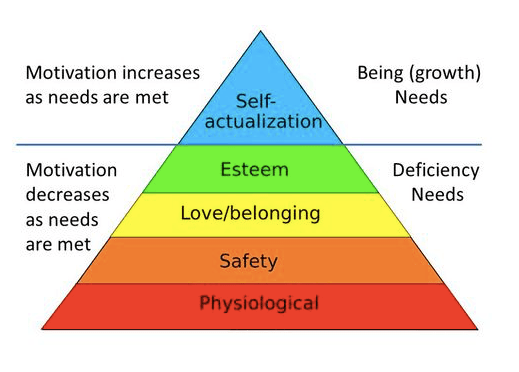
Perhaps you’ve seen Maslow’s famous chart of the “hierarchy of human needs”. Abraham Maslow was an American scholar and scientist who proposed these findings in a famous journal article in 1943… and then went on to further develop its basic concepts over subsequent years.

In simplified form, Maslow stated that humans first of all have fundamental physiological needs such as water and food. Without these, there is no survival. However, once these most basic needs are met, humans then have the margin to think about…. or reach for other needs. In this hierarchy, physiological needs are then followed by needs such as safety, love / belonging (need for community), esteem and respect from others, and so on. At the top of this hierarchy is a human need for self-actualization. Of course, worrying about self-actualization would seem absurd to the person who did not know where their next meal was coming from. Thus, the kind of graduating hierarchy….and changing motivations.

As I look at these various needs and how they’re placed in this scheme, I am reminded of words from scripture and teachings from Jesus. One that comes to mind is the portion of scripture at the end of Matthew 6 – part of the famous “sermon on the mount”.

“And why do you worry about what you will eat, or what you will drink…. or what you will wear? Look at the birds of the air…. and the flowers of the field. They don’t worry and struggle…. and yet their heavenly father knows all about their needs, and takes loving care of them. Won’t he do the same for you?”

In Jesus’ words there is the recognition that basic physiological needs are important – and will need to be met. But there is also a hint that we are not alone…. that our heavenly father is able to help us meet those needs. Jesus also points to fundamental spiritual needs as well as these physical ones.

“So seek first of all the kingdom of God (a relationship with God), and you’ll find that all of these other physical needs that you worry about will be provided for you.”

Another text that may relate to these thoughts is found in Matthew 4:4, where Jesus responds to Satan’s temptation about food – Satan’s challenge for Jesus to turn stones into bread.

“For man cannot live by bread alone… but by every word that comes from the mouth of God.” (Jesus quoting from Deuteronomy 8:3) Here Jesus seems to be indicating that even if our bellies are full, even if we have met all of these most basic physiological needs – we still cannot survive in a truly complete way, because we are created with spiritual needs as well. So while Maslow’s research is fascinating, and worth considering, I love the way that Jesus pushed us to look at both our physical needs – as well as our spiritual needs, and to always prioritize the latter.

Which leads us to our beautiful text for this morning – these two wonderful verses in Psalm 32. In verse 7, it appears to be the psalmist addressing God: “Lord, you have been my hiding place – you’ve provided both safety… and songs of victory!” – such encouraging words! You’ll notice that the psalmist has not said that God has helped him avoid all troubles – only that when the trials came, God was always his shelter and safety in the midst of the storms.

Verse 8 then appears to be God responding to the psalmist: “I will guide you along the best pathway for your life. I will advise you and watch over you.” Again, what encouraging words these are! Promises of guidance and direction. When I was younger these words seemed excellent and obvious – I was inexperienced, knew little about life, and felt a great need for wisdom from God. I somehow imagined that once I was much older, perhaps I wouldn’t need guidance as much. Yet, even now, in my 60s – I feel more than ever the desire for clarity, for direction, for God to take my hand and lead me through what lies ahead.

Today is our church’s annual meeting. Can we apply these two short verses to our experience as a church? For over 115 years the Lord has been both our hiding place… and safety – as well as our guide. Won’t he do the same for us as we move ahead and consider our tomorrows?

Lord, thank you for being our hiding place…. our safety.

Thank you for the promise to show us the best pathway for tomorrow.

(the above is a summary of the message shared during worship on February 6, 2022.)

The Gifts of the Spirit

I Corinthians 12:1-11

We live in a world where we are always encouraged and pushed to compare ourselves with others. To compare our bodies, looks, and appearances. To compare our income, our homes, our cars. To compare our skills and education. Making comparisons is not always bad – but most of us know intuitively and instinctively – that constantly comparing ourselves to others does not lead us to an accurate view or assessment of ourselves.

Of course, this habit of comparing ourselves to others can also become part of our church life. We compare our faith and our expression of faith with other brothers and sisters. We compare our attendance and giving levels with others. Maybe we admire the faith and service of others – while feeling small about our own contributions to the life of the church. Whether we end up feeling superior or inferior, comparing ourselves to other Jesus followers can be a problem.

In our text for today Paul is speaking to a church in Corinth that had gotten wrapped up in comparisons. They seemed to see a kind of hierarchy of gifts amongst its members. Some had the gift of service, and some wisdom. Some had more amazing gifts – like the gift of miraculous healing or speaking in tongues. Evidently there had been some fighting about “who was the greatest” and who “was the most spiritual”.  Paul, in talking about the various gifts that the Holy Spirit gives to each of us, makes the following points:

1.  All gifts come from God

11 All these are the work of one and the same Spirit, and he gives them to each one, just as he determines.

There’s no need to compare or see some kind of “ordering” or “hierarchy” of gifts. They ALL come from God and are distributed by the Holy Spirit WHEN and TO WHOM the Spirit decides. There’s no need for boasting or feeling proud. A “gift” – by definition – is freely given.

2.  The gifts we receive are NOT for our own personal benefit or satisfaction, but for the good of the group – the body of Christ.

7 Now to each one the manifestation of the Spirit is given for the common good.

When “me, my, mine”  – as in rights and privileges – become more important than “our” – as in the good of the group – perhaps we have moved toward a dangerous imbalance. God gives us blessings – in order that we may bless others.

Remember the first promise in Genesis 12 to Abraham? God promises Abraham to bless him and give him children – in fact to make a great nation out of him, not because Abraham was more special or loved than others, but in order that Abraham and his descendants would become the channel – the pipeline – of that blessing to all the other nations on earth.

God intends that my gifts provide for me AND you. Your gifts provide for you AND me. We are meant to be interdependent.

3.  Our diversity – differences of gifts – is NOT a problem to be overcome, but the very DESIGN of God for us.

Although we didn’t read to the end of the chapter today, Paul goes on in verses 12 – 31 to describe the church as a body, made up of many parts. Some parts seem more important than others – but, in fact, every single part plays a unique and important role – so that NONE of them can be said to be non-essential.

18 But in fact God has arranged the parts in the body, every one of them, just as he wanted them to be.

So it’s not a matter of “putting up with” our differences or trying to find some way to “deal with” all of our eclectic personalities and variations. Rather, it is coming to the realization that we would not be a complete and healthy body WITHOUT each variation and unique part!

A song by the the former Japanese boy band SMAP, while maybe not quite the same as scripture, nevertheless shared the same message that Paul did to the Corinthians. The song title translates as “A One-Of-A-Kind Flower in this World”. A loose translation of the Japanese goes like this:

In front of the flower shop / a variety of flowers lined up / I guess everyone has their favorites / but they’re all so beautiful / none of them wondering “whose #1?” / none of them arguing about who’s the most beautiful / each one standing tall in their bucket of water

Why is it that we humans love making comparisons? / Each one of us is different, yet we want to be #1? / It’s true, each one of us is a “one-of-a-kind” flower. / We each have a unique seed within us / Shouldn’t each of us just nurture our seed and grow into a beautiful flower?

Yes, each of us gifted by God, uniquely created, specially loved, and specially designed to bless and gift others. May this be our posture and prayer this week!

Lystra

Acts 14:8-20

A man who has been crippled from birth was listening to Paul proclaiming the good news of Jesus Christ. Without anyone asking for the man’s healing, Paul discerns that the man had faith to be healed and heals him. We saw Peter and John do a similar act of compassionate healing in Acts 3.

The reaction of the crowd was pretty drastic. They declared that the gods had come down to them in human form.  They assumed that Barnabas was Zeus and Paul was Hermes.  Why did they think this? Apparently, there was an old tale about Zeus and Hermes visiting an old pious couple who lived near Lystra and offered them hospitality, even though they did not know they were entertaining gods. The gods rewarded them for their kindness.

So, the crowd misinterpreted the healing act as Paul and Barnabas’ power being manifested, instead of power coming from Jesus Christ. They assumed that Paul and Barnabas were gods and offered hospitality to them and were even preparing to make a sacrifice to them.

Paul and Barnabas must have been horrified. They were here to proclaim the truth about Jesus Christ, to wean these people from their beliefs in gods and goddesses, but instead, they were being worshipped as gods.  So, they quickly explained that they were mortals and that they were there to preach to them about Jesus Christ.  They were able to stop the crowd from offering sacrifice to them.

Things quickly turn for the worse when Jews came from Antioch and Iconium and won over the crowds.  They incited the crowd to turn on Paul, so they stoned him and dragged his body out of the city, thinking that Paul was dead. Luke does not tell us how Paul was able to recover so quickly that he was able to continue the journey with Barnabas, but we can assume that there was some miraculous healing involved.

We see in this passage that Paul and Barnabas continue to witness for Jesus Christ as being the Messiah, and through the power that comes from the Holy Spirit, continue to miraculously heal people, much like Jesus did and like Peter and John did.

We live in a different time in that the canon of the Christian scriptures is complete, and we have available to us the basis of God’s salvation story. We have the Bible which testifies to the fact that Jesus of Nazareth is the Son of God and the savior of the world. We are not called to travel like Jesus, Peter, John, Paul or Barnabas, showing God’s powers through performing miracles.  Instead, we are to witness to the world around us through our learnings from the Bible, by what we say, what we do, and how we act.

So, does what Paul and Barnabas experienced have application to our lives today?  Can we learn how to be better witnesses for Christ by looking at this passage?

How the crowd reacted to the miraculous healing was understandable, considering the belief system and culture of that time and place. Inexplicable things seemed to happen randomly in peoples’ lives, and they were attributed to the doings of the numerous gods and goddesses they thought existed. So, when they witnessed this seemingly impossible healing of this man who was crippled from birth, they concluded that these two men had superhuman powers, and therefore, they must be gods. They certainly did not want to offend these two gods, so they were willing to honor them and offer sacrifice to them.

Paul and Barnabas knew that they did not possess any supernatural powers. They knew that the healing power came not from them, but from God. They were aware that they were trying to be obedient to the Holy Spirit’s guidance, and that was the source of the power to perform miracles.

They must have been rather horrified that the people were attributing the healing to Zeus and Hermes, and that they were being mistaken for these pagan gods.  They were trying to be witnesses for Jesus Christ, but instead, people thought they were in the presence of Zeus and Hermes.  So, they did their best to explain the truth to them.

In situations like this, there is always temptation to have people believe positive things about you and let them treat you accordingly. It is not a bad feeling to be respected or revered and be given things that you may otherwise not get – Presents, banquets, honors, even wealth.

What is our attitude when we successfully complete a ministry entrusted to us from the Lord as individuals or as a church? Are we filled with a sense of accomplishment that is beyond just “we have completed the task assigned to us with the help of the Holy Spirit”?

A wise teacher taught me long ago that as soon as we look back at a completed task with satisfaction or pride, we are taking the credit that God should be getting.  We should always look ahead and not back at completed tasks/projects.

A good reminder of this can be found in Jesus’ words recorded in Luke 17:7-10 7“Who among you would say to your slave who has just come in from plowing or tending sheep in the field, ‘Come here at once and take your place at the table’? 8Would you not rather say to him, ‘Prepare supper for me, put on your apron and serve me while I eat and drink; later you may eat and drink’? 9Do you thank the slave for doing what was commanded? 10So you also, when you have done all that you were ordered to do, say, ‘We are worthless slaves; we have done only what we ought to have done!’”

Let us keep in mind that all good things come from God, and He should get the credit, even when people want to give us the credit. Let us be reminded that we are the servants of the Lord.

(The above is a summary of the message shared by Shun Takano during worship on January 9, 2022.)