Jesus Washes Feet

John 13:1-17

“Where do you come from?”

  • Have you ever been asked this question?
  • We can answer it simply: I come from Washington….or, I was born in St. Cloud, MN….. or , I come from Spain, etc.
  • Of course, this question can be taken on a deeper, philosophical level as well. “Where do we come from?” “What is our origin?”
  • Adopted children often have these questions arise sooner than biological children. Who were my birthparents? Where are they now? Why didn’t they want me?
  • Even deeper would be the question of life. How did we get here? We know the biology…. We just don’t understand the mysterious life force…

Knowing where we come from can be a powerful thing…..

How about this question….

“Where are you going?”

  • Have you ever been asked that?
  • Again, we can answer simply: I’m going to Tokyo, or I’m going to the store…. or I’m going to California to visit my son…
  • But this question too, can have profound meaning: Where are you heading? Where are you traveling to? What is your life goal? Where is your final destination?
  • These are all difficult, some might even say unanswerable, questions.

Yet, knowing our final destination can be a powerful thing……

Where we have come from….. and where we are going……

Our Starting Point….. and our Destination.

In verse three of today’s text, we read these words:

3 Jesus knew that the Father had put all things under his power, and that he had come from God and was returning to God;

He knew that he came from God, that he would be returning to God, and that in the meantime….he had the power of God with him.

What was the result?

Look carefully….the sentences are connected. Because he knew where he had come from, and because he knew where he was going, and because he knew that God had given him power for this work, Jesus got up, wrapped a towel around his waist, took a basin of water, and began to wash his disciples’ feet.

Because Jesus knew where he came from…. Where he was going…. And that the power of God that was with him…. He was able to serve his disciples.

I challenge you today with the words here in verse 3.

They’re almost hidden. They almost slip by unnoticed. But I think they’re important.  If we truly want to love each other, if we truly want to serve each other…. As Jesus has commanded, then I think we need to understand the words of this verse.

So we’re back to the initial question.

Where do we come from?

Do we truly believe that our life…. the breath we breathe, the pumping of our hearts, the mysterious life within our bodies and souls are all a gift of God? Do we truly believe that our lives are not our own…. As scripture teaches?

Or, have we been fooled into thinking that the family into which we were born, the country in which we have citizenship, the health we presently enjoy, the food we so easily eat each day…. have we been fooled into thinking that it’s by our own efforts and struggles that they have all become ours?

And how about that other pesky question.

Where are you going? Where is your destination?

Do we truly understand that since our lives are not our own, that in many ways we are NOT in control of how many years and days we will live. Do we see that our days, and the hairs on our heads, and the health of our bodies are… in many ways – not within our control? Of course, because our bodies and lives are a gift and precious, we need to take good care of them. But even so…. Our destination is in God’s hands. We will eventually return to Him. Do we believe this?

The reason this is all so important is that it gives us the power and steam to wash other peoples’ feet.

Without a clear sense of where we’ve come from…and where we’re going… and the fact that God has called us and given us power for this journey….we won’t have the ability to serve others freely as our Master has served us.

We will always be tempted to grasp, to collect, to hang on, to keep the best for ourselves, to store up treasures on earth….. and on and on.

Eventually we’ll just stop talking about serving each other….or living sacrificially for each other. We will instead use words like “rights” or “privileges” or begin to focus on “taking” rather than “giving”.

Church, we have been called to wash feet. We should be in the business of washing feet. How can we do that this week? Whose feet will we wash? What does that really look like? Of course, we are speaking metaphorically since we don’t actually have a custom of foot washing in our culture. But what does serving others look like?

14 Now that I, your Lord and Teacher, have washed your feet, you also should wash one another’s feet. 15 I have set you an example that you should do as I have done for you.

(the above is a summary of the message shared during our worship on March 30, 2025.)

We Will Serve the LORD

Joshua 24:1-15

Scholars believe that it has been 20 to 30 years since Joshua led the Israelites into the promised land. Joshua is now 110 years old and knows his time on earth is ending. So, he gathers the people at Shechem to give his final message to the people.

Joshua is now playing the role of a prophet, beginning his address with, “Thus says the LORD, the God of Israel.” He reviews the history of the promise God gave to Abraham and how the LORD kept His promise through Isaac, Jacob and Moses. Joshua makes it clear that it was the LORD who allowed them to possess their inheritance by driving the people out and parceling out the land to the tribes.

Joshua encourages the people to revere the LORD and serve Him in sincerity and faithfulness. Joshua makes it clear that there is a choice to be made, and that there are only two choices – Either serve the LORD or serve something else.

Joshua declares that as for him and his household, they will serve the LORD.

In vv. 16-23, the people respond by saying that they too will serve the LORD. Joshua then reminds the people in vv. 19-23, that it is not going to be easy. The LORD is a holy God and He is also a jealous God and requires total loyalty from His people. The people insist that they will serve the LORD.

Why did Joshua choose Shechem as the place for his final message? We get some clues when we look back in Genesis:

  • Shechem was where God spoke to Abraham for the first time in Canaan (Genesis 12:7)
  • Jacob purchased land there (Genesis 33:18-20) and later, Joseph’s bones will be buried there
  • Before heading to Bethel to erect an altar there, Jacob gathered all the idols and buried them in Shechem (Genesis 35:2-4). And Joshua’s command in v. 14 to put away the gods that your ancestors served is the same command that Jacob had given to his household.

In the polytheistic ancient Near East, it was assumed that the people worshipped and sacrificed to many deities, depending on the situation. This was the norm and there was no concept of these deities being jealous because of this. Joshua reminds the people that this is not the case with the LORD – He is a jealous God and will not accept Israel serving other gods.

Joshua is driving home the point that the LORD is not like the other deities who were worshipped by the people in Canaan. With the other gods, people would call on them for favors or to appease their anger. But what the LORD demanded was a true relationship. The LORD was willing to be fully committed to the people and He expected that the people be fully devoted to Him. This was not to be a casual relationship, but more like a marriage.

It is not just about not breaking the laws that the LORD commanded. Imagine someone telling his/her marriage partner at the end of the day and saying, “My commitment to you is complete today since I have not committed adultery.”  Similarly, it takes much more than just keeping the commandments to be considered as fully committed to the LORD.

God was fully committed to providing a path to salvation for us. He sent His only Son to the cross so that our sins can be forgiven. In return, He deserves and demands our full devotion.

Joshua was a great servant of the LORD and a great leader of people. His declaration that he and his family will serve the LORD influenced the whole nation — They worshipped the LORD.

As Joshua pointed out, it is not always easy to be fully committed to the LORD and His ways. Jesus taught that all the laws can be summarized as, “Love God and love others”, which is not easy to do.

For any person in relationship with this God must choose each moment, choose whether to be faithful to God or to some competing reality. As Deuteronomy 6:5 points out, we are to “love the LORD your God with all your heart, and with all your soul, and with all your might”. With the help of the Holy Spirit, let us devote ourselves to the Lord.

(The above is a summary of the message shared by Pastor Shun Takano during worship on March 23, 2025.)

Caleb

Joshua 14:6-15

Even though everyone was warned about not taking anything from Jericho, a man named Achan could not resist and took a mantle and some silver and gold and hid them in the ground. Not knowing this and thinking that they could defeat the city of Ai easily, the Israelites attacked and were defeated with thirty-six killed.

Joshua called out to the LORD and was informed that someone had sinned against the LORD by taking things from Jericho, and that was the reason for their defeat. The LORD let them know that it was Achan. Achan confessed and was dealt with along with his family.

Then the LORD gave clear battle instructions to Joshua, who carried it out to victory over Ai. Joshua then built an altar to the LORD and renewed their covenant.

The people of Gibeon had heard what Joshua, and the Israelites did to Jericho and Ai, and were afraid. Some of the men tricked Joshua into believing that they were from far away and made a covenant of peace and protection. When Joshua found out that he was tricked, he kept the covenant but forced the Gibeonites to become their servants.

There were many battles, and the LORD gave them victory and the fighting ceased. Then as Moses promised, Joshua allotted land east of the River Jordan to the tribes of Reuben, Gad and the half-tribe of Manasseh.

Now it was time to divide up the promised land, which was to the west of the Jordan. The LORD commanded that they cast lots for the inheritance for the nine and one-half tribes. This was to make the people understand that it was the LORD who was determining which tribe settled where.

We now come to this morning’s passage where Caleb receives his portion of the land allotted to Judah (Caleb represented the tribe of Judah to spy out the land back in Numbers 13).

Caleb makes his case:

  • When he and the eleven other representatives spied out the land, he gave an honest report and urged the people to move forward, but ten of the spies put fear in the hearts of the people and they refused to enter.
  • Moses promised the land to Caleb because of Caleb’s loyalty to the LORD and his willingness to carry out the LORD’s commands.
  • The LORD has kept Caleb healthy and strong, even though he was now eighty-five years old, and now will drive out the Anakim, the race of giants that Israel had feared so much

Joshua blesses Caleb and gives him the land that was promised, and Caleb is successful in driving out the Anakim and bringing the land rest from war.

From the first time we are introduced to Caleb, we see that he is a man who has complete faith in not only the LORD’s power but also that the LORD will keep His promises. This makes Caleb utterly faithful, loyal and courageous.

We do not see Caleb acting on his own. He is forever waiting for instructions from the LORD and then following them. When he spied out the land, he saw the same obstacles that the others saw. But instead of being afraid for them and their children, he was so sure that LORD would give them victory, he urged them to go forward.

When the tribe of Judah was allotted their land, Caleb saw that the land the LORD had promised him as his inheritance was included and reminded Joshua. And taking possession of Hebron, Caleb was able to clear his portion of all the former inhabitants, as commanded by God.

When the Israelites first came to the border of the promised land, Caleb was the first to declare that the LORD would give them the land and that they should go in. Joshua joins him later to try to persuade the people. But the people are too fearful, and they refuse.

Caleb and Joshua are the only two to be allowed into the promised land after the forty years in the wilderness. Caleb is a warrior and utterly fearless. In many ways, we could see him leading Israel into the promised land, but that role is given to Joshua. We do not see any signs of jealousy or discontent about this. Even when he has to suffer wandering in the wilderness with all the people who lacked faith in the LORD. All he does is obediently and successfully carry out all the tasks that are given to him.

We could learn much from Caleb. When we accept Jesus Christ as our Lord and Savior, our sins are forgiven, and we are promised eternity with our LORD and our brothers and sisters in Christ. But until we leave this life behind, we have been given the task of being witnesses for the LORD and point others to the saving grace of Jesus Christ.

There may be times we do not necessarily like or want the tasks given to us, but let us pray that the Holy Spirit will give us the love and power sufficient to carry them out. Let us go on serving the LORD in the same way that Caleb did – V. 14 tells us that “he wholeheartedly followed the LORD.”

(the above is a summary of the message shared by Pastor Shun Takano during worship on March 9, 2025.)

CARE / USAID

Rachel Wolff (daughter of our former pastor, Rev. Steve and Betty Luttio) works for CARE – a large humanitarian NPO that has been part of USAID since 1949. The recent January order to stop all US government programs for health, poverty reduction, and life-saving assistance around the world has impacted hundreds of millions of people. The letter below, sent out to supporters of CARE by the president and CEO of the organization, explains that impact….and describes their continuing commitment and concerns.

We include it here, both as a form of sharing important information, as well as to function as a call to prayer. Please pray for the many who are impacted, and especially for Rachel and her family as it appears that due to the end of funding, they will need to return to the US by the end of March.


Dear CARE Supporter,

I am reaching out because I want you to hear directly from me about how international aid cuts are affecting CARE.

We are facing historically tough and complex challenges which I want to share along with the choices we are making to ensure CARE’s continuity and resilience. We want to invite you into the story and into the work ahead.

The January order to stop all US government programs for health, poverty reduction, and life-saving assistance, has impacted hundreds of millions of people around the world. It also means that humanitarian organizations, including CARE, and beloved faith-based organizations, are facing anguishing choices.

Humanitarian aid is not abstract, it is life-saving help for women, children, and families who need food, medicine, and shelter. This aid depends upon thousands of humanitarians and an infrastructure to deliver that assistance.

The Reality for CARE:

CARE has worked in partnership with 14 US Presidential administrations, starting with President Truman, to deliver global relief and support in places of conflict, natural disaster and poverty. We receive approximately 40% of our funding from the US government.

Every year, we match this critical support with funding from 250,000 individual supporters like you and institutions ranging from family foundations to Fortune 1000 companies.

With the Stop Work Orders, we were forced to pause 71 programs serving 7 million people in 31 countries virtually overnight. We received waivers for approximately a dozen programs to maintain life-saving assistance. But this past week the State Department announced that 10,000 assistance and humanitarian programs were being cancelled, which represents an estimated 90% cut of all US government international assistance.

What This Means for CARE:

These terminations will have immediate and devastating human consequences for CARE participants and partners. In Ethiopia, 6.6M people who depend on humanitarian aid will lose access to food. In Honduras, more than 470,000 vulnerable people may lose health services. In Sudan, we will have to close 38 healthcare centers serving more than 500,000 people. And this is only a tiny fraction of the impact of these cuts.

Such massive numbers often mask the people behind them, so let me share a couple of stories with you. Over the last few days, I have been thinking about Radhika, a 12-year-old girl in Nepal who, in her words, saw the “end of her dreams” when her CARE run school was shut down.

And the story of Hanus’s three-year-old son in Ethiopia whose critical malnutrition treatment abruptly ended, leaving her to watch helplessly as he deteriorates. “I will lose my child if this cessation of aid continues,” she said. And there are so many more heartbreaking stories like these.

CARE’s Response:

As a result of the cuts, CARE has had to make tough organizational decisions. We have had to lay off or furlough hundreds of staff in the US and around the world. And with the program terminations we just received, we will be forced to release additional global team members.

We have reached out to generous supporters who have helped us create a Triage Fund to keep some essential lifesaving programming going. Thanks to that support, we have been able to restart malnutrition treatment for babies in Sudan, distribute food in Zimbabwe that was in danger of rotting, and deliver 2.7 million essential drugs to clinics in Somalia before they went bad.

CARE’s Continued Commitment:

We have a proud history to carry us through this moment. With the invention of the CARE package after World War II, we have participated in 80 years of American generosity. Today, as one of the largest networks of humanitarians in the world with operations in more than 100 countries, we are committed to navigating the complexity ahead and living up to this history. We are re-dedicating ourselves to:

·        Impact: We commit to delivering the highest return on investment in terms of lives changed and lives saved.

·        Efficiency: CARE spends 90% of its funds directly on programs. We maintain an unmatched level of efficiency in the dollars invested, whether from the US government or our individual supporters.

·        Locally Led Solutions: 96% of our team-members come from the communities they are serving, and we build upon trusted long-term relationships with local businesses and governments.

·        Transparency and Accountability: CARE’s investment in due diligence, partner vetting, and performance management is a non-negotiable in building trustworthy, operationally sound programs that align with our values wherever we work. We measure and transparently report our impact each year.

·        Bi-Partisan Partnership with the US Government: CARE has long-standing partnerships with leadership on both sides of the aisle. We will continue to work to sustain and deliver bi-partisan US government humanitarian investments to make the people of the US and the world safer, more secure, and prosperous.

‍CARE’s work has lifted millions out of poverty. But there are still enormous needs, and we are seeing increases in the number of people impacted by conflict, natural disasters, and poverty. Today, there are more than 300 million people who need humanitarian assistance in the world and almost 700 million face the daily agonies of extreme poverty.

If the US government does step back, CARE will step forward. No single supporter or donor can replace governmental investments, but I am confident we will see a surge of civic mobilization in dollars, volunteerism, and voices to support American generosity in the world.

It is important to remember that more than half of our funding comes from non-US government sources. This is why, now more than ever, your support and solidarity are needed. As journalist Nick Kristoff recently said at a CARE event, while it may feel like a drop in the bucket, that is how we fill buckets!

I see examples of this all around us – donors who have increased their giving by 10 times or the CARE staff members who have lost their jobs but want to volunteer their time to continue to extend care around the world. And I am finding solace in notes of inspiration and solidarity from CARE colleagues and participants all around the world. One of our team members in Ethiopia shared a beautiful Amharic word that uniquely speaks to this moment, Birchi – which means “Be strong, you’ve got this.”

With your continued support, CARE will stand in the breach for those who are most vulnerable in the world, we will be with them, and we will be strong together.

With gratitude,

‍Michelle Nunn
President and CEO, CARE

Care Organization

Glory and Agony

Luke 9:28-42

28 About eight days after Jesus said this, he took Peter, John and James with him and went up onto a mountain to pray. 29 As he was praying, the appearance of his face changed, and his clothes became as bright as a flash of lightning. 30 Two men, Moses and Elijah, 31 appeared in glorious splendor, talking with Jesus. They spoke about his departure, which he was about to bring to fulfillment at Jerusalem. 32 Peter and his companions were very sleepy, but when they became fully awake, they saw his glory and the two men standing with him. 33 As the men were leaving Jesus, Peter said to him, “Master, it is good for us to be here. Let us put up three shelters–one for you, one for Moses and one for Elijah.” (He did not know what he was saying.) 34 While he was speaking, a cloud appeared and enveloped them, and they were afraid as they entered the cloud. 35 A voice came from the cloud, saying, “This is my Son, whom I have chosen; listen to him.” 36 When the voice had spoken, they found that Jesus was alone. The disciples kept this to themselves and told no one at that time what they had seen. 37 The next day, when they came down from the mountain, a large crowd met him. 38 A man in the crowd called out, “Teacher, I beg you to look at my son, for he is my only child. 39 A spirit seizes him and he suddenly screams; it throws him into convulsions so that he foams at the mouth. It scarcely ever leaves him and is destroying him. 40 I begged your disciples to drive it out, but they could not.” 41 “O unbelieving and perverse generation,” Jesus replied, “how long shall I stay with you and put up with you? Bring your son here.” 42 Even while the boy was coming, the demon threw him to the ground in a convulsion. But Jesus rebuked the evil spirit, healed the boy and gave him back to his father.

Today is the last Sunday of Epiphany. You’ll remember that epiphany means “a disclosure, unveiling, manifestation, appearance…” It represents the time when Jesus, born as a human baby, is openly revealed to be a king, the Son of God. The season begins right after Christmas and usually focuses on the following texts:

  • The visit and worship of the MAGI to the baby Jesus and his parents
  • Another common epiphany text is the baptism of Jesus (where God’s voice from heaven is heard…)
  • We close the season today…. with the transfiguration of Jesus, where the disciples “see the glory” of Jesus on the mountain top.

MOUNTAIN TOP / GLORY!

Here we have described the transformation of Jesus, with bright light, a voice from heaven, and visions of Moses and Elijah. Jesus has taken Peter, James and John to the top of a mountain to pray. What happened was truly a “mountain top” experience for the three disciples. Have you ever had one of those, spiritually speaking?

In the synoptic gospels…..the transfiguration account is immediately followed by this story about the healing of a young boy. In the lectionary, they are always coupled together. And it is this “mountain top” epiphany – this story of glory…. That I want to compare today with this other story of agony…that happens once they have come down from the mountain.

DOWN FROM THE MOUNTAIN / AGONY!

However, next…. They come down from that mountain, and what follows is not a high, but a “low” …..shear agony as they are met by a father agonizing over his son. Scripture describes the son as demon-possessed…. all of the signs which are given are also the symptoms for epilepsy:  screaming, convulsions, rigidity, grinding teeth, and foaming at the mouth.

The disciples are not able to heal the boy….and so Jesus, seemingly somewhat frustrated, heals him.

Then right after this healing…..Jesus again talks about his imminent suffering and death…. But again, the disciples DO NOT UNDERSTAND.

And finally, the disciples have an argument (I’m not kidding) about “who is the greatest”, directly following their failure of not being able to heal the demon-possessed boy!

A quick recap:

ON THE MOUNTAIN TOP:  the disciples see Jesus’ GLORY, hear God’s voice…and Jesus’ identity is clearly revealed to them.

DOWN FROM THE MOUNTAIN: 

  • the disciples can’t heal the boy or help the agonizing father,
  • they don’t understand when Jesus again explains his impending death
  • they even argue about who’s greatest.

So the powerful disclosure on the mountain….is followed by ignorance, fear, and failure once they are down from the mountain.

Wouldn’t it be great if we could bottle our emotional and spiritual “highs” …. So that we no longer needed to experience anxiety, fear, and failure?  Whenever we were in trouble we would have our emotional high to keep us going.

I can remember attending bible camp as a young person, feeling emotionally charged, high, empowered….while at camp. But once I got home and wasn’t surrounded by the “glory”…. I sometimes lost steam and power, and confidence in my new-found spiritual strength.

We are about to enter the season of Lent, and it’s important that we understand this rhythm of glory and agony in our own lives.

I don’t know about you, but this week, while reading and seeing reports of what is happening in our nation’s government –  I also had feelings of ignorance, fear, weakness, inability to know what I should be doing….as a Christian and as a citizen. I believe in the gospel…. And in the power of Jesus to save and heal. Yet, at the same time, I have felt helpless and unsure of how to proceed. How about you?

The epiphany is real…. But so are the agonies.

  • Jesus experiences the transfiguration….where his heavenly Father approves of him and expresses love. And then immediately following that, Jesus reminds his disciples of what lies ahead – suffering and death.
  • Paul – has a vision including blinding light and Jesus’ voice. And that vision changed everything! Yet, for Paul as well, it meant only hardships, suffering, uncertainty, “we see through a mirror darkly”, etc.

For us as well, our epiphanies… our understandings and “seeing” of Jesus will not result in immediate glory. Our faith walk is not always a steady climb. It involves ups and downs.

Just as the disciples saw the transfigured Jesus…and immediately continued in their weaknesses, so we too, while seeing the glory of God, continue often in our weakness. The change is “little by little” – becoming more and more like our Lord Jesus… over time.

So, don’t be discouraged in these times of crisis, chaos, and trouble.

They are part of our walk.

These words from Paul in II Corinthians 3:18 may be helpful!

18 And we, who with unveiled faces all reflect the Lord’s glory, are being transformed into his likeness with ever-increasing glory, which comes from the Lord, who is the Spirit.

This week we enter the period of LENT, which is the period that we walk with Jesus toward Jerusalem, where death and the cross await him. We already know about Easter…. the conclusion to the story. So let’s walk with Jesus, knowing that the ups and the downs… are OK, and part of our journey.  Amen

(the above is a summary of the message shared in worship on March 2, 2025.)

Paul’s Sermon in Athens

Acts 17:16-34

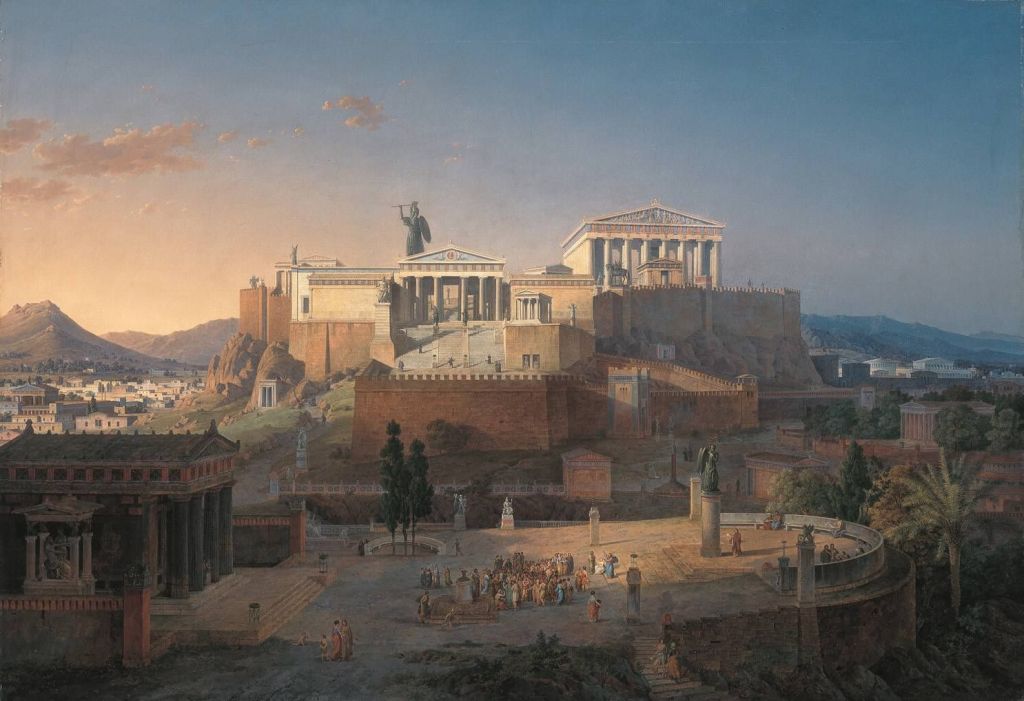
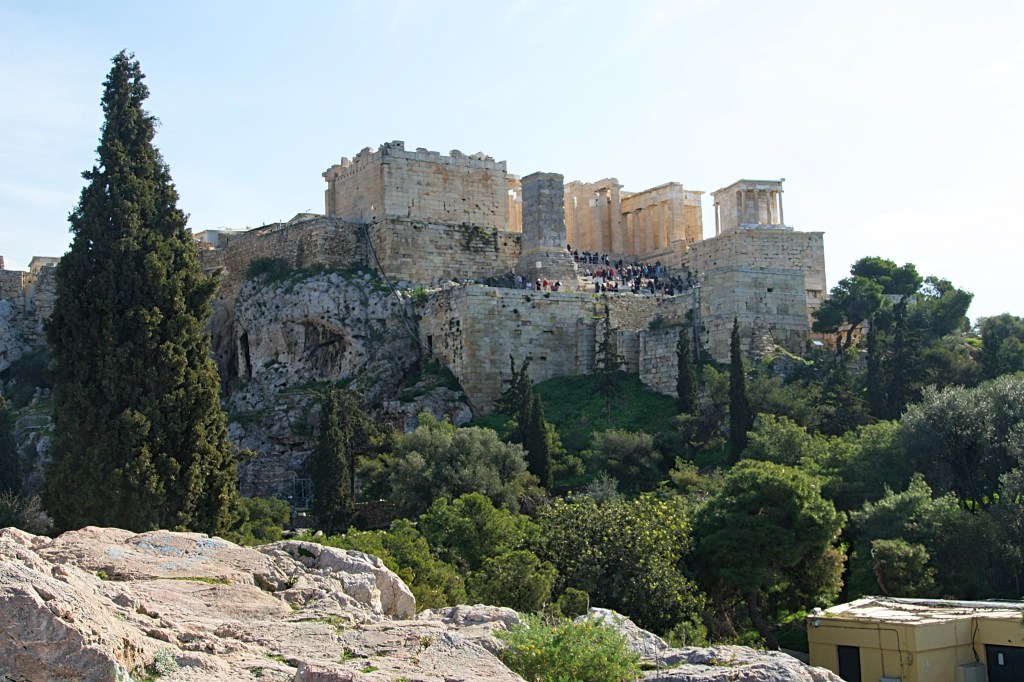
Most of you know that we had the chance to visit Greece during the past couple of weeks and visited Athens. While there we visited the famous Acropolis, saw the ancient ruins located there, as well as the Areopagus (sometimes referred to as Mars Hill) which is located just below the Acropolis. At present, the Areopagus is just a large outcropping of rock…that tourists can climb up on. But in ancient times it was thought to be the foundation for a number of official buildings that made up the center of government, as well as a courthouse where trials were conducted. It was here that the Apostle Paul is said to have delivered a speech to the elders, philosophers, and other teachers who were interested in hearing his message. (Acts 17)  Today I want to look briefly with you at that sermon that Paul delivered. (above is the Acropolis, with the remains of the Parthenon most clearly observed….the photo below shows the present day rock – you can see tourists on it – where the Areopagus and its buildings once stood.)

Context

In the Biblical account Paul, along with his companions Silas and Timothy, had run into trouble in both Thessalonica and Berea after preaching about Jesus Christ. They decided to split up for safety reasons, and Paul was brought to Athens, while Silas and Timothy remained in Berea. The plan was for Silas and Timothy to eventually catch up with Paul there in Athens. Paul had not planned an evangelistic trip or message in Athens. He was simply there, in some respects, as a tourist just looking around. (The picture below is an artist’s rendering of the Areopagus – the courthouse and large patio area in foreground – as well as the Parthenon and other temples – higher on the Acropolis – as it may have appeared during the time of Paul.)

Location

We have three locations listed where Paul was preaching and witnessing. First, in the synagogue, or the church. Second, in the marketplace. And last, he was invited to the areopagus.

  1. Synagogue – where the Jews were gathered to worship, study the law.
  2. Marketplace – where the Athenians were busy congregating, doing business, discussing various topics.  (Schools, stores, public politics, etc.)
  3. Areopagus – the political and philosophical center. At the time Paul gave this sermon there was already a history of 4-500 years of areopagus “rule”. Not a monarchy, and not yet democracy. But a group of leaders.

Today, we often think of the church in old testament terms. A holy place, meeting together at a holy time (Sunday a.m.) with holy people (pastor) wearing holy clothes (gowns and stoles) and doing holy things. However, this is really based on a concept of Solomon’s temple rather than on any church we see in the new testament accounts.

We don’t need to deny our buildings or land. They have been given to us by God. But they must serve the purpose of reaching OUT into our society. They are a base of operations. A place of preparation…in order that we might be sent out to the marketplace. We cannot wait merely for people to come to us, as if this is the only location where the Holy Spirit is working. We must see that our main work and witness is out THERE, in the public square.

Ian Thomas said: “The measure of a healthy church is not in the seating capacity – how many can gather on a Sunday morning – but on the sending capacity – how many are sent out during the week.” So while Paul was speaking in the local synagogue (church)…he is also out in the marketplace.

Audience

While part of his Athenian audience appeared to be fellow-Jews (at least in the Synagogue), his audience at the Areopagus were non-Jews, leaders of Athens, i.e., those outside the faith.

Content (Acts 17:19-34)

What does Paul preach? How does he say it? Paul does not berate them for their idolatry, even though he was troubled by it. He instead looks for those points of commonality. He recognizes that although the Athenians have not yet known or met Christ, they desire to seek for power and spirituality that is bigger than themselves. They may be merely superstitious, but they are nevertheless seeking. It’s clear that Paul chooses to speak with gentleness and an obvious respect for his listeners. His attitude is one of humility and his desire is to find common ground. (the photo below is the view of the ancient ruins of the Acropolis as seen from the present day areopagus rock.)

The content of his sermon may be summarized as follows:

  • God is a creator God. He has made everything! He doesn’t live in buildings built by man’s hands. (At this point it’s not hard to imagine that Paul may even have pointed towards the Parthenon, the massive stone temple which would have towered above them on the nearby Acropolis.)
  • God gives everyone breath and life…He is the source of life. So God really doesn’t need anything from human hands.
  • All humanity comes from one source – God – through Adam, and we are all one family, not many.
  • God did this so that people would seek him and perhaps reach out for him and find him, though he is not far from each one of us.
  • We are all God’s children!
  • If God made us (we being created) how can things that we then make with OUR hands (idols of silver, gold, stone) be equated somehow with GOD??!  They may be historical, they may be beautiful, they may seem worthy of our attention…but something to be worshipped??  NO!

So far, the Athenians – and perhaps even most people today – could agree with Paul’s sermon. But the sermon closes in verses 30-31.

  • In the past God overlooked such ignorance, but now he commands all people everywhere to repent.
  • For he has set a day when he will judge the world with justice by the man he has appointed. He has given proof of this to all men by raising him from the dead.

Pauls’ conclusion brings in the truth about Jesus Christ and his resurrection. When he concluded, what were the results of his sermon? It appears that the results were mixed.

  • Some just outright laughed at Paul when he spoke of resurrection, considering it nonsense.
  • Others appeared somewhat interested, saying “let’s hear some more later.”
  • Some believed.  (Two that are mentioned – Dionysius, a member of the Areopagus Council, and Damaris, a woman who was present at Paul’s appearance.) Interestingly enough, even today, a stone plaque – memorializing Paul’s sermon – is still at the Areopagus, and a large Avenue name after Dionysius still runs near the site and handles a large volume of traffic!

So what can we learn from Paul’s message and appearance at the Areopagus?

  1. Paul had met the risen Christ…and it had completely changed his life! He spoke boldly and courageously wherever he went. While we all have different personalities and gifts (we certainly are not all like Paul!), we are encouraged by the words in John’s first letter – “For we tell you about what we have seen and heard.” Yes, witnessing for Christ is not a technique, a program, a style, and certainly not a personality…. We are simply encouraged to tell others about that which “we have seen and heard.” This of course makes it necessary to meet and hear from the risen Christ regularly…
  2. We must approach our kingdom work with HUMILITY and respect for others, seeking common ground as Paul so clearly did here in Athens.
  3. We must see our real work as OUT THERE in the marketplace, rather than confined merely to the synagogue (our own church building.)
  4. Believe that God is CLOSE to all of our family and friends (v.27). Do we really believe that God is CLOSE to all people? That he made us and loves us and is right nearby?  Lord, forgive us for thinking that so many are FAR from you!

(the above is a summary of the message shared during worship on February 23, 2025.)

Jericho

Joshua 6:12-25

In the last chapter, Joshua encountered the commander of the LORD’s army. When Joshua asked him whether he was there to help them, the commander made it clear that he was there to command, not to help. Joshua accepts the commander’s position and asks what his orders are.

Joshua must have been anticipating a heavenly strategy that was brilliant and victorious, but the orders he was given were to have the warriors march around the city, along with the ark of the covenant , led by seven priests carrying horns. They were to do this once a day for six days. Then on the seventh day, they were to march around the city seven times with the priest blowing their horns. Once they had marched around the city for the thirteenth time, the priests were to make a long blast with their trumpets. When the people heard the trumpet, they were to shout with a great shout. The wall would fall, and the people were to charge in.

This may not have sounded like a winning strategy, but to Joshua’s credit, he had enough faith in the LORD to not question it and was willing to be obedient.

Joshua orders the procession with the warriors leading, followed by the seven priests with the horns, the ark of the covenant, and then the rear guard. Further, Joshua commands the people to be silent while marching, while the priests blew the horns constantly.

They do this for six consecutive days, and then on the seventh day, seven more times. When the people hear the long blast of the horns, they shout, and the wall of Jericho falls.

 Joshua informs the people that the whole city was to be devoted to the LORD for destruction, except for Rahab and her family. They are to keep none of the things they find. All things made from silver, gold, bronze and iron are to go into the treasury of the LORD.

In the future, there will be battles where the LORD tells Joshua how many men he will need and what military strategy to use, but not with Jericho. Joshua does not plan any attack strategy; instead, Joshua is prompted by God at every turn.

It seems that the LORD is regarding Jericho as a burnt offering, destroyed as a gift to God. It is to acknowledge that it was God who won the battle.

In modern days, our inclination is to think of the great numbers of people of Jericho killed, while only Rahab and her family were spared. However, we need to keep in mind that in Deuteronomy 20, Moses commands that in cities like Jericho, anything that breathes cannot be left alive. The reason given is so that the Israelites will not be taught how these people worship their gods, which is abhorrent to God.

If Joshua were to follow Moses’ commands literally, he could not have saved Rahab. But the LORD allowed Joshua to spare the one who put her faith in God for salvation.

It is interesting that after the parts about the destruction of the people, sparing Rahab is mentioned immediately after. This happens in verses 17, 22 and 25. The writer must have been bothered a bit by the command to annihilate all the people of the town.

When Joshua was told about how Jericho was to be conquered, he probably did not think, “Wow, that is a great strategy – We are sure to be victorious”, since on the surface, the plan did not make sense. Marching around the city for a total of thirteen times, blowing the horns, and then shouting should not result in the walls falling. However, Joshua was willing to obey the LORD in this.

Each time they completed the march around the city, it could have been that Joshua’s anxiety was increasing, since there was no sign of the wall coming down. It was not like they saw bits and pieces starting to crumble as they marched – Nothing was happening. Still, Joshua led the way, regardless of how he might have been feeling. Joshua had faith that the LORD is powerful and that the LORD keeps His promises.

Sometimes our prayer life is like this. We tried and tried to witness for Jesus to someone we love, but to no avail. We pray for that person for decades with no visible changes, but then one day, that person is saved. So, if there are people who we have been praying for their salvation, do not give up. God can change people. Continue to pray for them.

Most of us may be bothered by how the LORD commanded them to annihilate whole cities as they inherited the promised land. But unlike examples of peoples being driven off their lands in our history, this was not some expansionistic exploits of a nation hungry for land or sense of manifest destiny. All of creation belongs to God, and He explicitly chose to give the land to Israel, and He had the right to do so.

Before the Israelites were ready to inherit the land, many people had settled in it. But instead of worshipping God, they worshipped their own gods and goddesses, and this was abhorrent to God, and He did not want His chosen people to adopt any of these practices.

By allowing Rahab to be spared, God showed His desire to offer salvation to those who would turn to Him.

Romans 6:23 says, “. . . wages of sin is death . . .” – Which means all of humanity is headed for destruction. This is similar to what the people living in the promised land were facing, as Israel started its conquest. And like in the case of Rahab, God is willing to give salvation to those who turn to Him. God sent His only son, Jesus Christ, to the cross so the death that we deserved was paid by Jesus. Now, we can be forgiven for our sins and be saved, by believing this and accepting Jesus as our Lord and Savior.

For those who have not accepted Jesus yet, do so, since you are headed for eternity without God. That is not God’s desire – He wants to save you.

For those who have accepted Jesus as Lord and Savior, continue to pray for those who have not. Even if you have been praying for them for a long time and do not see any bricks starting to fall, continue to pray. Keep going on with hopeful faith, just like Joshua and the Israelites did, marching around the fortress of Jericho.

(the above is a summary of the message shared by Pastor Shun Takano in our worship on February 16, 2025.)

Commander of the Lord’s Army

Joshua 5:13-15

13Once when Joshua was by Jericho, he looked up and saw a man standing before him with a drawn sword in his hand. Joshua went to him and said to him, “Are you one of us, or one of our adversaries?” 14He replied, “Neither; but as commander of the army of the LORD I have now come.” And Joshua fell on his face to the earth and worshiped, and he said to him, “What do you command your servant, my lord?” 15The commander of the army of the LORD said to Joshua, “Remove the sandals from your feet, for the place where you stand is holy.” And Joshua did so.

After wandering in the wilderness for forty years, the LORD stops the flow of water and Joshua leads the Israelites across the River Jordan on dry land. Once they all cross over, the river’s flow goes back to normal and manna stops, ensuring that the Israelites have no option of turning back. The LORD commands that all males be circumcised and that the people celebrate the Passover.

Now the next task is to conquer the walled fortress city of Jericho. Although the LORD had assured victory in the promised land, there have been no additional instructions from the LORD on how to proceed.

Joshua is probably wondering if they are supposed to go ahead and plan an attack, and the LORD will help them. He is walking near Jericho, looking at the walled city and wondering what the best tactic is. They really do not have veteran warriors, nor do they have the normal tools to break down the gates or climb over walls – Battering rams and ladders.

Then he encounters a warrior with a drawn sword. Joshua probably thought that if this mighty warrior with the sword was on their side, it would be of great help, but if he were an enemy, it would just add to their difficulties. He was probably hoping that this warrior had been sent by the LORD to help him to defeat Jericho.

So, Joshua asks him, are you for us or against us? The warrior’s answer must have taken Joshua by surprise – “Neither. I am not here to help you – I am the commander of the LORD’s army.”

Joshua must have felt the power of God emanating from the warrior, since Joshua immediately accepts the warrior as his commander and an emissary of God and falls on his face to worship him.  Then he immediately asks what the commander’s orders for him are.

Some Christian scholars concluded that the commander of the LORD’s army is Christ in His pre-incarnate form. Otherwise, they think Joshua would not have worshipped him.

As Joshua is leading the Israelites to live in the promised land, this becomes an important example to others and to us. When we accepted Jesus Christ as our Lord and Savior, we too have entered promised land living. Like Israel, we are surrounded by people who are not believers. Like Israel, we have tasks ahead of us. Like Israel, we live in the era where God’s promises have started to come true, but the fulfillment is still in the future.

So, what can we learn from Joshua on how to live our lives as Christians in this world?

Joshua had a set of abilities that are useful as the people’s leader. But the thing that the Lord required of Joshua was not his intellect, power of persuasion, adaptability, nor strategic thinking – What the LORD required most from Joshua was faith strong enough to be obedient. In other words, a worshipful attitude towards God.

One way to look at worship is that it is comprised of two parts – Adoration and praise. Adoration is love and respect for who God is, and praise is thankfulness for what God does for us. If we are in the correct attitude of worship, then obedience flows from it, as well as the desire to serve Him. We saw this in Joshua.

Another great example of the right attitude towards a king can be found in the story of the Three, found in 1 Chronicles 11. They were Jashobeam, Eleazar and Shammah – The three mightiest of King David’s elite group of warriors. Jashobeam was their leader and was known for killing 300 enemies in one battle with his spear.

The Philistines were occupying Bethlehem, David’s hometown. In a moment of nostalgia, David was reminiscing about his home and the well, and spoke out loud that he would love to drink water from that well. The Three decided to satisfy their king, and without being ordered to do so, they snuck in behind enemy lines and fetched some water from the well and brought it to David. David was horrified that they had risked their lives to do this and would not drink it – Instead, he offered the water to the LORD.

Being sensitive to what the Lord desires and being willing to put themselves at risk is what the Three did, and it is something we can learn from them for our lives.

Joshua might have thought that LORD was going to be his helper in conquering Jericho, but the LORD corrected this thinking by declaring that He is not on Joshua’s side, but He was there to command.

From this, we can learn that it is the same with us. God is not here to be our helper; He is here to command us. And the type of relationship that the Three had with David should give us hints as to how we should regard our Lord, Jesus Christ. We should perpetually be sensitive to what our Lord desires.

Physically, we live in a democracy, which means there are roles for us to play in determining the future of this country, through voting, social action, etc. But spiritually, we are part of the Kingdom of God, with Jesus as our King. It is a monarchy, and as citizens of the Kingdom and subjects of the King, our role is not to determine the future direction of the Kingdom. God decides that and He acts according to His plan. Our role is to determine what God requires of us and be willing to be obedient to His commands.

This is the lesson we can take with us from this morning’s passage.

(the above is a summary of the message shared by Pastor Shun Takano during our worship on February 2, 2025 – via ZOOM.)

The Promised Land

Joshua 5:1-12

After the two spies, who were aided by Rahab, returned safely to Joshua, the Israelites march to the edge of the River Jordan. God wants to make sure that the people know that He is with Joshua, so He has Joshua give the command for the priests who are carrying the ark of the covenant to move forward. As soon as the feet of the priests hit the water, the water stopped flowing and started to pile up near the city named Adam, some 30 miles upstream.

The priests with the ark stood in the middle of the river while the Israelites crossed over on dry land. Once all the people crossed over safely, twelve selected men put rocks in the middle of the river as a memorial. Once that was done, the priests crossed over and as soon as their soles touched the promised land, the river water started to flow again.

Once everyone was safely on the promised land, the LORD commands that all males be circumcised. Circumcision was the sign of the covenant with the LORD that was established in Abraham’s time. So, it seems appropriate that as the people of God are about to inherit the promised land, that the sign of the covenant be re-established.

Also, the people ate the produce of the land, and the manna ceased. This, along with the water of the River Jordan being back to flood stages meant that the people no longer had the option of turning back to the wilderness nor to Egypt. The people were now fully committed to living in Canaan.

Although we tend to remember the parting of the Red Sea, the other water miracle of stopping the flow of the River Jordan was just as amazing. We know that when God shows His great powers in such public fashion, He has multiple purposes for doing so. It allowed the Israelites to safely cross over into the promised land.  Also, the kings of the surrounding countries were devastated. They knew that they did not stand a chance against Israel, if the LORD was fighting their battles for them.

It also gave the Israelites enough faith and trust in the LORD to have all the males circumcised. This meant that they would be sitting ducks for any enemies to defeat them, since the males would be incapacitated to fight for three days. The fact that this command came to them immediately after the Jordan River miracle made it easier for them to trust that the LORD had the power to keep them safe.

In many gospel songs, the theme of “going over Jordan” has been used as an imagery of moving from this life to the eternal life, where there is deliverance from sin, pain and sadness, and peace and joy. However, this was not quite the case for the Israelites. There will be battles and hardship and learning how to live as God’s people.

For us, crossing over Jordan is like moving from our old life into life of faith in Jesus Christ. When we repent of our sins and accept Jesus as our Lord and Savior, our sins are forgiven, we are accepted as people of God, and the promise of our eternal life with the LORD and other believers is given to us. However, this does not mean that as soon as we become Christians, all our problems disappear, and we live happily ever after. We still have enemies, battles to fight, and a life of obedience to the commands of our Lord. We have the responsibility to be our Lord’s witnesses to those we encounter.

We can learn from the Israelites on how to prepare ourselves to live under God’s promises.

They start their new life in the promised land by circumcising their males. For us, what is equivalent to circumcision is baptism. It is the sign that we belong to God and that God claims us as one of His. So, if there are any believers here that have not been baptized yet, I would encourage you to talk with Pastor Tim and consider getting baptized.

If you have been baptized already, then I would urge you to recommit yourselves to Jesus and to following His commands and being faithful to Him.

At this stage, the Israelites are not sure how they are going to proceed. All they know is that there is no turning back, since there is no longer manna, and the River Jordan cannot be recrossed. They can only depend on God’s promises and forge ahead.

Although we can go back to living our old lives and abandoning our faith, we ought to eliminate that option and depend on God’s promises and forge ahead.

For the Israelites at this stage, the promise of becoming a great nation is far into the future. It will not happen until the days of King David and King Solomon – Some 400 years into the future. For us, the Kingdom of God is here, but will not fully be implemented until Jesus returns sometime in the future.

For us, we not only have the promise that Jesus will establish His kingdom in full in the future, but also have the promise that when our lives are done on this earth, we will be resurrected and live forever on the new earth with our Lord, where there will be no more tears and no more sufferings

So let us step out in faith and go do the Kingdom work that has been allotted to us.

(the above is a summary of the message shared by Pastor Shun Takano during our worship on January 26, 2025.)

Rahab

Joshua 2:1-14

Joshua sends two men into the promised land to spy out Jericho. They stay at Rahab’s house, and the king of Jericho hears about it and sends men there to capture them. Rahab protects the spies by hiding them on the roof, while misleading the king’s men.

Rahab makes an agreement with the spies that she will keep their whereabouts a secret, if they will guarantee her and her family’s safety when Israel attacks Jericho. The spies agree on the condition that Rahab tie a crimson cord in her window and keep everyone inside once the attack starts. Rahab agrees.

Scholars wonder why this story of Rahab is inserted here. The narrative flows smoothly from Joshua 1 to Joshua 3.  The reason might be to highlight early how Israel will implement the command in Deuteronomy 20 where it directs to completely annihilate the people of the towns that the LORD is giving them as their inheritance. Even though the people of Jericho will be destroyed, Rahab and her family will be spared. So, there will be room for people to be saved who profess faith in the LORD.

We see the perfect planning of the LORD at work. All the big show of power that took place during the Exodus – The ten plagues, the parting of the Red Sea and the destruction of the Egyptian army – They were meant to drive fear into the hearts of all the people in the region. It was so effective that Rahab and the inhabitants of Jericho are still familiar with what the LORD did some forty years later.

So why did Rahab risk herself in protecting the spies? Rahab’s belief that the God of Israel is the one that rules heaven and earth is the starting point. Further, she believes that the LORD will give the land into Israel’s hands. She believes that the destruction of Jericho is imminent.  Her focus is the wellbeing of her family. To protect her and her family, she is willing to put herself at risk with the king’s men, while protecting Joshua’s spies. She is hoping that by protecting the spies, she can earn protection for her family.

It can be said that Rahab’s is an act of faith. Even though she knows little about the LORD except for His actions in the Exodus, she stakes her and her family’s life on her belief that the LORD is the God over heaven and earth and that He will keep His promise to the Israelites. She also believes that the LORD can act in mercy and spare her and her family.

So, she is willing to bet their lives on the future mercy of God, at the risk of the anger of her own earthly king.

We can see some parallels to Rahab’s story with the Passover. The Israelites locked themselves inside their homes with blood on the door frames. When the angel of death came, the households with the blood on the door were spared. In Rahab’s case, the crimson cord on the window would be the sign for the Israelite army to spare them from death.

It is also of note that according to the Gospel according to Matthew, Rahab is the mother of Boaz, who marries Ruth. This makes Rahab the great-grandmother of King David. The letter to the Hebrews mentions Ruth among the heroes of faith for her actions. And the letter of James mentions Rahab as an example of one who acted in faith, just before his famous words, “. . . faith without works is also dead.”

Back in Numbers, when Moses sent out the spies into the promised land, he did so because he was following the command from the LORD. There is no indication that the LORD commanded Joshua to send in the two spies. So, it seems that Joshua did this on his own initiative. It is puzzling as to the reason for doing this, right after the LORD directly assured him that He will bring victory and success in the conquest of the land. Moreover, all the two spies did were go to a brothel, hide for three days, and report to Joshua what they heard from Rahab. Not necessarily a successful espionage trip.

Although this story of Rahab seems like an insignificant narrative which does not really advance the narrative, it ends up being an important one. An example of an ordinary woman who acts according to her strong belief in the power and mercy of the LORD to save herself and her family stands as an example to all of us. Through Rahab’s act of faith in the LORD, she is saved from death and is allowed to live as part of the nation of Israel. She ends up being an ancestor to Jesus Christ. And she is such a good example that two separate books of the New Testament use her as a positive illustration of faith.

Rahab was able to act in faith, even though she had no guarantees that the LORD and the Israelites would spare her and her family. But through the Bible, we have guarantees. If we repent of our sins and accept Jesus Christ as our Lord and Savior, we are guaranteed to have our sins forgiven, guaranteed to being accepted into the family of God as daughters and sons, and guaranteed that the final death will pass over us into eternal life with our Lord. And we are given a vocation from the LORD – To be witnesses to the fact that Jesus Christ is the Son of God and the Savior of the world.

So, when the time comes to act in faith, let our faith move us into action, like it did for Rahab.

(the above is a summary of the message shared by Shun Takano during our worship service on January 12, 2025.)