Death of the Firstborn

Exodus 12:29-32

Even after nine previous plagues, Pharaoh does not agree to let Israel go, so God sends the tenth plague – The death of the firstborn. Pharaoh has had enough and summons Moses and Aaron and tells them to go away with their flocks and herds. He also asks for a blessing. The Egyptians are eager to have Israel gone from their land and when asked, give them jewelry of silver and gold as well as clothing.

The LORD instructed the people through Moses and Aaron how to survive the death of their firstborn. They are to sacrifice a lamb for each family. They are to take some of the blood and put it on the two doorposts and the lintel of each house. They are to roast the lamb and eat it that night. No bones are to be broken. The LORD will pass through the land killing every firstborn human and animal, but when He sees the blood, He will pass over that house. This is the implementation of Passover.

People obey the Lord’s instructions, and their firstborn are kept alive, while the firstborn of the Egyptians perish in the night.

The month of the Passover is now to be considered the first month of the year, and the Passover tradition is to be observed every year and passed down through the generations, so that they too can be reminded of the great things the LORD did for Israel.

Celebration of Passover has been kept alive by tradition and ritual, following the command of the LORD regarding avoidance of leaven found in Exodus 12:14-19. During the festival of Passover Jewish households not only do not eat leavened bread but remove any leavened products throughout the house.

The Seder meal is at the center of the celebration. Families gather around the table and follow the ritual that includes reading the story of Exodus, drinking four cups of wine and eating symbolic foods – Matzah (unleavened bread to represent hurried departure that did not allow for dough to rise), bitter herbs (symbolizes the bitterness of slavery), a roasted shank bone (representing the Passover lamb) and others.

The telling of the story is meant to keep the knowledge alive of what the LORD did for them. The youngest person present traditionally asks the Four Questions:

  1. Why is this night different from all other nights?
  2. Why do we eat unleavened bread tonight?
  3. Why do we eat bitter herbs?
  4. Why do we dip our food twice tonight?

The food is dipped first in bitter herbs (representing the bitterness of slavery), and then in charoset (mixture of chopped apples, nuts, wine and spices), representing hope and resilience even in difficult times).

Each of the four cups of wine represents a different aspect of Passover. The first cup marks the beginning of the Passover meal. The second cup is consumed after reading the Haggadah, or the Passover story. The third cup is drunk after the meal, signifying redemption from Egypt and expresses gratitude for freedom. The fourth cup is the Cup of Elijah and is left untouched – It symbolizes hope for the future redemption and the arrival of the Messiah – It is called that because of the belief that Elijah the prophet will announce the Messiah’s coming.

Passover was celebrated in Jesus’ time, and it was the reason why the leaders of the land were in Jerusalem when Jesus was arrested, tried and crucified.

The New Testament identifies Jesus as the Passover lamb. John 1:29 refers to Him as “the Lamb of God who takes away the sin of the world”. Paul, in 1 Corinthians 5:7 speaks of Jesus as “our paschal lamb”.

Jesus is hanging on the cross as the Passover lambs are being sacrificed. Exodus 12:46 commanded that none of the Passover lamb’s bones should be broken. John 19:31-34 tells us that when the soldiers went to break Jesus’ legs so that He would die quicker, they found Him already dead, so no bones were broken.

The Passover lamb symbolizes deliverance, freedom and redemption. That is what Jesus brings us also. Passover freed Israel from slavery to Egypt, while Jesus frees us from slavery to sin. Paul teaches in his letter to the Romans that before we were saved, all we could do was sin, but now that we are saved, for the first time in our lives, we have the choice not to sin.

Revelation 20 tells us that after our earthly lives are over and the Lord returns, there will be a final judgment. There is a lake of fire which is second death and anyone whose name is not found written in the book of life will be thrown into it. The way to get our names into the book is to accept Jesus Christ as our Lord and Savior. When we do that, the blood He shed for us marks our hearts and second death will pass over us, just like the angel of death passed over anyone in the houses marked with the blood of the Passover lamb. Let us be grateful that our eternal life with the Lord is set, due to our faith in Jesus. For those who we encounter that are headed for second death, let us share Christ with them so that they might also get their names written in the book of life.

(the above is a summary of the message shared by Shun Takano during our worship on June 9, 2024.)

Praying For A Yielded Posture

Matthew 5:1-2;14-16

(Much of today’s sermon outline comes from Pastor Sanetta Ponton, who serves a Covenant Church in New Jersey.)

A few years ago our son was enrolled in a driver’s education course. There was both classroom learning as well as “behind the wheel” practice. As parents we were also part of the process, allowing him to practice driving while we rode in the passenger seat. There are many details and rules to learn, but most of the training could be summarized around the concept of “yielding” – being willing to “give in”, to be courteous and patient, perhaps even when the other driver is not. Don’t use your car as a weapon, don’t get angry, don’t encourage or participate in “road rage.” Take a deep breath, stay calm, practice patience…. In short, be willing to yield the road when necessary….even when you are “in the right”… in order to maintain the highest level of safety. Sounds good, right? But those of us who are experienced drivers know how hard it can be at times.

To yield is partly defined in the following ways: to admit to be true; to concede; to submit and comply with; to give up a demand, right, or claim.

But YIELDING is hard!

  • We don’t like to back down…or give up….or give in
  • We flash our high beams back at people
  • When someone tailgates us….we stubbornly stick to our speed and our lane
  • Our politicians don’t like to yield. They can’t even compromise anymore. Never give in!
  • In our polarized America…..yielding is not usually the posture that’s most evident

The concept of yielding has also been mis-used. Our Christian faith and scripture have been used to force people to yield against their wills.

  • African Americans forced to yield – kept in slavery for centuries
  • Native Americans / Indians forced to give up their culture / re-educate their children in boarding schools across North America
  • Women forced to stay in abusive marriages 
  • We could go on and on……
  • So we can understand why some people might be a bit reluctant to quickly accept the need for a yielding posture.

However, a posture of yielding shows up in scripture….and is a powerful message in Jesus’ teaching.

Matthew 5:1-2

“Now when he saw the crowds, he went up on a mountainside and sat down. His disciples came to him, and he began to teach them…”   

In Matthew 4, Jesus has already begun his public preaching on the Kingdom, chosen disciples, begun performing miracles of healing, etc. The crowds are gathering.

But here in chapter 5 Jesus begins to teach his disciples what it looks like to live in the Kingdom of God. How it actually takes place, what it should really look like. How can we become salt, light, different from those around us? How should we interpret the Law? How do we deal with our enemies? How do we practice our spirituality – prayer, alms giving, and fasting? In each case, it appears that humility and a posture of yielding are absolutely fundamental to living in kingdom community!

So while yielding is HARD, and not encouraged by society, and while it HAS in the past been mis-used as coercion and force…… yet, Jesus teaches a yielded posture as absolutely critical to shared life in the Kingdom of God. While our culture may look down on it….Jesus calls those who have had to yield, who have had to accept a life of difficulty and sadness, and tears, and poverty…..as “blessed”!

How do we actually practice a yielded posture in our prayer life?  

  1. Look up to Jesus  (Matthew 5:1)
    • Jesus positions himself on the mountain so he can see them, and they him
    • Keep our eyes on Jesus –Jesus not only teaches humility and yielding…but models a life of yielding to his heavenly father.
    • In prayer,  we can practice a physical posture of yielding (kneeling, bowing, retreating to our private, quiet place….not praying to be seen by others.) 
  2. Recognize the authority of Jesus Christ and submit to his teachings
    • The disciples come to him on the mountain and sit….giving Jesus their attention.
    • “Who is this….that even the winds and the waves obey him?” It takes time, but the disciples begin to sense the authority of Jesus in a powerful way. At the end of Matthew, Jesus offers that authority…and his continuing presence…to his disciples… to us!
    • Do we come with a posture of yielding and learning? To come to learn implies that there is more for us to gain. What is the new thing that God is trying to teach us….that we might be resisting?
    • Is this possibly what’s missing in our society? Is it possible that we are no longer open to learning? “We go, each to our own news silos to hear only the things that confirm what we already believe.” Instead, can we go to God in prayer…go to scripture together…with the real hope that God might teach us something new?
  3. Recognize that we do not yield alone. We are part of a community of disciples yielding to the Lord and to one another. This builds a community that mirrors the Kingdom of God.

May God continue to shape and lead us as a church….as we learn to yield completely to God….and to each other.

(the above is a summary of the message shared during our worship on June 2, 2024.)

The Plagues

Exodus 7:8-13

Moses and Aaron go to Pharaoh and do what the Lord commanded them. Aaron’s staff turns into a serpent, but the Egyptian magicians also duplicate the act. And even though Aaron’s serpent swallows up the Egyptian serpents, Pharaoh, whose heart was hardened, refused to listen. This sets up the ten plagues that the LORD will visit upon Egypt.

The first plague is the water turning into blood. When Aaron strikes the water of the Nile with the staff, the water turns to blood, the fish die and starts to stink. All the water in Egypt turns into blood. The Egyptian magicians could also replicate this, and Pharaoh refused to listen.

Seven days later, Aaron stretches out his staff and frogs come up from the waters and cover the land. The magicians are also able to bring up frogs. Pharaoh calls Moses and Aaron and requests that they pray to the LORD to take the frogs away and then he will let the people go sacrifice to the LORD. So that there would be no mistake that the LORD is doing this, they set up the exact time that the frogs would go away, and they all die at the appointed time. Pharaoh changes his mind and will not let the people go.

Then Aaron strikes the dirt with the staff and it turns to gnats, and they cover the humans and animals. The magicians cannot duplicate this one, and they admit that this is the LORD’s power. Pharaoh refuses to let the people go.

Then the LORD sends swarms of flies. Goshen, where the Israelites live, is free of the swarm of flies, but the rest of Egypt is covered. Pharaoh summons Moses and Aaron and offers to let the people sacrifice to the LORD, but in Egypt. Moses informs Pharaoh that the sacrifice has to be outside of Egypt. Pharaoh agrees, the LORD removes the swarm of flies, and again, Pharaoh changes his mind and refuses to let the people go.

Pharaoh is told that if he continues to refuse to let the people go, then a pestilence will attack the livestock of the Egyptians, but not the livestock belonging to Israel. Pharaoh refuses and the Egyptian livestock die.

Then Moses takes handfuls of soot from the kiln and throws it in the air. It causes festering boils on humans and animals. It gets so bad that the magicians can no longer come into Pharaoh’s presence. Pharaoh still refuses to let the people go.

The LORD warns Pharaoh that there will be heavy hail and all people and living things in the open fields will die. People who believe the warning put people and animals under shelter, and those who do not believe keep them out in the open field, where they die. There is no hail in Goshen. Pharaoh summons Moses and Aaron and admits that he has sinned and requests that they pray to the LORD so the hail will end, and he will let the people go. The hail stops, but Pharaoh still does not let the people go.

Moses and Aaron go to Pharaoh and warn him that the LORD is about to send locusts to Egypt. Pharaoh’s officials urge him to let the people go. Pharaoh is willing to let the men go but not the children. Locusts come and cover the land eating all the vegetation. Pharaoh relents and asks that the locusts be taken away. But once all the locusts are gone, Pharaoh changes his mind and refuses to let the people go.

Then the LORD sends darkness on the land so intense that people could not see each other. It lasts for three days, but there was light in the land of Goshen. Pharaoh is now willing to let all the people go, including the children, but insists that the livestock must remain. Moses insists that the livestock must go with them, but Pharaoh refuses and threatens Moses with death.

These setup the final disaster on Egypt – The death of their firstborn, and Passover for Israel, which we will look at next time.

There are no satisfactory natural explanations for any of these disasters. It goes beyond natural events. Water is no longer water, amphibians and insects overrun the land, hail large enough to shatter every tree falls from the sky and darkness so thick that no one can see each other. The fact that the land of Goshen is not affected by any of these makes it clear that these are God’s doing.

Yet, we see that God does not act alone – He acts through Moses and Aaron. It is a joint venture. God is doing all the heavy lifting, but He chooses to depend on Moses and Aaron to do their part. Of course, Moses and Aaron could do nothing without God. It is interesting to note that for the first three plagues Aaron is the one that is active, but then Moses takes over the primary role – Just like the LORD’s original plan.

The reason why the LORD stretched this into a total of ten plagues is hinted at in Exodus 9:16 – “But this is why I have let you live: to show you my power, and to make my name resound through all the earth.”

The immediate purpose was for Israel to be freed to go occupy the promised land and become a great nation. But God also had a plan for the salvation of humanity. Passover will become the central point of the Old Testament. Everything that came before and everything that comes after either looks forward or looks back to the event. The connection between Passover and the death on the cross of Jesus Christ, the Lamb who takes away the sins of the world, is integral.

Because all ten plagues played out in all their exaggerated way meant that the whole world would note what happened to Egypt and the power of God was on full display to be feared and remembered.

As Egypt carried out its deadly plan of genocide for Israel by killing all the male babies, the LORD put a stop to it. By twisting creation in unnatural ways, God restored the order of His creation and purpose for Israel to bring forth the ultimate blessing on humanity – Jesus Christ.

We are not called out for giant things like Moses and Aaron, but we need to remember that God has roles for each of us to play for His kingdom. To be witnesses to the fact that Jesus Christ is the Son of God and the Savior of the world – To preach this good news to all who need to hear. Like Moses and Aaron, we cannot do it without God, but God is also depending on us to do our part.

(the above is a summary of the message shared by Shun Takano during our worship on May 26, 2024.)

Straw Will Not Be Provided

Exodus 5:1-23

After successfully meeting with the Israelite leaders, Moses and Aaron go to see Pharaoh and give him the message from the LORD to let Israel go celebrate a festival. Pharaoh not only refuses, but he also orders that straw no longer be provided to Israel, and yet, the number of bricks produced cannot be reduced.

The Israelites do not meet the quota of bricks and so the Egyptians beat the supervisors and task masters. The supervisors complain to Pharaoh and are told the reason – Because Moses and Aaron demanded to let Israel leave. So, they blame and complain to Moses and Aaron.

 Moses turns to the LORD and asks Him why this is happening. Instead of the people being delivered, the people are suffering more than before.

We can certainly empathize with Moses. He did not want this job. He did not want to confront Pharaoh. He was expecting that the Lord would swiftly show His power and free the people. Instead, the people’s sufferings have increased. He probably does not know how to address the concerns and complaints of his people. The only thing Moses can do is to turn to the LORD for a solution, since it is now way too late to reverse course.

We see how Egypt managed to keep the Israelites under control, even though they outnumbered the Egyptians. It is a pyramid scheme where only a few benefit from the labors of many. The slaves are driven hard to the point of exhaustion, making them easier to control. If they complain or cause problems, things will get worse – This is as good as it gets.

A few are “promoted” to supervisors with some power over the rest, serving as an example that if one works hard, things could get better. If problems arise, then these “leaders” are tasked to keep the people in line. The people cannot deal directly with Pharaoh, so they can only deal with the leaders, which keep them in conflict with each other. Schedule is the key and must be kept at all costs. This leaves little time for holidays and complaining.

This system is no different than how American slavery worked, and in some milder way, how large manufacturing firms worked before labor laws.

This system of oppression works well enough that we see in verses 22-23 that Moses does not blame Pharaoh for the people’s increased hardship but puts the blame on God.

God answers Moses in 6:1 – 1Then the LORD said to Moses, “Now you shall see what I will do to Pharaoh: Indeed, by a mighty hand he will let them go; by a mighty hand he will drive them out of his land.”

The LORD is not only going to have Pharaoh drive out the people from Egypt, He is going to demonstrate His great powers to Pharaoh, Egypt, and the surrounding nations. Other nations are going to hear about what the LORD does to Egypt, which will make them fear Israel, which will work to their advantage in the future.

The fact that God responds to Moses’ questions/complaints and explain what He intends to do must have been a welcome situation for Moses. Had God not responded to Moses, it would have put Moses in a very difficult position. He would have to deal with the fact that the people he claimed to have come to help are suffering more because of him obeying God.

Sometimes when we are doing what we believe God wants us to do, we experience setbacks. It will make us stop and ponder about the situation. It could be that God has His intent and timing for His plan to have the full effect and results. But it also could be that we got it wrong, and we are just doing what we want to do, or that we misinterpreted what God wanted us to do.

Moses’ situation was a little different, since there was a visible encounter with God, with God speaking directly with him. God also told Moses exactly what He wanted Moses to say and do. It was not left up to Moses’ imagination or discretion. Also, when trouble came and Moses called out to God, He answered immediately and in a direct and concise manner.

This is not the way things normally work for us. Through answers to prayer, reading of the Bible, listening to messages, requests coming from church leaders, etc., we get an inkling of what God wants us to do. When things do not go as planned, or the people we are trying to help end up dissatisfied, we get unsure of what we are to do. We call out to God in prayer for help, but often, we are confronted with what we perceive as silence. We often do not get a direct response from God like Moses did.

So, what do we do in those situations? We proceed with caution, and in prayer. We ask for the help of the Holy Spirit to guide us, in correcting us if we are not on the right path. We need to be aware that the answer can come from any direction – From reading the Bible, advice from pastors, contents of messages, a message from fellow sister or brother in Christ. There is always a chance that we are simply doing what we want to do, rather than what the LORD wants us to do. If we are the only beneficiary of what we are doing, then we should practice extreme caution….and careful discernment.

However, we can be pretty certain that we are on the right track if we are doing things that the LORD clearly commanded us to do. This includes helping people in need, bringing the good news of forgiveness and salvation through Jesus Christ, making disciples of Christ and bringing God’s blessings to others.

We may not have the huge task of helping to liberate a nation from slavery, but we do have the task of witnessing to the world that Jesus Christ is the Son of God and the savior of the world. Even if we get into situations where we are not sure that what we are doing is actually helping anyone, we need to keep turning to the LORD in prayer, knowing that He knows what He is doing, and He will be with us and will not abandon us.

(the above is a summary of the message shared by Shun Takano during our worship on May 12, 2024.)

Praying to Hear

Matthew 6:5-8

And when you pray, do not be like the hypocrites, for they love to pray standing in the synagogues and on the street corners to be seen by men. I tell you the truth, they have received their reward in full. But when you pray, go into your room, close the door and pray to your Father, who is unseen. Then your Father, who sees what is done in secret, will reward you. And when you pray, do not keep on babbling like pagans, for they think they will be heard because of their many words. Do not be like them, for your Father knows what you need before you ask him.

(Today’s sermon outline comes from a colleague of mine, Pastor Peter Ahn, who serves a Covenant Church in New Jersey.)

As one half of a married couple I have become aware, over the years, of the important issue of really listening to my partner. Often my inability to listen…to hear correctly….is the source of misunderstandings and hurt feelings. I either haven’t been concentrating while listening…or I’ve listened but not really heard or understood.

If we are to have a deep, meaningful, relationship with someone, we need to really listen, to really hear. Could that be true in our relationship with God as well?

Do we approach God in prayer, and end up doing all the talking? Is our prayer just a long list of things we’re worried about….or things we need?

In the very first sermon about prayer in this series, we learned – and in fact we emphasized the fact that there is NO ONE CORRECT way to pray. God loves us – He does not mind if we tell him all the things we want, just like a small child telling their parents all the things they want for Christmas. God is so patient and just loves the fact that we’re praying at all.

But I also said in that first sermon that our prayers may change….as our faith grows. As our faith matures we may find that we are more and more longing to HEAR from God – to hear his voice – and not just fill the time with our own voice telling God what we want or need.

If it’s going to be a real relationship, then it will need to be a conversation – back and forth – not just me reciting words. In short we need to learn how to pray…. In order to HEAR God.

How do we do that?

Matthew 6:5-6

“And when you pray, do not be like the hypocrites, for they love to pray standing in the synagogues and on the street corners to be seen by men. I tell you the truth, they have received their reward in full. But when you pray, go into your room, close the door and pray to your Father, who is unseen. Then your Father, who sees what is done in secret, will reward you.”

How do we pray…in order to hear from God? First, when we pray, we make prayer about God, and NOT about ourselves.

  • In this passage the leaders and hypocrites were praying but it was all about themselves – doing it so that they could be seen, doing it so that they could be heard, doing it so that they could be respected. It was all for their glory….and not about God’s glory. And God says that when we pray that way, we have already received our reward.
  • Now of course, corporate prayer is not wrong…but prayer that is about our glory is not helpful in hearing God’s voice.

In continuing verses (Matthew 6:9-10) we see Jesus teaching his disciples to pray in these words:

“This, then, is how you should pray: ‘Our Father in heaven, hallowed be your name, your kingdom come, your will be done on earth as it is in heaven’”.

All about God, and not about me!

If we want to hear God’s voice, we must make our prayers about God.

How do we pray in order to hear God?  Secondly, we need to be willing to embrace Silence.

Again, from our text for today, Matthew 6:7-8 “And when you pray, do not keep on babbling like pagans, for they think they will be heard because of their many words. Do not be like them, for your Father knows what you need before you ask him.”

God already knows everything we need. We don’t need to keep telling him. He is inviting us to be silent before Him.

Mark 1:35 – Jesus himself goes out in the morning to a quiet place, a lonely place in order to be silent before his heavenly father.

In my earlier example – just as I need to stop talking, and give complete attention to my wife, in order to really hear her, we need to stop “babbling” in our prayers, and become silent before God, telling him that we are listening.

But silence is hard isn’t it? Our minds quickly move to other topics and thoughts.

Why is practicing silence so important?

  • Silence allows us to let go – to surrender our will to God’s will. It allows us to let go of control, let go of our fears. Most of our prayers come from a place of fear and anxiety. Becoming perfectly silent helps us recognize that…and begin to move toward trust.
  • In Silence, we let go of our agendas / our plans – we allow communion with God (our relationship with God) to be the focus of our prayer….and not what we can GET from God. We seek His Face, rather than His Hand. We want Him, and not what He can Do for us.
  • In Silence we shut our mouths…. and more fully open our hearts to HEAR God’s voice.

So in summary, how do we practice prayer….in order that we may more clearly hear God’s voice?

  • By Making God the center of our prayer – His glory, not ours; His will, not ours
  • By Embracing Silence
    • Surrendering our will, control, and fears
    • Letting go of agendas and plans, and making communion with God the goal
    • Opening ourselves to HEAR.

Perhaps you could start with a very short and simple rhythm of praying silently for 3 minutes a day? It will take practice before we are easily able to sit still and listen for that long! We may need to choose a special word (like “Jesus”, or “trusting”) , or a key image or phrase (like “speak, for your servant is listening”, or “God, I give you my anxieties”)… in order to help us stick to our listening…and not wander off to our daydreaming!

Remember, there is no wrong way to pray. God will meet us where we are. And maybe, just maybe…we’ll actually start looking forward, and expecting – to regularly hear from God!

(the above is a summary of the message shared in worship on May 5, 2024.)

God Persuading Moses

Exodus 4:1-17

In Exodus chapter 3 God calls out to Moses through a burning bush and tells him that he has been chosen to go to Egypt so that God can free the Israelites and lead them to the promised land. Moses is reluctant about accepting this assignment. He probably remembers that forty years earlier, he thought he might be the one to help the Israelites and when he tried to intervene in a quarrel between a Hebrew and an Egyptian, things did not go so well.

Moses had a real fear that the Israelites would not listen to him nor accept him as their leader. So, God reveals His name to Moses and promises that He will be with Moses and that he and the Israelites will one day worship God on the mountain on which he stands.

At the beginning of Exodus chapter 4, Moses still has concerns about the Israelites not accepting him nor believing that the LORD appeared to him. So, the LORD gives Moses two signs to show the Israelites. The first was his staff turning into a snake when thrown down on the ground and then back to a staff when held by the tail. The second sign was for Moses’ hand to turn leprous, and then back to clean.

Moses then points to his problem with giving speeches to a crowd. The LORD tells Moses that He is aware of his speech impediment and that it will not hinder him from doing the LORD’s work.

Moses runs out of excuses and simply tells the LORD to send someone else. The LORD gets angry with Moses and tells him to take his brother, Aaron, with him. The LORD will tell Moses what to say, and Moses will tell Aaron what to say. The Lord commands Moses to leave for Egypt with Aaron and his staff.

Moses goes back to his father-in-law and asks permission to go to Egypt, and then leaves. The LORD then instructs Moses to not only perform the signs to the Israelites, but also to Pharaoh.

Then we have the frightening scene where the LORD threatens to kill Moses, presumably because of uncircumcision. But Zipporah, Moses’ wife, performs circumcision on their son, and the Lord decides to leave him alone.

The LORD instructs Aaron to go into the wilderness to meet Moses. They meet at the mountain of God where Moses explains everything to Aaron. They go to Egypt and Aaron speaks to the Israelites and performs the signs, and the people believe. They are moved to hear that the LORD had paid attention to their misery and was now going to act on their behalf. They bow down and worship the LORD.

Everything is now set for confronting the Pharaoh and requesting that he let the Israelites go.

There are several things to note about this passage.

After the LORD assures Moses that He will be with Moses, Moses still has concerns. But the concern is not about whether the LORD will be with him, but about the people’s response. Even if the LORD is with him, Moses is worried that the people will not believe him and will not listen to him. And it is apparent that the LORD also is aware of this possibility, since in verses 8-9, He covers the possibility of the people not being persuaded by the first two signs.

It is obvious that even if God has the power to bend everyone’s will to His, He chooses not to. People have the freedom to act – To accept or to reject. This aligns with our experience in sharing the gospel – People have the freedom to accept or to reject.

Considering the interaction between God and Moses in this section, it would seem easier for God to deal with the Egyptians directly, rather than using a reluctant Moses. Surely if God would directly deal with Pharaoh and exercise His great and terrible powers, freedom for the Israelites would be secured quicker than going through Moses. Yet, God chooses to go through Moses, even though Moses’ reluctance eventually moves Him to anger. Here again, God chooses not to make Moses into an automaton – Moses keeps his ability to give excuses and asks God to send someone else.

It is also notable that after the LORD’s anger was kindled against him, there is no mention of Moses changing his attitude. There are others in the Bible that when called by God, obediently go about doing Kingdom work. Moses was not one of the eager ones. Even though we know that Moses ends up being the greatest prophet of the Old Testament, his beginnings as a servant of the LORD started out a bit bumpy.

We see that God chooses to form partnerships with humans to move His plans along. While God supplies His power, the human still must do their part. Even if God will turn the staff into a serpent and back, there would be no opportunity for this show of power unless Moses and Aaron speak all the words that the LORD gave them. It would just be a magic show without explaining what God is doing.

In verse 14, we are told that Aaron was already coming to see Moses, apparently out of love and the desire to be with him. God uses this special relationship that existed between Aaron and Moses in verse 27 by telling Aaron to go see Moses at the mountain of God. We see that God can use special relationships – familial relations, marriage, friendship, etc. – For His purposes.

Whether for small things or big things, God can choose to rely on us for His work. Like Moses, we can ask for God’s help, and He will provide it. And whether we are reluctant like Moses, or eager like Joshua or Paul, God can still use us if we do what God assigns us to do.

So, when God gets our attention in some way, and reveals to us what He relies on us to do, let us step up willingly and in firm belief that if we do our part, God will do His.

(the above is a summary of the message shared by Shun Takano during our worship service of April 28, 2024.)

God Appoints Moses

Exodus 3:1-15

According to Acts, Moses was forty years old when he ran away from Egypt and spent another forty years as a shepherd. God is now ready to use Moses to free the Israelites from slavery in Egypt and lead them to the Promised Land.

God calls out to Moses through a burning bush and introduces Himself as not only God of Moses’ father, but the God of Abraham, Isaac and Jacob. Moses’ parents must have taught him about God’s promise to his ancestors and how his people had come to live in Egypt through the activities of Joseph. It was important that Moses understands the relationship between God and his ancestors, and the future vision of the nation of Israel.

Moses feels that he needs to be able to tell the Israelites exactly which god has sent him, so God reveals His name to Moses. This name in some English Bibles is indicated by all upper-case LORD, and in Japanese Bibles with a bold . Due to misunderstanding, there was a time that people believed this name was “Jehovah”, but scholars now believe it is pronounced “Yahweh”.

If one wants to keep a distance from people, one does not reveal one’s name. The fact that God was willing to reveal His name to Moses means that He was seeking an intimate relationship with Moses and his descendants. He is not an aloof deity.

Although Moses’ father-in-law is a priest, Moses is not. He is not on a religious pilgrimage – He is just tending to a flock of sheep. Moses notices a strange sight, a bush that is burning and yet not consumed, and out of curiosity he decides to approach it. When God sees that Moses was paying attention, He calls out to him.

In our daily lives, we may find something that we find curious, or mysterious or interesting. It is possible that God is trying to get our attention. An example might be that we keep hearing about a certain Biblical passage over and over within a short period. That might be a good time to look at that passage and see how we might apply it to our lives. It might be an event or news about work or family or world events that make us look at scripture more closely. When God sees us stopping and paying attention, the Holy Spirit can lead us to what God desires of us.

God tells Moses that He is going to free the Israelites from the Egyptians and lead them to the Promised Land. It is a two-step process – Freedom and a fresh start. He does not just free them and leave them where they are.

For us, when we accept Jesus as our Lord and Savior, our sins are forgiven and eternal life with God assured. We do not have to move to a new land once this happens, but our priorities will need to shift. If not, we will soon find ourselves living a life that is no different than before. Ephesians 2:10 tells us that we are created to do the good works that God has prepared for us. Jesus commands us in Matthew 6:33 to seek first the kingdom of God.

When God first calls to Moses, Moses is ready – “Here I am”. However, after hearing what God wants him to do, he is not so sure – “Who am I?”. Moses wants some assurance that this is really God’s plan for him.

God responds by assuring him that God will be with Moses and the sign that it is God who is sending him will be that they will come back to this mountain to worship God.

This is a bit curious, since many things will happen, and many days will have passed until Moses comes back to this mountain with the Israelites. How could something so far off in the distance be a sign for Moses at this juncture? It is true that by the time the Israelites are freed, and Moses leads them back to the mountain of God, everyone will know that it was God who sent Moses to Egypt. But how is this supposed to help Moses at this moment?

This is how God works. He wants us to step out in faith and rely on His promises. We have a great future promised to us – eternal life with our LORD and fellow brothers and sisters in Christ. Sometimes the task at hand seems daunting to us, but we too need to rely on God’s promise that He is with us. We may not be sure until the tasks are complete, and we are worshipping and praising God, but that is part of living in faith.

God’s promises give us hope. Not the “I wish this would happen” sort of hope, but the type of hope that is assured. We can trust in the promises of God and step out boldly in the direction to which He leads us.

So let us be like Moses and be curious of what is going on around us, pay attention to what God is doing, and be ready to say, “here I am” when God calls.

(the above is a summary of the message shared by Shun Takano during our worship of April 14, 2024.)

Devote Yourselves to Prayer

Devote yourselves to prayer, being watchful and thankful. And pray for us, too, that God may open a door for our message, so that we may proclaim the mystery of Christ, for which I am in chains. Pray that I may proclaim it clearly, as I should. Be wise in the way you act toward outsiders; make the most of every opportunity. Let your conversation be always full of grace, seasoned with salt, so that you may know how to answer everyone. Colossians 4:2-6

Today we are looking at the opening phrase “Devote yourselves to prayer….”  Or “pray without ceasing…”    

What does this phrase mean? At the very least, no matter how one defines “devote” or “without ceasing” we know that it means to prioritize prayer. To keep praying. To never stop praying. To make prayer important in our lives.

But this short text talks about more than prayer. It is Paul, begging his friends to pray for him….in order that he will be able to preach the gospel boldly. Paul wants his very life, even while in prison in Rome…to be a proclamation of the gospel.

Lastly, Paul gives advice to his readers about their attitudes and the power of their words. “Be wise in the way you act toward outsiders. And let your words – your conversation – be full of grace and seasoned with salt, so that you may know how to answer everyone.”

The over-arching theme of these verses is: God’s mission accomplished through us.

  • Through our prayers  (v. 2-4)
  • Through our lives (v. 5)
  • Through our words (v. 6)

Let’s look at each of these:

Through our prayers

  • prayer is the basis for everything in our lives.  (remember the acronym “BLESS” from our sermon series on sharing our faith with others? The “B” stood for “Begin with prayer”!) Everything “begins with prayer”
  • Prayer is our own lifeline to survival – we are completely dependent on God.
  • Prayer causes us to be more watchful / alert, more thankful…
  • I challenge you today, to devote yourselves to prayer….to begin everything with prayer!

Through our lives

  • Most people in Paul’s position (in prison!) would tend to think that little could be done. He asks everyone to pray for him – not to get out of prison – but that God would “open a door”, give him an opportunity – to preach the gospel boldly! (right where he was)
  • Amazingly, while in prison (house arrest?), Paul finds the time and strength to write these letters: Ephesians, Philippians, Colossians, and Philemon. These epistles are still witnessing and blessing us today! Now that’s “making the most of every opportunity!”
  • Paul was wise in the way he acted toward his captors ….and others, making the most of every opportunity he had. He suggests the same wisdom for us. Don’t waste time! Make the most of every relationship!
  • May I be honest with you this morning? I’ve felt somewhat convicted by this passage. I realize that my prayer life is often weak. My faith is often cold. As your pastor, am I taking advantage of every opportunity? I challenge you today, to pray regularly, for me, your pastor, that I may be bold…and share the gospel clearly in the way I should!

Through our words

  • Has there ever been a time in our society when our words were more hurtful, more polarizing, more devastating than they are now? Paul’s words: “Let your conversation always be full of grace, seasoned with salt…..so that you’ll always know how to answer each person.”
  • In Proverbs 12:18 it says:  “Reckless words pierce like a sword, but the tongue of the wise brings healing.“  
  • How should we as Christians act toward outsiders…..not just those in a different political camp, but those from a different religious or cultural background? How can our conversations be full of grace, full of love, seasoned with salt….tasty and inviting?
  • Why are Christians in our society and media so often seen as angry and judgmental?
  • I challenge you today to engage in conversations with your neighbors that are filled with grace, not judgment – and seasoned with salt.

      God desires to use each of us in reaching out to the lost. Each of us are to be involved in mission. According to Paul’s words today, that is…

      • Through our prayers
      • Through our lives
      • Through our gracious words

      And how do we begin? Hey….It ALL begins with PRAYER!!

      (the above is a summary of the message shared during our worship on April 7, 2024.)

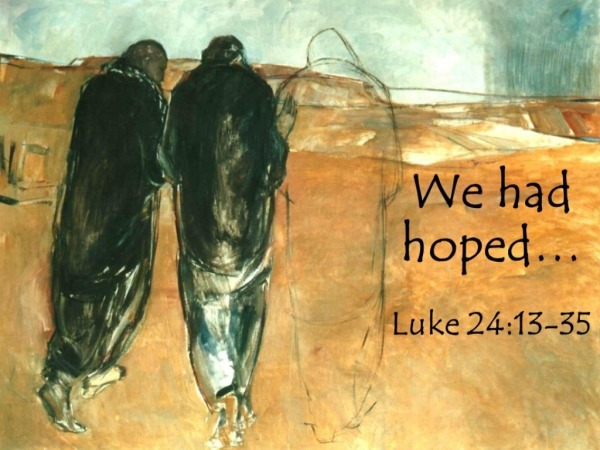
      We Had Hoped…

      Luke 24:13-35

      Our text for today is often referred to as “The Road to Emmaus”. It takes place on the afternoon of that first Easter Sunday.

      Earlier in the day, at daybreak, the women had taken spices to the grave of Jesus, and found his body missing. Two men in gleaming white clothes spoke to them, “Why are you looking for Jesus here? He has risen, just like he told you he would.” When the women return to where the 11 disciples and other followers are, and report what they saw….no one really believed them. It seemed like nonsense to them. Peter actually runs to the tomb and checks it out for himself….and he finds it exactly as the women said, but doesn’t know what to make of it.

      From there, we come to today’s text. That very afternoon two disciples are traveling from Jerusalem to Emmaus. We are told it’s a distance of 7 miles, so we know it would take 2-3 hours if walking. Cleopas is one of them, the other unnamed. They walk along discussing everything that’s happened, including the report from the women that very morning.

      As they’re walking, Jesus joins them. But it says that “they were kept from recognizing him.” Jesus asks them “What are you discussing?” They are shocked. “Are you the only one in all of Jerusalem that doesn’t know what’s happened?” Jesus plays along…”what things?”

      “About Jesus of Nazareth” they say. “He was a great prophet in word and deed. But our leaders condemned him to death and had him crucified. We had hoped that he was the one that was going to save Israel. And not only that…..three days have gone by, and this morning some of our women went to the tomb where Jesus was buried and found his body missing. They told us about seeing a vision of angels – who told them that Jesus was not there and was alive!”

      Jesus then begins to teach them, starting with Moses and going through the prophets – concerning all of the writings about himself.

      When they approached Emmaus, Jesus appeared to be traveling on but they convinced him to stay the night with them since it was getting late. And then, while at the table, Jesus takes bread, gives thanks, breaks it, and offers it to them. They suddenly recognize that it’s Jesus…..and he disappears from view.

      They are so excited and amazed that they immediately rush back to Jerusalem that very night in order to report everything to the other disciples…. only to find out that Jesus has also appeared to Peter!

      I love this story. But what should we take away from it?

      • There are two phrases that become “bookends” – keys to this story. The first is “We had hoped…..” (v.21) This phrase represents for me a complete loss of hope. A complete death of the vision. Unless we understand the depth of disappointment, the complete dejection of these disciples…. we cannot truly understand how incredible the resurrection of their hope was. Think of an experience in your life that could be described with that phrase:
        • We had hoped that God would answer our prayer….. but He didn’t.
        • We had hoped that God would bring our son home safely…. but he died in battle.
        • We had hoped that God would heal our daughter…but she died.
        • Fill in your own.  Imagine again what it feels like to have your hope die.
      • The second phrase is this:  “Were not our hearts burning within us?” While Jesus is walking with them and talking to them….they feel something. They couldn’t put a finger on it until later…..but when they look back they agree….. “we felt a burning in our heart” “we felt a new hope starting to flicker….” If the first phrase represents death, this second phrase represents resurrection.
        • Have you ever had this kind of experience? It’s maybe a bit harder to describe, but I can think back on a few incidents in my life where I sensed a deep hope, a new inspiration…..that wasn’t connected to my circumstances. It was like a hope that was from outside myself. A resurrection of hope in a difficult situation.

      We are often quick to move from Palm Sunday to Easter Sunday, forgetting the agony, pain, and yes….complete loss of hope and death…..that the cross represents. Without a true sense of that death and loss, our understanding of resurrection remains artificial, and flimsy as well. He is Risen! And he offers us new life and new hope!

      Two final (and important) thoughts from this story:

      • Jesus is always walking with us, whether we recognize him or not, whether we’re aware of his presence….. or not. Do we really believe that?!
      • It’s in fellowship with the living Christ, with Jesus, that we will recognize his presence, that we will sense that he is truly alive! In the breaking of bread, the disciples suddenly recognize Jesus. Revelation 3:20 says “Look, I stand at the door and knock….if anyone hears my voice and opens the door, I will come in, and eat with that person, and they with me.” Yes, it’s true. Jesus desires an intimate relationship with each of us. Only when we open the door of our heart, invite him to come in, and share fellowship and friendship with the living Christ….will we truly believe that He is risen!

      (the above is a summary of the message shared during our Easter Worship on March 31, 2024.)

      Palm Sunday

      John 12:12-16

      12The next day the great crowd that had come to the festival heard that Jesus was coming to Jerusalem. 13So they took branches of palm trees and went out to meet him, shouting, “Hosanna! Blessed is the one who comes in the name of the Lord—the King of Israel!” 14Jesus found a young donkey and sat on it; as it is written: 15 “Do not be afraid, daughter of Zion. Look, your king is coming, sitting on a donkey’s colt!” 16His disciples did not understand these things at first; but when Jesus was glorified, then they remembered that these things had been written of him and had been done to him. 

      Today is Palm Sunday, which commemorates Jesus’ entry into Jerusalem on a young donkey, where He was greeted with excitement as the coming king. It is also the beginning of the Holy Week and will culminate next Sunday when we celebrate the resurrection of Jesus Christ.

      The crowd’s shout mirrors Zechariah 9:9 and points to the future messiah and king who will come riding not on a war steed, but a young donkey. This should have given a hint as to the peaceful nature of the coming king. Not a warrior king that is coming to defeat the Romans, but a king of peace, who will reconcile humanity to God.

      The Romans conquered Judea in 64 BCE, which means the Jews had been under Roman rule for close to a hundred years by the time Jesus entered Jerusalem on that Palm Sunday. The people were hoping/believing in a messiah that would defeat the Romans and kick them out of Judea. They still believed that would happen on that Sunday, so Jesus was welcomed in as a conquering king. But as events moved forward and it was clear that Jesus was not going to lead a rebellion and defeat the Romans, most of the population regard Him as an imposter who had raised false hopes and is ready to see Him crucified.

      Let us look at some of the events and teachings of Christ leading up to His resurrection in the Gospel of John.

      After the entry, Jesus talks about His impending death. He also teaches that whoever serves Him must follow Him and that whoever serves Him, the Father will honor.

      The crowd questioned Jesus about what He said about dying. They believed that the Messiah would rule forever, so how could Jesus be the Messiah, if He is going to die? Jesus explained that He has come not to judge the world but to save the world. No one was going to understand this until after the resurrection.

      At the last supper Jesus leaves an example to His disciples by washing their feet – They too are to humble themselves and serve others.

      Jesus then foretells of His betrayal by one of the Twelve, and then gives them a new commandment to love one another. And this love for each other should be so obvious that everyone would know that they are followers of Christ through this love.

      Jesus then foretells Peter’s denial – That Peter would deny that he knows Jesus three times before the cock crows the next morning.

      Jesus then promises that after He departs this world, the Holy Spirit will be given to them, who will abide with each believer. Even though they will weep and mourn at His death, their pain will turn to joy. He also prays for peace for the disciples, since He knows that their lives are going to be turned upside down.

      Then Jesus goes to a garden to pray and to prepare Himself for what was to come.  There, He is betrayed by Judas and is arrested. As foretold, Peter denies Jesus. Then Jesus is put on trial. Pilate finds Jesus not guilty, but the Jews insist that He be executed. Pilate tries to save Jesus by having the crowd choose to free either Jesus or Barabbas, but the crowd chooses Barabbas to be freed.

      Pilate has Jesus flogged and tortured, hoping that this would appease the crowd. But the crowd is not appeased and threaten Pilate that he would be considered a traitor against the emperor, since they insist that Jesus claimed to be a king, and a king would be against the emperor. Pilate feels trapped and sentences Jesus to death.

      On the day of Preparation for the Passover Jesus is crucified. He dies as the Passover lambs are being sacrificed. Truly the “Lamb of God who takes away the sin of the world,” as John the Baptist declared in the first chapter of John’s gospel.

      Resurrection day, or more commonly referred to as Easter, is the most celebration-worthy day in the Christian church calendar. Christmas has become the greater celebration world-wide, due to its popularity even amongst non-Christians. But Christ’s resurrection is the more meaningful event. If Jesus had not gone through with the crucifixion, or if He had not rose from the dead, He wouldn’t be remembered today, nor would we be celebrating His birth. As 1 Corinthians 15:17 says, “If Christ has not been raised, your faith is futile, and you are still in your sins.”

      Historically, Christmas was included in the church calendar two to three hundred years later than Easter.

      Next Sunday is Easter, and a day of great celebration. Palm Sunday, in contrast is to contemplate on what Christ went through so that our sins can be forgiven. Yes, there was a crowd celebrating and cheering for Jesus when he entered Jerusalem, but that was based on a mistaken assumption. They were not really celebrating Jesus, but the great Messiah that they were hoping who would drive the Romans from the land.

      So, what should we be doing to prepare our hearts for next Sunday’s celebration?

      We should realize that being God, Jesus had the power and the free will to not go through with the cross. Or He could have numbed Himself to the pain of being flogged, having nails driven into his wrist and ankles, and the excruciating pain of being crucified. He also had the power to just come down from the cross. But He did none of these things. For the punishment that humanity deserved for their sins, Jesus had to endure the pain and die. So, even though Jesus understood the pain and sufferings that awaited Him, He freely chose to go through with it until death.

      We should also remember why Jesus had to die on the cross. It was for our sins. We may not consider our sins as being too bad, but it was bad enough that a sacrifice of an animal would not do – The Son of God had to die for our sins to be forgiven.

      Because of what He went through on our behalf, all we must do is to confess our sinfulness and accept Jesus Christ as our Lord and Savior. If we do that, then our sins are forgiven, we become sons and daughters of God, and are assured eternal life with our Lord.

      We should also remember what Jesus taught during the Holy Week. For us to humble ourselves and to love one another in a way that stands as a witness to the world of God’s love. We should be grateful of the gift of the Holy Spirit, who will guide and teach our lives, as well as give us the love and strength sufficient to love God and love others.

      We should also realize that we too deny Christ through what we say, what we think and what we do or do not do. When we are reminded that we have denied Christ, we should ask for forgiveness and then go on serving Him.

      Romans 14:9 reminds us that, “For to this end Christ died and lived again, so that he might be Lord of both the dead and the living.” So, we should also contemplate how best to serve our Lord, who was willing to suffer and die for us.

      Let us do these things to prepare ourselves for the great celebration next Sunday.

      (the above is a summary of the message shared by Shun Takano during our worship on Palm Sunday, March 24th)