
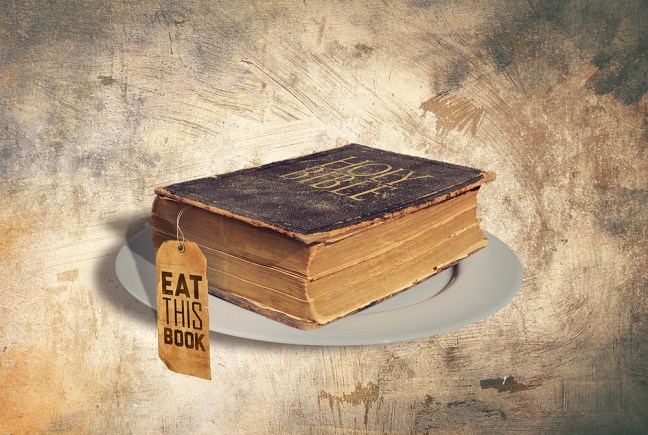
Ezekiel 3:1-3
1 And he said to me, “Son of man, eat what is before you, eat this scroll; then go and speak to the house of Israel.” 2 So I opened my mouth, and he gave me the scroll to eat. 3 Then he said to me, “Son of man, eat this scroll I am giving you and fill your stomach with it.” So I ate it, and it tasted as sweet as honey in my mouth.
Jeremiah 15:16
16 When your words came, I ate them; they were my joy and my heart’s delight, for I bear your name, O LORD God Almighty.
Revelation 10:9a
9 So I went to the angel and asked him to give me the little scroll. He said to me, “Take it and eat it.
Scripture is filled with references to food, banquets, and meals that were shared. Jesus himself spends much of his time in ministry eating with others and enjoying conversation around shared meals. In today’s texts we have the unusual metaphor of “scripture AS food” – an image of “ingesting God’s Word” as one would physically partake of food.
Eat this book…
This strange and surprising command appears several times in Scripture: “Eat this book.” When the prophet Ezekiel was called by God, the Lord gave him a scroll and said: “Son of man, eat what you find here; eat this scroll, and go, speak to the house of Israel.” Ezekiel opened his mouth, and God gave him the scroll to eat. Then he said: “So I ate it, and it was in my mouth as sweet as honey.”
God’s Word is not merely something to read or study. It is not simply information for our minds. God’s Word is something we are invited to receive deeply—to take it into our lives, allowing it to become part of who we are.
The prophet Jeremiah expressed the same truth: “When your words came, I ate them; they were my joy and my heart’s delight.”
Jeremiah did not simply say, “I read your words,” or, “I have considered your words…” He said, “I ate them.” God’s Word became nourishment for his soul.
Many years later, the apostle John received a similar command from an angel in his vision: “Take it and eat it.”
Again, the message is clear: God’s Word must move from the outside to the inside. It must become part of us.
Jesus understood that human beings need more than physical food. When Satan tempted Him in the wilderness, Jesus answered: “Man shall not live by bread alone, but by every word that comes from the mouth of God.” (Matthew 4:4)
Jesus was not saying that physical bread is unnecessary. He fed the hungry and cared for people’s physical needs. But He reminded us that we have a deeper hunger—a hunger in our souls. That is why Jesus declared: “I am the Bread of Life. Whoever comes to me will never go hungry.” (John 6:35)
Jesus does not merely give us bread. Jesus Himself is our bread. He is the nourishment our souls need. Think about a meal prepared before us. We can admire it. We can study the recipe. We can talk about how wonderful it looks. But unless we eat it, it cannot give us strength. The same is true of God’s Word. We can own many Bibles. We can listen to sermons. We can study Scripture. But God’s Word changes us when we receive it deeply and allow it to enter our lives.
Today, may we hear God’s invitation to “eat” more fully of His word. There are MANY ways that we can be nourished through the Book, through the Word of God:
Hearing, studying, meditating, singing, and memorizing….could all be ways that we are “nourished” by God’s word.
Today we sang God’s word when we sang the words of Matthew 4: “Man does not live by bread alone….but by every word that proceeds from God’s mouth.” We read God’s word as we looked at these three passages together. We studied and meditated on these same words. And we considered the fact that Christ Himself…told us “I Am the Bread of Life.” So we’re reminded that along with the book, the physical Bible, the visual Word of God, we also have a relationship with the Logos, the WORD – which was from the beginning.
“Take and eat.”
Receive His Word. Receive His promise. Receive Christ, the Bread of Life.
(the above is a summary of the message shared during our worship on July 12, 2026.)

