
Psalm 146
1 Praise the LORD. [1] Praise the LORD, O my soul. 2 I will praise the LORD all my life; I will sing praise to my God as long as I live. 3 Do not put your trust in princes, in mortal men, who cannot save. 4 When their spirit departs, they return to the ground; on that very day their plans come to nothing. 5 Blessed is he whose help is the God of Jacob, whose hope is in the LORD his God, 6 the Maker of heaven and earth, the sea, and everything in them– the LORD, who remains faithful forever. 7 He upholds the cause of the oppressed and gives food to the hungry. The LORD sets prisoners free, 8 the LORD gives sight to the blind, the LORD lifts up those who are bowed down, the LORD loves the righteous. 9 The LORD watches over the alien and sustains the fatherless and the widow, but he frustrates the ways of the wicked. 10 The LORD reigns forever, your God, O Zion, for all generations. Praise the LORD.
As we watch the news and read our newspapers, we are reminded of the various issues that our society and world face. Some are large, like the wars that rage in many parts of our world. Some are smaller in scale, like our Seattle Police Department and various changes that are happening there recently. And of course, many, many more.
As citizens, we hold opinions, and we wonder how we should relate to these problems. We listen to the voices of various leaders. Some we agree with, some we don’t. But in all of this, we seek for leaders who can inspire us, provide direction, maybe even lead us out of some of these problems. Even when we become a bit jaded, or cynical, we still recognize the value of good leadership in government.
In the Bible we also see Israel seeking and praying for good leaders to help them out of troubling times. In the book of Psalms, particularly, we see many instances where “good and just leaders” are prayed for. Of course, this was before democracy as we know it, so the prayers in Psalms were usually for a “good, wise, and just king” to lead them. Many of these are referred to as the “royal psalms”. (Psalm 2, 18, 20, 21, 72, 144, are some examples) In Psalm 72 we have this example of the king (King Solomon) being described in the following way:
May he judge your people with righteousness,
and your poor with justice. (Psalm 72: 2)
For the king delivers the needy when they call,
the poor and those who have no helper.
He has pity on the weak and the needy,
and saves the lives of the needy.
From oppression and violence he redeems their life. (Psalm 72:12–14a)
At the end of Psalms, we have another group of poems that have often been called the “Hallelujah Psalms”. These refer to Psalm 146-150, the last 5 psalms in the book. They get their name from the fact that every one of these psalms begins and ends with the phrase “Hallelujah” in Hebrew, or “Praise the Lord.”
However, in the final “Hallelujah Psalms”, Ps. 146-150, the emphasis changes from an earthly king, to God himself, who saves and lifts up the oppressed. All of the things that a good earthly king was supposed to be involved in, are now things that God Himself does for his people. In our text for today, those acts of God are listed in verses 7-9:
- God executes justice for the oppressed.
- God gives food to the hungry.
- God sets the prisoners free.
- God opens the eyes of the blind.
- God lifts up those who are bowed down.
- God loves the righteous.
- God watches over the aliens
- God upholds the orphans and the widows.
- But God brings the way of the wicked to ruin.
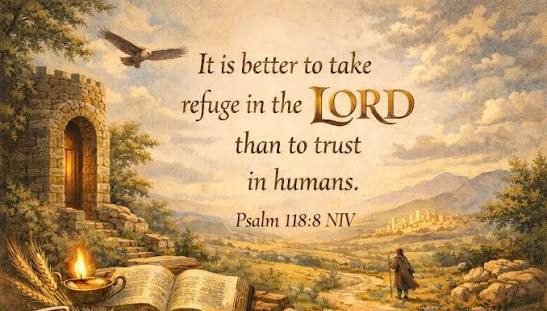
The justice that used to be the King’s responsibilities (in the earlier royal psalms) now becomes solely the work of God Himself. And not only that, but in today’s text we have the unusual warning in verse 3 – “don’t put your trust in princes” …. Or, to put it another way, “don’t pin your hopes on human leaders – they are unable to save, and unable to provide salvation and real help for you. Only God can do that.”
If only God can really help us, should we then avoid any participation in politics and government? If only God can really save us, should we quit voting and other political involvement completely? No, that can’t be right! So how can we find a proper balance between “trusting only God, not human leaders”…..and “being involved in society and government?” How do we do that?
I believe that Psalm 146 gives us some clear hints as to how that might be possible. If we sing and pray this Psalm over and over again, what effect would it have on us?
- Of course, we would constantly be reminded, by verse 3-4, that we are NOT to place our hope in humans or human institutions. Though they may do much good at times, our hope is not in them. Any allegiance to partisanship, political party, or even dynamic leaders will need to take a back seat to our total trust in God.
- As we sing, pray, and meditate on this psalm, we become very aware of the people for whom God is constantly working – those who are suffering: those who are oppressed, poor, hungry, immigrants and aliens, orphans and widows, those who are marginalized. In the same way that our prayer for a specific situation often leads us to be involved in the solution of that situation, our praise and worship of a God who is constantly helping those who suffer…..leads us to also get involved with those who are suffering and have needs. We find in singing our praise of a loving and just God….that our own hearts become more and more involved in that work of love and justice.
We can find a balance: a “NO” to totally trusting human leaders and institutions… but, nevertheless, a “YES” to action on behalf of our neighbor and community.
God, you execute justice for the oppressed. God, you give food to the hungry. God, you set the prisoners free. God, you open the eyes of the blind. God, you lift up those who are bowed down. God, you love the righteous. God, you watch over the aliens. God, you uphold the orphans and the widows. If You are doing all of this God, then I want to be part of it too! Show me how.
This is another way of balancing “Love God, Love Neighbor”
- We love God by trusting Him only.
- We love neighbor, by caring for our neighbor, community, nation, and world. We act on their behalf – it may be through organized political groups, or it may be more individual – but we are moved to love our neighbor as ourself.
So, what’s the biggest take-away of Psalm 146?
When we praise and worship God, we are most changed. As we praise, God is shaping us. As we worship, God is shaping our actions, even our politics.
- We recognize the folly of depending on humans and political parties
- But… as we praise God and sing his praise, we recognize His work that is listed in verses 7-9. We sense that as God’s people, we are also to be involved in God’s salvation and work with the poor, oppressed, blind, imprisoned, immigrants and aliens, widows and orphans, etc.
Let us praise and worship the Lord! Hallelujah!
(the above is a summary of the message shared during worship on August 2, 2026.)

