Resurrection

Acts 24:10-21

I have a hope in God—a hope that they themselves also
accept—that there will be a resurrection of both the righteous and the unrighteous.

Paul’s accusers, along with Paul, were called in front of Felix, the governor. Tertullus, the attorney for the high priest and the elders spoke about how Paul was a leader of the Christians and that not only was he agitating the people, but that he was profaning the temple.

Paul was then given a chance to defend himself.  He denied the charges and told Felix that his accusers cannot prove any of their charges. He stated that all he was doing was worshipping and that he was not disputing with anyone nor stirring up the crowd.  Basically, according to Paul, it came down to the fact that Paul believed in the resurrection of the dead, while some of the accusers did not, and that was the reason he was put on trial.

So let us look a little closer about the resurrection of the dead.  When we hear the word, we tend to first think about how Jesus Christ was resurrected from the dead.  This was not simple coming back from the dead, only to die again later, like Lazarus, or any of the people who we hear about coming back to life after their heart stops.  Jesus’ resurrection was permanent – He came back to life bodily and will not die again.

We also think about the resurrection of the believers. The Bible promises to us that if we accept Jesus as our Lord and Savior, we also will be bodily resurrected and live eternally with God and our fellow believers.

What about those who die without accepting Jesus as Lord and Savior – Do they simply become extinguished?  They are resurrected also – Paul states in v. 15, “. . . there will be a resurrection of both the righteous and the unrighteous”.

This means the everyone will be resurrected. The difference is that the believers will live with God once they are resurrected, while the nonbelievers will live without God.  The Bible speaks of this place without God as dark and agonizing, where the fires do not cease and there will be gnashing of teeth – Definitely not a pleasant place.  Eternity without God is not something you would wish for, for yourselves, your loved ones – probably not even your enemies.

The last part of the book of Revelations, chapter 20, depicts the scene where the dead are judged. Everyone is going to be judged according to their works. Presumably, everyone is going to be judged as failing to meet God’s standards. It sounds like each person will know that they have failed to be judged as worthy and should be thrown into the lake of fire. But then the book of life is mentioned – anyone whose name is found in that book will not be thrown into the lake of fire.

So, how does anyone get their name into the book of life?  It is simply a matter of faith – Faith in Jesus Christ. Anyone who accepts Jesus as their Lord and Savior will have their names written into the book of life.

I am aware that many loved ones and friends, as far as I know, have passed away without coming to a saving faith in Jesus Christ.  But I know that most of them did get an opportunity to hear about the Lord. So, my hope is that sometime before they died, even if it were in the last seconds of their lives, they had a change in heart. This hope is based on the fact that the Lord does not wish for anyone to perish, and that every chance would have been given. The Bible tells us that the return of Jesus is being delayed so that more people are given the chance to come to faith in Him.

We know that there is nothing we can do for those who have already passed away. However, we should take seriously the task of telling the living about Jesus Christ – How He is the Son of God and the Savior of the world.

For whatever reasons, it seems that society has lost its manners. Behaviors that would have been considered rude and unacceptable a few years ago have become common place. It has become much more unpleasant. From experience, once these lines are crossed, societies don’t revert back so easily. We can expect that it will steadily get more crass, ill-mannered and violent.

Physically, this world has some truly beautiful places, and yet, we know that it is also in a fallen state. The Bible tells us that in the end, a new earth will take its place. Whether this means that this earth will be renewed and restored to the original state, or a brand new one will replace this one, it is going to be a far lovelier place.

As unpleasant as this world can be, for those whose name is written in the book of life, they can be comforted to know that this is the closest to hell that they are going to get.  But for those whose name is not on the book of life, this world is going to be the closest they are going to get to heaven.

Like Paul, we believe in the resurrection of the dead. We also have been told that after resurrection, only those with their names written in the book of life are going to avoid the lake of fire and be able to spend eternity with God and other believers in a new earth.

So, like Paul, let us commit to telling as many people as we can, as many times as we can, about the saving grace God is offering us through His Son, Jesus Christ.  It is not always easy, but the Holy Spirit will provide us with the words, love and power as needed.

(the above is a summary of the message shared by Shun Takano during our worship on Sunday, October 16, 2022.)


No One Can Serve Two Masters

Luke 16:1-13

Last week in the news we heard of various labor problems between workers and unions representing them: teachers in Seattle and Kent, nurses in Minnesota, the large railroad companies…. there was collective bargaining, tense talks…. and talk of strikes.  Even when we read the news, we all have opinions – about wages, pensions, strikes, general conditions, reasons for economic problems, etc. If we’re really honest, we know that these are NOT simple matters. The economy…. and money issues…. are complicated!

It was true in the time of Jesus as well. A huge gap between the rich and the poor. A Jewish prohibition against charging interest for loans, and many other issues not so different from our own.

Today’s passage may be one of the most difficult of Jesus’ parables. All through Luke we’ve struggled with our relationship to money and riches as we’ve read the texts and sought to understand the words of Jesus.

A rich man hears that his money manager is cheating him. He tells him to give a final account because he is being fired. The manager thinks to himself “I’m not strong enough to do actual labor, and I’m too embarrassed to beg, how should I avoid this disaster?” He decides to cook the books of his master’s debtors, in order that they would all be indebted to him and welcome him once he was fired.

I’ll admit that I don’t really understand this parable completely. I’m not positive exactly what Jesus meant. I can only guess.

But here are the verses that raise some problems:

Verse 8

8 “The master commended the dishonest manager because he had acted shrewdly. For the people of this world are more shrewd in dealing with their own kind than are the people of the light.”

What does shrewd mean? Why was the manager commended? Why is he praised?

We can only assume that he is not praised for further cheating his master (!), but for acting shrewdly…. “using the system”.

The commendation is directed not toward the manager’s cheating, but “because he had acted shrewdly” (v. 8) regarding what he cared most about – money, and for saving himself from a personal catastrophe. 

Perhaps we could interpret the verse more positively like this:  “If worldly people are so shrewd regarding something as insignificant as “worldly wealth”, should not believers be even more shrewd about the “true riches” of the kingdom of God? 

Or stated slightly differently: “If people of this world are smart and cunning (creative and active) …. shouldn’t believers also be willing to work hard and use every opportunity at one’s disposal to further the kingdom?”

Verse 9

9 “I tell you, use worldly wealth to gain friends for yourselves, so that when it is gone, you will be welcomed into eternal dwellings.”

This is maybe the most troubling and difficult verse. Surely, this cannot mean that we should used money gained by cheating in order to buy friends and influence people.

Instead could we interpret it more like this: – “to be willing to work within this ‘unequal, often unjust economy’ to help others, to do justice…. in order to “gain treasure in heaven”. Matthew 6:19 / Matthew 25, etc. Now granted, that’s not exactly what the text says….it is an admittedly generous interpretation. But it is at least conceivable and surely in line with other texts in Luke.

Verse 11

11 “So if you have not been trustworthy in handling worldly wealth, who will trust you with true riches?”

This may be the key to this passage. Said differently, “If you’re not able to handle insignificant things like possessions and money wisely, how are you going to make good decisions about “real” treasure…. spiritual treasures?”

Verse 13

13 “No servant can serve two masters. Either he will hate the one and love the other, or he will be devoted to the one and despise the other. You cannot serve both God and Money.”

As in other places in Luke…. what is required is an absolute devotion to Jesus and kingdom values. Just like we were told to “hate our families” we are told to “hate money”. Not that we are not involved or can’t own any….only that we cannot be enslaved to it… treat it as a master.

So where does this difficult parable leave us? What are we to learn from Jesus’ story? Here’s my attempt at a couple of answers:

Conclusions:

  1. Money is complicated – no simple answers in scripture.
    1. Should we get rid of all of it? Yes, there are literal statements to this effect, but no standard response is observable.
    2. Should we equate great wealth with great blessing and approval from God? Again, there are many biblical examples where this is stated or inferred. But there are also as many texts which would point in a totally different direction.
    3. Is tithing the right answer? Is it sufficient? Here too, scripture (especially the old testament) would affirm this. But Jesus never taught it explicitly – and most of his references to tithing in the new testament are negative in meaning. Instead, Jesus seems to emphasize not 10%, but always 100%!
    4. In short, there doesn’t appear to be “one size fits all” when it comes to money and finances.
  2. Money must serve the Kingdom… we must NEVER serve Money.  Our only Master can be God.
    1. Jesus doesn’t seem to romanticize the poor, nor does he stigmatize the rich.
    2. In verse 14ff he criticizes the Pharisees for being “lovers of money”. They justified themselves and their wealth….through appearing righteous, but God knew their hearts.  14 The Pharisees, who loved money, heard all this and were sneering at Jesus. 15 He said to them, “You are the ones who justify yourselves in the eyes of men, but God knows your hearts. What is highly valued among men is detestable in God’s sight.”

Are we lovers of money? Are we slaves to money? Or are we servants of  God, lovers of God who leverage our money and  possessions shrewdly….on behalf of the Kingdom?

(the above is a summary of the message shared during our worship time on September 18, 2022.)

The Plot to Kill Paul

Acts 23:11-22

After being told that Paul was a Roman citizen, the tribune wanted to find out what Paul was being accused of, so he called a meeting of the Jewish leaders. Paul caused a rift between the Pharisees and the Sadducees by emphasizing that this was about Paul’s hope of the resurrection of the dead.  Since the Pharisees believed in the resurrection and the Sadducees did not, this caused a dissension between the two groups. The Pharisees ended up taking the stand that they found nothing wrong in Paul, and things started to turn violent. The tribune, fearing for Paul’s safety, took Paul back down into the barracks.

That night, Jesus came to Paul and told him that the plan was for Paul to testify for Jesus in Rome. So, now Paul knew for sure that somehow, he will eventually reach Rome.

Meanwhile more than forty Jews vowed to kill Paul, and that they would not eat nor drink until that task was accomplished. Their plot was to ask that Paul be brought to the council, and they would ambush him on the way.  But the son of Paul’s sister heard about it and told the tribune, who snuck Paul out to take him to Caesarea to meet with the governor Felix.

Due to v.11, both Paul and the readers know that Paul is going to make it to Rome, regardless of how much the enemy tries to prevent it by placing roadblocks in the way.

The first roadblock comes in the shape of the conspiracy to ambush Paul on the way to the council meeting. This is thwarted by the intelligence gathered by Paul’s nephew and the actions of the Roman tribune. Sometimes help comes from unexpected places. In this chapter we see the Pharisees siding with Paul, as well as a Roman tribune.

Paul understands that he will get to Rome, but he is probably going to endure hardships along the way. The only thing that is promised to him by God is that Paul will be a witness for the Lord in Rome. There is no promise of peace, prosperity or longevity in Paul’s earthly life. Yet, Paul seems content and determined to do the Lord’s will.

From the early stages of his life as a Christian, Paul expected hardships for his life going forward. If we look back to Acts 9, where Saul’s conversion to Paul happens, we see the Lord telling Ananias about His plans for Paul – “. . . for he is an instrument whom I have chosen to bring my name before Gentiles and kings and before the people of Israel; I myself will show him how much he must suffer for the sake of my name.”  Ananias most likely informed Paul about what the Lord said about him, and Paul, being a devout follower of God, seemed to have accepted this as his role in life, as long as he was alive in this world.

Along with Paul’s sense of duty to do the will of the Lord, he also was convinced that this life is not all there is. There is an eternity that can be spent with the Lord and other believers, where there will no longer be suffering or having to deal with sins of yourself or others. This becomes apparent in his letters to the various churches.

Does this mean that Paul lived in misery? It does not seem to be the case. We see deep relationships he established with other believers who valued his fellowship and grieved when he parted. Paul didn’t pursue joy, but he found joy in doing the will of the Lord.  He did not pursue fame or fortune, so his contentment did not depend on those things.

We share with Paul the knowledge that if we have Jesus Christ as our Lord and Savior, we are assured of eternity with God and brothers and sisters in Christ. Regardless of what happens to us in this life, there will be eternal life that will be far better than this one.

Unlike Paul, we don’t have an inkling of where our final destination on earth will be – Our Rome. However, we do know that wherever our final earthly destination might be, all along our journey, we are to be witnesses for our Lord Jesus Christ.

J. R. R. Tolkien was a contemporary of C. S. Lewis.  They were both professors at Oxford and members of the Inklings, which met on Tuesdays to discuss and critique the literary works of fiction they were working on. Works such as “The Chronicles of Narnia” and “The Lord of the Rings” would go through this honing process.

I first read “The Lord of the Rings” while I was in college, and it is still one of my favorite series of books – Probably have read it more than seven times.  I was glad when Peter Jackson finally made a cinema version that captured the essence of the work. I always saw the journey of Frodo, the hobbit, as representing what our walk in faith should be. Frodo was not the strongest or the wisest, but he understood that a task that he did not want, nor was qualified for, fell into his lap and that it was his duty to try to carry it out. He was pretty sure that he would fail, but he understood that other people’s lives and peace were at stake. He sets off with a group, but things happen, and they get separated. People he thought he was going to depend on either betray him or part ways. He also gets unexpected help from others along the way.

We are probably more like Frodo than we are like Paul.  However, we and Paul share the same Lord and the same conviction that we are here to do the Lord’s will – To be witnesses of Jesus Christ, wherever and whenever we are.  Sometimes we receive help from unexpected places, and at other times, we are to be the unexpected help to others.

Let us be like Paul and not worry about the plots that might be against us, but be confident that the Lord knows what He is doing as He sends us along on our journey – A journey that is assured to end in the presence of the Lord.

(the above is a summary of the message shared by Shun Takano during our worship on Sept. 11, 2022)

To Hate One’s Family and Life…

“If anyone comes to me and does not hate his father and mother, his wife and children, his brothers and sisters–yes, even his own life–he cannot be my disciple.” Luke 14:26

In our text for today (Luke 14:25-33) Jesus is traveling with a large crowd. Why are these crowds following Jesus? We get used to the stories, but it’s important to remember that what Jesus is doing in his ministry is absolutely astounding and surprising. Casting out demons, healing the sick, speaking with authority and even demonstrating power over nature – calming the winds and the waves with a word. People are flocking after this new teacher.

But suddenly, almost as if to warn the crowds – or to challenge the crowds – he begins talking about the cost of being a true disciple. Sure it’s fun to follow the crowd when there’s a show, when there are miracles, when healings are happening! But Jesus is on his way to Jerusalem – to die on a cross. So he lays it out clearly – there’s a real cost to following Jesus!

He states three things that are required:

  • You must hate your family and your own life. (father, mother, brother, sister) 
  • You must take up your cross
  • You must get rid of all of your possessions  

Let’s look at each of these as they seem pretty severe.

Hate your own family  

Throughout the old and new testaments there are passages where “hate” and “love” are used as a comparison or a method of teaching. An earlier passage in Luke where Jesus says that “no one can serve two masters. Either he will hate the one and love the other, or love the one and hate the other” shows how these words were used hyperbolically to make a point.

No one hearing Jesus that day would actually have thought that he was requiring them to emotionally hate their families. The clear commands in the Torah to honor your father and mother, and to love your neighbor as yourself (surely this would include family members!) would seem to rule out a literal meaning of Jesus’ words.

A look at the parallel passage in Matthew 10:37, where Jesus teaches about the conditions for discipleship, may also be of help here. “If anyone loves their family more than me, they are not worthy of me.” It’s clear that Jesus is stating things strongly in order to make a comparison between commitments and allegiances. To be a disciple of Jesus will mean that an allegiance to him will be absolute, will need to supersede any ties to family – no matter how important those may be.

Take up your cross 

Most biblical scholars are not even certain how the crowds hearing Jesus’ statement to “take up one’s cross and follow me” would have understood that phrase. For those of us reading it today, we immediately associate the phrase with the cross of Calvary, the cross upon which Jesus died. It has even entered our common lectionary – “to bear one’s cross” – as a common way to indicate the acceptance of one’s burdens and trials. The crowd that day was of course pre-Calvary and therefore we’re not certain how they would have understood it.

An earlier passage in Luke 9:23-25 also uses the phrase. Then he said to them all: “If anyone would come after me, he must deny himself and take up his cross daily and follow me.”

Along with the added word DAILY, this passage indicates a regular and steady acceptance, not only of one’s own burdens and trials, but the willingness to take on the burdens and struggles of others in some form. Remember that even Simon of Cyrene carried the cross upon which Jesus would be crucified.

Being a disciple sounds like hard work! Because of that, Jesus gives us two practical examples:

Building a tower:

If anyone is planning on building a tower (or any other structure) it’s important to first consider the supplies and resources that one has. Do I have enough time, labor, lumber, and sufficient budget to cover all the expenses? Will I be able to complete the project? Who wouldn’t sit down and take time to consider these issues?

Going to War:

And if a king or nation plans to wage war against another king or nation it would be important to first consider the size and strength of one’s own army compared to that of one’s foe. How many soldiers, horses, spears (tanks, guns, ammunition) will it require in order to defeat the enemy? Maybe we should come to some peaceful agreement instead? Who wouldn’t sit down and take time to consider these issues?

In the same way, it’s important to truly understood the sacrifices required in order to become a faithful disciple.

Get rid of all your possessions

“In the same way, any of you who does not give up everything he has cannot be my disciple.

Seriously? All of them? What is Jesus saying here?

Most people in Jesus’ day did NOT give up all their possessions. When the early church was living communally (Acts 2), people were not giving up everything. Selling one’s property and sharing it with the community did not appear to be a requirement but was done voluntarily. (Ananias & Sapphira)

This, too, is an extreme way of saying that our thoughts about possessions must change! The idea that we are owners of anything needs to be called into question. We are stewards of God’s blessing, not owners!

A recent story I read in preparing this message may help us understand (taken from Debi Thomas, writing for Journey with Jesus):

A group of people are taking a voyage on a large cruise ship with many levels and cabins. A passenger on the lowest level decides to dig a hole in the floor of his cabin. As the water begins to rush in, people come running and demand “What are you doing??! He answers: “This is my cabin. I paid for it.” In the end the ship sinks.

This is admittedly a silly and oversimplified story. But it speaks to Jesus’ command for us to get rid of our possessions.

When we answer Jesus’ call, when we become his disciple, we are now on a large ship, the kingdom of God ship. “My cabin” no longer exists. I’m connected to everyone else and what I do with my cabin is connected to everyone else’s well-being. Jesus’ call on my life is absolute and that includes the things that I call “my own”, whether it be time, talent, or stuff.

So, what are we to make of these three severe requirements for discipleship? Our faith, walking with God, WILL involve sacrifice and sometimes difficulties. Jesus asks us to subordinate, to renounce anything that we own, value, love, or depend on…. MORE than God.

Can we own possessions without being possessive? With open hands….. as stewards?

Can we have a single-minded allegiance to Jesus…without being small-minded and exclusive toward others that are different than us?

Can we daily consider not only our own trials and struggles, but those of others?

Can I see how committing myself to Jesus, will mean committing myself to ALL others?

Jesus’ words earlier in Luke 9:24 may be a good summary:

“For whoever wants to save his life will lose it, but whoever loses his life for me will save it.”

(the above is a summary of the message shared during our worship on September 4, 2022.)

Paul’s Testimony

Acts 22:1-21

In Acts 21, while Paul and his companions were in Philip’s house in Caesarea, a prophet named Agabus came down from Judea and told them that when Paul gets to Jerusalem, the Jews would bind Paul and turn him over to the Gentiles. Paul goes to Jerusalem, the Jews attack Paul and Roman soldiers had to keep the mob from killing him. Paul asks permission from the Romans to speak to the mob, and Paul gives his testimony to the Jewish mob.

The reason why the crowd was so riled up was because they were told that Paul was teaching others to break away from Jewish traditions and even defiled the temple by bringing Gentiles into it. Paul starts out by establishing his credentials as a Jew:  He considers himself a Jew and he was well trained in the Law by one of the great teachers of the law, Gamaliel, and that he was a staunch defender of their religion and persecuted the Christians, believing that Jesus was a false messiah and that His followers were defiling God and the Jewish religion.

Having established his Jewishness, Paul goes on to describe his conversion:  How on the road to Damascus he was hit by a blinding light. How the risen Jesus spoke to Paul and told him to go to Damascus where he will be told what he is to do.  When he got to Damascus, how Ananias told him that Jesus had called him to do missionary work among the Gentiles.

Although Luke didn’t write this passage to give us a model for how to give our testimony, we could learn from it.  Before going into how he became a Christian, Paul established identity or commonality with the audience. Once this common ground is established, he then proceeds to the conversion account.

So, how successful was this approach for Paul in this instance? In verse 22, we are told that the crowd decided to kill Paul. This is a good reminder to us that just because we are doing what the Lord led us to do, that our desired outcome is not guaranteed. As the Lord’s servant, all we can do is what we are led to do, and not worry about the outcome – That is up to the Lord.  Is it possible that some in the crowd came to know the Lord through this, but much later? We just don’t know, but like in the parable of the sower, the important thing is to sow the seeds.  The seeds may not grow into fruitful trees, but there is no chance of that, if the seeds are not sown.

When we look at Paul’s account of his conversion, we see that it was not just about Paul coming to believe that Jesus was the Messiah. He saw and heard things that he could not on his own and he was given a calling – a vocation. Now that he was accepting Jesus as Messiah, he also now knew that his calling  was to testify about Christ to the Gentiles.

This is what Paul writes in Ephesians 2:10: “For we are what he has made us, created in Christ Jesus for good works, which God prepared beforehand to be our way of life.” 

We might think or hope that the reason we came to believe in Christ was so God could shower us with His love and goodness so that we can live a happy life on earth as well as in eternity. If we just focused on that, we may forget that we were called to do His works on earth. Further, doing His works may include misunderstandings, oppositions, hardships, and even death.

When God created Adam and placed him in the garden of Eden, the first thing he gave him was a vocation, a calling – to take care of the garden.  When Paul was shown the light, he was given a calling. What is our calling?  According to Acts, the Holy Spirit was given to us so that we can be witnesses to people near and far that Jesus is the Son of God and the savior of the world.

Each of us are given different roles to play.  We can trust that the Holy Spirit will guide and direct us to the who, what, when and where.

One thing that caught my attention about Paul’s testimony is that he specifically brings up Stephen. Acts 8:1 tells us that a young man named Saul was there when Stephen was stoned to death and that he approved of their killing him. This Saul was the pre-conversion Paul, and he was helping by keeping the coats of the men who were murdering Stephen, so that they could throw the stoned harder and better.

The stoning of Stephen occurred about 30 years prior to Paul’s testimony in this passage. Thirty years ago from today (2022) would be 1992. What do we remember from 1992?  Some events from 1992:  Riots in LA due to the acquittal of those who killed Rodney King; Johnny Carson hosts his last Tonight Show; Hurricane Iniki devastates Kauai; Toronto Blue Jays become the first non-U.S. team to win the World Series; the first smartphone, the IBM Simon, is introduced; Yugoslavia and Czechoslovakia dissolved.  When pointed out, we remember these things, but would not have otherwise remembered them.

We tend to remember major events in our lives. We also remember things we regret doing, and the killing of Stephen seems to be one of those things that Paul remembered. Otherwise, he would not have included it in his testimony.

Once Paul became a Christian and tried to live according to his calling, he probably felt a kinship to Stephen.  Stephen was performing his calling when he was killed. Not only was he willing to go through hardship and even death for his calling, but the last thing he asked His Lord to do was to forgive those who were stoning him.

Paul was not using this memory of Stephen to beat himself up or play “what if” games – It was a reminder of his great sinfulness and in contrast, the great love of God that would forgive his sins and even give him a calling for the Kingdom. This sense of appreciation fueled Paul’s dedication to his calling, even to the point where he now stands where Stephen did – giving testimony to who Jesus is, even if it meant arrest and death.

When memories or reminders of our past sins come into our minds, don’t try to wipe it out or ignore it. Use it as a reminder of God’s great capacity to love, forgive and use us, regardless of our sins. This should energize us to commit to our calling – a calling that our great and loving God gives to each one of us.

World Vision Global 6K Walk

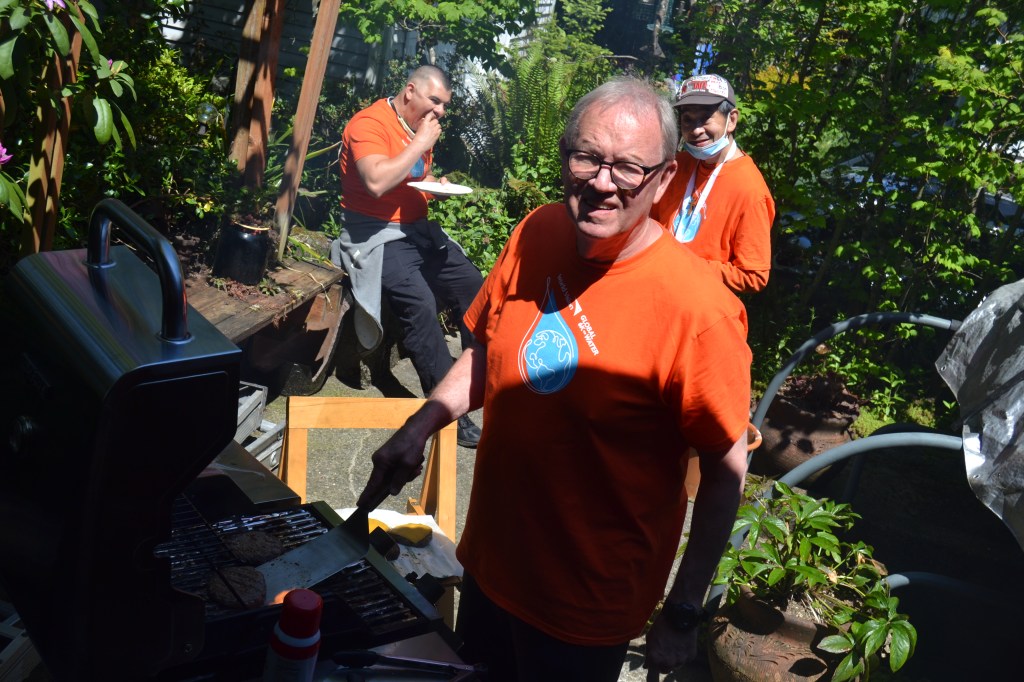
Reflecting back on this year’s participation in the World Vision Global 6k Walk on May 20, 2022…..here are some pictures taken on this beautiful day.  Our JCC Team raised a final total of $4575.00 from a team of 34 members.  20 walkers participated in the actual walk, who scooped up water from Lake Washington, to honor those individuals around the world who walk an average of 6k (3.728 miles) to find water for their families.  Let’s keep World Vision in prayer that they will be successful in using all collected funds to build much needed clean water sources for those in need.  And we thank everyone who participated, supported and donated to this cause and especially remember our beloved member and friend, Howard McCay, whose memory we honored with our participation. – Sue Hanson & Bi-Lan Chiong / team leaders ( if the photos appear small, you should be able to pinch or click on them to enlarge them for better viewing)

Mom with the twins!
Final Group Photo (with a few folks missing….)

I Am Ready

Acts 21:7-14

7When we had finished£ the voyage from Tyre, we arrived at Ptolemais; and we greeted the believers and stayed with them for one day. 8The next day we left and came to Caesarea; and we went into the house of Philip the evangelist, one of the seven, and stayed with him. 9He had four unmarried daughters who had the gift of prophecy. 10While we were staying there for several days, a prophet named Agabus came down from Judea. 11He came to us and took Paul’s belt, bound his own feet and hands with it, and said, “Thus says the Holy Spirit, ‘This is the way the Jews in Jerusalem will bind the man who owns this belt and will hand him over to the Gentiles.’” 12When we heard this, we and the people there urged him not to go up to Jerusalem. 13Then Paul answered, “What are you doing, weeping and breaking my heart? For I am ready not only to be bound but even to die in Jerusalem for the name of the Lord Jesus.” 14Since he would not be persuaded, we remained silent except to say, “The Lord’s will be done.”

Paul and his traveling companions arrive at Caesarea and stay at the house of Philip. 

We were first introduced to Philip back in Acts 6, when he was chosen as one of the seven leaders to make sure that the Greek speaking widows were not being neglected. Then in Acts 8, we learned that due to Saul’s persecution of the Christians, Philip went to Samaria to proclaim the Messiah. He was led by the Lord to the desert road to Gaza, where he encounters an Ethiopian official, witnesses to him and ends up baptizing him. He then is miraculously transported to Azotus, where he continued to proclaim the good news until he reached Caesarea.  Apparently, he settled there and now has a family.

It is interesting to realize that Philip left Jerusalem because of the persecution for which Paul was responsible, and now, Philip is hosting Paul in Caesarea.  It is just another reminder that God can work in mysterious ways. Sometimes, what appeared as a real negative turns out to be happening in accordance with God’s will and purposes.

While at Philip’s house, a prophet named Agabus arrives from Judea and informs them that the Holy Spirit had revealed to him that when Paul gets to Jerusalem, he will be bound by the Jews and turned over to the Gentiles.

Upon hearing this, Paul’s friends urge him not to go to Jerusalem. They took the message as a warning from the Holy Spirit for Paul not to go to Jerusalem. But Paul is not interpreting this as a warning to stay away from Jerusalem, but simply information of what will happen when he gets to Jerusalem.

In the past, Paul received specific guidance from the Lord to not go to certain place (Acts 16:6-8), but Agabus’ message was not such an instruction. Paul understood that he was to go to Jerusalem. It’s not too different than when Jesus met with Moses and Elijah to talk about what was going to happen to Him in Jerusalem.  It was to prepare and be clear on what was to happen – it was not a warning to stay away from Jerusalem.

Paul is saddened by the fact that his friends are so fearful about what would happen to him in Jerusalem. Paul tells them that he is ready to be bound and to even die in Jerusalem for the name of the Lord Jesus.

When Jesus was facing His tribulations, even if it was not His desire, He was willing to experience the humiliation and the pain of being arrested, flogged and crucified.  All for the Kingdom of God and the forgiveness of our sins.

Paul was willing to be arrested and die for the name of the Lord Jesus.  He understood that the part he is being asked to play for the sake of the Kingdom includes arrests and execution. Amazingly, he was able to declare to his friends, “I am ready”.

What about us?  Are we ready? Or when we hear about some crisis that could come upon us, instead of being ready to face it for the sake of the Lord, are we more ready to try to avoid it?

I’m certain that the vast majority, if not all, of us, will not be called upon to be put to death for the sake of the Kingdom. But are we ready to do God’s will when He calls?

What the Lord calls us to do is probably different for each of us and might be varied, depending on what our situation is. However, whatever it is, we should be ready and willing.  Considering that it most likely will not include arrests and executions, we should be thankful for that, and be more willing to do what is put in front of us.

Before becoming a Christian, Paul persecuted the church, since he sincerely believed that Jesus was a false messiah, and that Jesus’ followers were enemies of God. Once he encountered the risen Lord on the road to Damascus, his life turned completely around. He now knew that Jesus was the Messiah and that even though Paul was His enemy, Jesus had not only forgiven Paul, He was going to make Paul a witness for Him. Paul knew that he had sinned against God, and yet, he was allowed to live and to serve God. He became a loyal servant and was willing to do whatever the Lord called him to do, even to be arrested and executed.

So, for Paul, what the Lord would have him do was not optional, but something he felt duty bound to do, as well as desired to do. That would be consistent with considering Jesus Christ as our Lord.

According to Romans 14:9, Jesus died on the cross and was resurrected so that He could be our Lord. And when we come to accept Jesus as our Lord and Savior, we are entering that Lord-subject relationship with Jesus.

In the first letter to the Corinthians, Paul mentions different roles of church members – preaching, teaching, ability to speak languages, ability to interpret languages, healing, being helpful, leadership, etc. We are all called to do one or more of these things. I believe being helpful would include things like encouraging, consoling, providing food, shelter, hospitality, etc.

If you have been an active member of a church body, you probably have experienced fulfilling one or more of these roles, whether you volunteered on your own, or was asked to do so by someone. If we were to follow Paul’s example, the next time an opportunity arises, instead of considering it as an option, or something to be avoided, we should be ready to act.

There are many good examples of how a servant of the Lord should live their lives. We should pick one that we like and follow it. The one that speaks to me is the parable of the worker in the field that Jesus told and is recorded in Luke 17. Once we are done doing the work of the Lord, instead of expecting accolades or being treated with honor, our attitude should be, “we have done what we should have done”, and then ask what we should do next.

Paul lived his life in appreciation for the forgiveness and purpose that Jesus Christ had given to him. Whether the next task was easy or hard, Paul was always ready to do the Lord’s will, even if it meant being bound and executed.  Let us follow his example and be a loyal servant of Christ.

Captive to the Spirit

Acts 20:17-37

Paul continues his journey with the desire to reach Jerusalem by Pentecost. He bypasses Ephesus, probably due to the opposition he encountered there, and goes to Miletus. From there, he sent word to the elders of the church of Ephesus to meet him there. Knowing that nothing but persecution and imprisonment lies ahead, Paul wants to give a farewell address to the leaders of the Ephesian church.

If we recall Luke’s account of the last supper, Jesus tells His disciples that he is about to be captured and put to death. He will be resurrected, but the time that He will be with His disciples is coming to an end. So, Jesus leaves them an example of how to carry on after He leaves, by washing their feet.

Paul is doing something similar here. He is also headed to Jerusalem where he will be persecuted and imprisoned. He is certain that he will never see the Ephesian church again and will be under attack by the enemy.  Paul wants to leave them with an example of how to live. How to stay true to the message, not be pursuing money and riches, but by supporting the weak. Paul was able to use how he worked amongst them as examples to follow.

The fact that Paul was able to use himself as an example is a testament to his sincere faith and living according to Jesus’ commands.  The fact that he lived amongst them for years and they got to know him from his day-to-day living, and still, was a good example is impressive.

For most of us, we are in a Christian context for only a few hours each week. We come to church, or to Bible study, or to church meetings, where our behavior and demeanor are on display. Most of us can come across well in those kinds of settings. However, if people could constantly see us in and out of church context, would we still be good examples?

When a church hires a pastor, do we look for someone who can act well while on duty, but live carelessly when they are not on duty? No, ideally, the pastor would be someone who always upholds Christ’s commands and teachings. It is no different for the rest of us. Once we are identified as Christians, we are witnesses for Christ, whether we are at church or in a different setting.

The world will be right in supposing that if the gospel of Jesus Christ is true, then it will be embodied in the lives of the followers of Christ. So, we must ask ourselves, “Would the world see in our lives that the gospel of Jesus Christ is true?”

It seems that these days, sadly, the world doesn’t necessarily see the embodiment of the gospel of Jesus Christ among the churches or individual Christians.  What should we do about this? Should we confront other churches and Christians who we feel are not living up the Gospel? There might be time and place for that, but most likely, the world is not going to look very positively on infighting Christians.

Instead, we must start with ourselves.  We need to start living according to Jesus’ commands.  Not just on Sundays, but full time.

These are some of the things that Paul did, according to this passage:

  • Did not shrink from doing anything helpful
  • Proclaiming the message and teaching publicly and privately about repentance and faith toward Lord Jesus
  • Testify about the good news of God’s grace until the end, no matter when that may be
  • Making sure that everyone around us gets a chance to hear the gospel message

We too are commanded to do these things, as led by the Holy Spirit.

How was Paul able to do this to the point where he could point himself to be the example to follow? We see throughout the book of Acts that Paul is very sensitive to the Holy Spirit’s guidance and very obedient. In verse 22, he uses the term, “captive to the Spirit”.  Which meant that if he felt the guidance of the Holy Spirit, he was going to follow that, regardless of what his own experience or intellect would tell him to do.

The Holy Spirit comes to live in our hearts when we accept Jesus Christ as our Lord and Savior. The Spirit will help to guide us each day by various means. He will help us to interpret and understand when we are reading the Bible. He will guide us through various means, providing us with love and power sufficient to do the work we are commanded to do.

So let each of us become a captive to the Spirit and be the embodiment of the gospel of Jesus Christ in this world.

(The above is a summary of the message shared by Shun Takano during our July 3rd worship time.)

Why, My Soul, Are You Downcast?

Why are you downcast, O my soul? Why so disturbed within me? Put your hope in God, for I will yet praise him, my Savior and my God.

Psalm 42:1-11

The words of this poet, this Psalmist, pose the eternal question of balance in one’s life and faith. How do we balance hope, on one hand……  with despair, on the other? How do we balance our faith in God (which is real), with our present anxiety and worry (which is also real)? How do we find balance between a strong sense of confidence in a joyful future…. and a sinking feeling of dark foreboding?

Have you ever had this kind of fight within your own soul? Have you ever struggled with your moods?Have you ever tried to talk yourself out of a bad mood?

I love the Psalms for this very reason. I can usually relate to the emotions expressed by the Psalmist. Here, the writer is brutally honest. He doesn’t beat around the bush. She says what she means.

What is this poet experiencing?

  • People are taunting him – “Where is your God?”
  • This assumes something else has gone wrong….. it appears to them that he has experienced some kind of trial and tragedy….. and has been abandoned.
  • Internally he is depressed and anxious. In verse 5 and 11 he speaks of being downcast. In verse 3 he is pushed to constant tears. In verse 7 he feels like drowning….. “all your waves and breakers have gone over me”

When you read verse 11, the end of the Psalm, is it a happy ending? Is the issue resolved?  In some sense there is a continuing struggle. The poet knows that real joy and hope will come from God….. but he is still not quite there yet.

What does this Psalmist DO during these times of depression and lack of peace? How does he attempt to regain a sense of balance? Some have counted 5 or 6 actions taken by this Psalmist to deal with his depression. I choose 3 to offer as suggestions for ourselves this morning:

1.   He asks God “WHY?”  – He shares his feelings with God honestly

verse 9: “I say to God, my rock, why have you forgotten me?

He’s not afraid to be honest with God…. to shout out his feelings. He knows that God has NOT really forgotten him. Just in verse 8 he has said that by night and day, God’s love and presence is with him. But in this present crisis….he FEELS like God has forgotten about him and shares that. You cannot share these kinds of feelings and thoughts with strangers. It’s only with intimate friends that we can open up like this. Is our relationship with God intimate?

2.  He remembers past experiences

Verse 4: he thinks back on the powerful experiences he has had in corporate worship…. At the temple…..singing and praising God with others.

Do you believe that our worship times together on Sunday are supernatural events? That they have the power to sustain our faith…. to keep us going? To grow us closer to God? If not, then our worship is a supreme waste of time. Yes, God meets us here. The poet remembers this and it causes encouragement in the midst of his depression. No doubt there are other past experiences which he can call to mind –  to remind him that God has brought him through dark valleys many times before.

3. He preaches to himself

He states what he knows to be true, whether he feels it at the moment or not.

Verse 5 and 11:

Why, my soul, are you downcast and disturbed? Why are you anxious? Hope in God, yes, Hope in God…..for I will yet praise him, my Savior and my God!”

In this walk of faith….in this fight for faith…. it’s often good to preach to yourself. To speak truths. Have you ever done this? We’ve all had various mantras over the years. Sometimes it’s as simple as “I am truly loved by God.”

“Jesus loves me”  – you’d be surprised how few Christians really believe that! I don’t mean non-believers who don’t believe in God at all. I mean Christians…..surprisingly few truly deeply believe that God LOVES them. If we took this truth more seriously, our daily lives would be different!

During the summer after my third year of college, I answered an ad in the paper and became a “summer Kirby vacuum cleaner salesperson”.  Every morning the sales people would gather for mutual encouragement and SINGING. Yes, they actually had a KIRBY songbook! I was surprised and can remember thinking….. “singing together about Kirby vacuum cleaners is not very cool.” (Some of the songs were pretty silly – like this one, sung to the tune of Yankee Doodle Dandy – “Kirby, Kirby really sucks….. but things are picking up….” – you get the picture.) But amazingly, the singing of songs and laughing together in this fashion actually fired up the team to get out there and sell vacuum cleaners. I didn’t get very rich that summer, but I learned a TON about direct sales and motivation. Talking to yourselves….using positive scripts…. is important for sales.

If sales people find it important to “preach to themselves” to “speak truth” to themselves…. how much more important is it for people of faith to repeat those sacred truths upon which our faith stands?

This Psalmist does that. He tells himself where hope is grounded…. where his hope will come from…. even if he’s not quite there yet…..

Hope in God! Hope in God!

(the above is a summary of the message shared during our worship on June 19, 2022.)

The Name of the Lord Jesus was Praised

Acts 19:11-20

In Acts 18, Paul traveled from Athens to Corinth and stayed there for 18 months. Then he traveled on to Syria and to Ephesus. People there asked Paul to stay longer, but he left for Caesarea, promising to return to Ephesus, if God willed. He traveled on from Caesarea to Jerusalem and then to Antioch.

Now in Acts 19, Paul is back in Ephesus, where God performs extraordinary miracles through Paul. Even articles of clothing and handkerchiefs that Paul used were enough to heal and drive out evil spirits. Seeing this, some Jewish exorcists started to use the name of Jesus to confront the evil spirits, but the evil spirits saw through their fake faith and defeated them.

Before I became a Christian, I would read passages like this and wondered whether these kinds of things really happened. Miraculous healings and evil spirits just seemed like myths or imagination running wild. But as I came to believe the Bible as the word of God, I had to conclude that if the Holy Spirit is real, then evil spirits are also real.

As the years accumulated, I saw that through prayer, healings did happen that couldn’t be explained just by science, although I never witnessed anything like what is described in this passage, where people were instantaneously healed through articles of clothing.

As for evil spirits, I had no experience with that, but my mentor shared with me his experience when he was a missionary to China and Tibet. He also shared with me how he and his wife were sometimes called to help with people in the Northwest who were being troubled with evil spirits. So, I asked him to put together a Bible-based study on the subject, as well as from his experience, and invited a small number of people who I felt could benefit from it to participate.

It was God’s timing, since soon after we completed the study, I received a call from a church member who was attending college at Central Washington. He had a Japanese friend who was being troubled by evil spirits and was wanting release, and he wanted me to try to help him. They happened to be visiting Seattle and wanted to meet somewhere. A few months later, I was asked to help a young woman from Japan who was being troubled by frightening visions.

The spiritual realm is real.  In our hearts we already know this, since we believe in the triune God, but it is easy enough to ignore the existence of evil spirits, since they don’t manifest themselves in concrete ways in our daily lives. In a civilized and modernized society like we live in, one of the tactics the enemy uses is for us to ignore or forget the existence of evil spirits.

The important point though, is that the result of these spiritual events like healing and exorcisms – is that the name of the Lord Jesus is being praised.

All of us have been given gifts and abilities, whether temporarily or for life. And whenever these abilities get us noticed, we are to use the opportunity to witness for our Lord, give praise to Him, and to point people towards Him. We are not to use these opportunities to only benefit ourselves.

There is a singer that started out in the contemporary Christian music scene that also appealed to non-Christians and she became a big “cross-over” star and became famous and wealthy. Her songs got vaguer about Christ, and on her popular website, there is no mention of Jesus Christ, no expression of appreciation to God, and certainly no witnessing to the fact that Jesus Christ is the Son of God and the savior of the world.

In contrast, although Paul performed miraculous things and became very famous, he never took advantage of this to become wealthy and comfortable. He knew exactly where these gifts and abilities came from, and for what purpose these opportunities were given him – So that the name of the Lord would be praised.

So whether we get known for our healings, exorcism, love, joy, peace, patience, kindness, generosity, faithfulness, gentleness, or self-control, instead of being pleased for ourselves, we ought to use it as an opportunity to bring praise to the name of Jesus Christ.

I think I’ve mentioned in the past, but when Hudson Taylor, the great pioneering missionary to inland China, was praised for his greatness, Taylor corrected the person by stating that he was just an ordinary man who served a great God.  That is a good thing for us to keep in mind in our lives. Whenever people think well of us, we should credit that to the fact that we are just ordinary, but we serve an extraordinary God.

The enemy is going to consistently try to get us focused on ourselves. He is going to try to convince us that our successes are through our talents and efforts. Once we believe that, then we are no better than those who tried to use Jesus’ name to drive out evil spirits even though their faith in the Lord was fake. We were saved so that we can do the good works of God. So, when the opportunity arises, let us ensure that the praise goes to the name of the Lord Jesus.

(the above is a summary of the message shared by Shun Takano during our worship service on June 12, 2022.)