Unless a Grain of Wheat…

I tell you the truth, unless a grain of wheat falls to the ground and dies, it remains only a single seed. But if it dies, it produces many seeds. John 12:24

Our text for today (John 12:20-33) follows directly after two other important accounts: Jesus’ raising of Lazarus… and his entry into Jerusalem on a donkey. People from all over had gathered in Jerusalem for the Passover festival. The Pharisees say with frustration in verse 19 – “the whole world has gone after him…”  referring to the unwelcome – from their point of view – buzz around Jesus as he enters the city.

Then today’s text opens with some people from that “whole world” – Greeks – who express a desire to “see Jesus”. What follows may be Jesus’ last public teachings. He describes his death, that the time is NOW, that he will die by being “lifted up” and that many will be drawn to him. We’re never really told whether Jesus “met with” these Greeks or even who they were. But Jesus words – particularly in verse 24, quoted above, is where we want to focus this morning.

On this 5th Sunday of Lent – what are we to learn?

Verse 24

I tell you the truth, unless a kernel of wheat falls to the ground and dies, it remains only a single seed. But if it dies, it produces many seeds. まことに、まことに、あなたがたに告げます。一粒の麦がもし地に落ちて死ななければ、それは一つのままです。しかし、もし死ねば、豊かな実を結びます。

Perhaps you’ve heard this well known statement of Jesus before – this image of a single seed dying in order to produce a bountiful harvest. A single seed can remain a seed for a long time. There have been reports of seeds found in the ancient palace ruins of King Herod the Great from the 1st century BCE. 20th Century scientists and archeologists wondered what would happen if the seeds were planted? They were first soaked in water and then given some hormonal nutrients to encourage germination. Amazingly, 7 date palm trees were able to be grown from those ancient seeds. The “power of life” was evidently still within these 2,000-year-old seeds! Extremely dry conditions in the Judean desert were credited with the fact that the seeds germinated, once planted.

Seeds, as long as they are left by themselves as single seeds, remain single seeds. Even after 2,000 years!

But when a seed is buried in the ground, something happens. If conditions are right, the seed and husk actually dissolve away as moisture and warmth allow for germination to take place, giving birth to a new plant  – resurrected from the seed that had appeared to be dead.

This is true with all of our grain. We can choose to eat it now – which we DO with the bulk of our seed and grain that is harvested. Or we can choose to plant the seed – bury it in the ground – in the hope and belief that it will produce a much larger and bountiful crop.

Jesus used this image to describe his own impending death. While he would be killed on a cross (lifted up), his subsequent resurrection would be the stimulus to draw many to himself, bringing a large harvest of Jesus-followers to fruition.

And of course, this is what happened… following Pentecost we witness in the New Testament the great growth of the early church. After 2 millenia, we are also a part of that harvest, started by Jesus’ death and resurrection.

Verse 25

But in the next verse Jesus goes on to make a parallel statement about us, and about the need we have to “not cling to our own lives”, to not “attempt to keep our single seed only for ourselves.” That, Jesus said, would mean death. However, if we would “hate our lives in this world”, sacrifice our lives, bury our single seed, we would not only see an abundant harvest but guarantee that we would see our life lasting into eternity.

The person who loves their own life will lose it, while the one who hates his life in this world will keep it for eternal life. 自分のいのちを愛する者はそれを失い、この世でそのいのちを憎む者はそれを保って永遠のいのちに至るのです。

How can we apply this in our own lives?

Many of you will remember the book we read together here at JCC called “Claiming Resurrection in the Dying Church”. The author is Anna B. Olson, pastor of St. Mary’s Episcopal Church in LA. That church shares our own history, being started in 1907 by Japanese immigrants to the west coast.

Toward the beginning of the book she shared an account of how the folks at St. Mary’s decided to clean out closets, cupboards, and storage rooms – in order to prepare for new ministry. Space had to be made in order that new things could happen. In one sense, old memories and traditions needed to be left behind in order that space could be made for new ministry – for new life.

While cleaning out the kitchen they came upon a cupboard FULL of small soy sauce bottles – you all know the exact type I’m talking about – small glass bottles with the red plastic top that allowed you to pour soy sauce out of either side and to keep refilling the bottles. That sudden find created quite a scene as the members all began to think and share about how often those bottles had been used over the decades – how many sushi parties and other Japanese meals had been eaten at St. Mary’s around those tables and using those soy sauce bottles. In the end, it was too difficult for them to simply throw out those bottles that day – even if they knew in their hearts that they would NEVER need that many soy sauce bottles again. Those bottles were directly connected to so many important memories. However, in the end, weeks and months later, after giving proper thanks to God for those memories and giving thanks to God for all the wonderful history that they represented – the members were able to get rid of them, to move on, and in the process, to open up new space in the kitchen for new things to happen.

In thinking about Jesus’ example of the single seed being planted and “dying” in order to produce new life… the following questions come to mind.

Personally,

  • What areas of my life need to be given up or given back to the Lord?
  • Are there areas that I am clinging to?
  • What part of my life and habits need to “die” in order that the abundant life that Jesus offers could be mine today?

And then, as a church:

  • Are there parts of our history and identity that need to be relinquished?
  • How do we both honor our Japanese past and roots, while making space for others that don’t share that heritage?
  • What needs to die, in order for germination and new life to take place?
  • For the plant to be healthy, what kind of pruning might be necessary?

As we enter the fifth week of Lent and continue our journey with Jesus toward Holy Week and the cross – may we sense that dying will actually be the secret to new life!

(the above is a summary of the message shared during our zoom worship session on March 21st.)

In the Name of Jesus Christ of Nazareth…

Acts 3:1-10

A man who could not walk since birth would be brought to the temple gate every day so that he could beg for money. There were no wheelchairs and ramps for him to get around, and there were no laws to protect and give people like him a chance to hold down a job. The only way he could live was to depend on other people’s mercy. It probably was not easy to carry this man back and forth to the temple, but there were people dedicated enough to him to do so every day. They probably figured that people who were committed enough to God to come to pray at the temple might be more likely to help the man, so they would time his arrival with prayer time.

The man was hoping to get money from Peter and John, but instead, received something miraculous and more important. For the first time in his life of more than forty years, the man was able to stand and jump and walk. So, he went walking and leaping praising God. When people saw him and recognized him as the man who used to sit at the gate and beg, they were amazed.

When we read accounts of miraculous healings in the Bible, we tend to first wonder why this man? There must have been needy people everywhere, but why was this man healed and not others? Then we think about the people we know that were ill that we prayed for, but the healing did not come. We wonder why that person was not healed. Often, we are not given the answer to why this person got healed but this person did not. This passage is no different – We do not know why this particular man was healed and not someone else.

Luke does give us hints as to why the healing occurred. In Acts 1, Jesus told His followers that they will receive power when the Holy Spirit comes upon them to be His witnesses to the ends of the earth. When healing the man, Peter does not simply heal him, but specifically states, “in the name of Jesus Christ of Nazareth, stand up and walk.”

Then we read in the latter half of Acts 3 that the masses gathered around Peter, John and the healed man. This gave Peter the opportunity to witness for Jesus Christ. We are told in the next chapter that over 5,000 people believed through this.

It is good to be reminded that the main reason that the Holy Spirit is given to us when we accept Jesus Christ as our Lord and Savior is not to just help us in our daily lives, but to be witnesses for Christ. So when something we believe miraculous happens, it is not for us to savor it, but to use it to witness for Christ.

There is a woman named Joni Eareckson Tada, who, as a daughter of an Olympic wrestler, lived a very active life. But when she was 17, she dove into the water not realizing how shallow it was, and she fractured her spine and no longer could move anything below her shoulders. She and her friends prayed for a miraculous healing, but it did not come. She went through depression and suicidal thoughts. Through occupational therapy, she learned to paint with a brush between her teeth. She got so good at it, she began selling her paintings. She also learned to write this way and began to write books. She has also released several musical albums and starred in an autobiographical movie. She has become an advocate for the disabled and served on the committee that drafted the Americans with Disabilities Act. She has been an encouragement and an inspiration to many. She mentions in her autobiography that although her prayers for healing were not answered in the way she hoped for, she realizes that God was able to use her in mighty ways that would not have been possible had she been healed and went back to living a normal life.

Through Luke, we see how a healing was used to witness for Christ. Through Joni, we see how the Holy Spirit enabled her to be a witness even though the healing that she was looking for was not granted. Let us be on the lookout for things that happen through the power of the Holy Spirit. When we realize it, do not just wonder and celebrate over it, but use it to witness for Jesus Christ of Nazareth. Do not fret about how best to witness or what to say – when the times come, have faith that the Holy Spirit will give you the power and love and the words to be witnesses.

(The above is a summary of the message shared by Shun Takano during our zoom worship time on Sunday, March 14th.)

The Cross…Wise or Foolish?

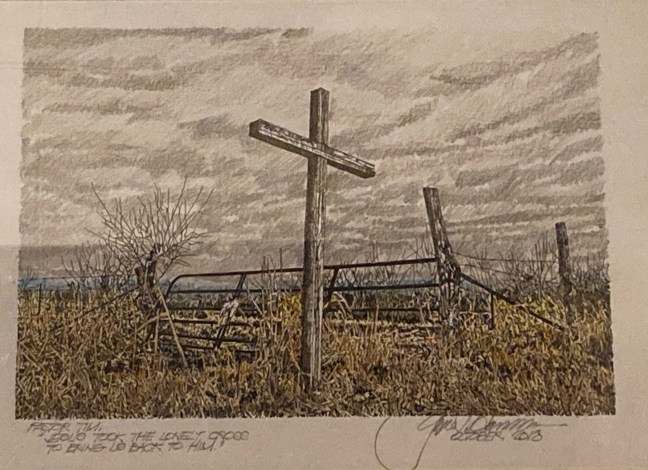
(The above illustration is a pen and pencil drawing by Gene Hanson that we shared during our worship time. Gene says the following about the meaning of the sketch: “The drawing as a whole depicts a sort of loneliness that Jesus must have felt as he approached and endured the cross. The broken down gate and fence represent the imperfections and brokenness of humanity. Of course, the cross is there to give us hope – a way to mend that fence.”)

I Corintians 1:18-25

The words of Paul in our text for today are familiar to many of us. They come in the form of a paradox – of upside down language. God’s wisdom is portrayed as foolishness to the world – and the wisdom of the world – is shown to be foolishness in terms of reaching or understanding God. What should we take away from this text for today, our third Sunday in Lent?

Verse 18

For the message of the cross is foolishness to those who are perishing, but to us who are being saved it is the power of God. 十字架のことばは、滅びに至る人々には愚かであっても、救いを受ける私たちには、神の力です。

If I had to restate this in my own words I would probably say something like this:

The message of the cross can be seen in two ways. 1. It’s either complete nonsense (foolishness) – to those who are approaching it through merely human understanding – or human knowledge – through philosophy, mathematics, scientific research, or even theology. Or, 2. It’s the key to everything (wisdom) – the power of God in our lives! It’s the key to our relationship with God and our eternal life in God. This is true for those who have heard the gospel story and accepted it in faith.

Verse 19-20

For it is written: “I will destroy the wisdom of the wise; the intelligence of the intelligent I will frustrate.” Where is the wise man? Where is the scholar? Where is the philosopher of this age? Has not God made foolish the wisdom of the world? それは、こう書いてあるからです。「わたしは知恵ある者の知恵を滅ぼし、賢い者の賢さをむなしくする。」 知者はどこにいるのですか。学者はどこにいるのですか。この世の議論家はどこにいるのですか。神は、この世の知恵を愚かなものにされたではありませんか。

Paul is NOT discrediting or demeaning education or learning.

Philosophy, theology, scientific research – these are not considered worthless or meaningless in this text. The church / Christian faith has often found itself on the wrong end of this argument – almost glorifying a kind of  “anti-intellectualism”, as if that were more pious and devout. Paul himself spoke often in his letters of the learning and study which he received as a devout Pharisee. He did say in Phil 3 that “compared to knowing Christ” all of his learning was like a pile of dung. But that was merely a comparison. He did NOT look down on learning. For Paul, human learning and knowledge has value – but it will never be enough to connect you with God.

Verse 21

For since in the wisdom of God the world through its wisdom did not know him, God was pleased through the foolishness of what was preached to save those who believe. 事実、この世が自分の知恵によって神を知ることがないのは、神の知恵によるのです。それゆえ、神はみこころによって、宣教のことばの愚かさを通して、信じる者を救おうと定められたのです。

The cross levels the playing field!

What Paul seems to be saying in verse 21 is that God, in his wisdom, has devised a route to salvation which does NOT favor the worldly wise, or wealthy, or fortunate, etc. It is completely egalitarian. In fact, God goes farther than simply creating a level playing field. He actually, on purpose, chose a method of salvation – the cross – that appears foolish and nonsensical. The only way to see the cross as our power and means of salvation is to place our trust in Jesus himself. Everyone is required to kneel at the foot of that cross and receive healing and salvation. The good news, and again, the egalitarian part – is that ALL are welcome!

Verses 22-24

Jews demand miraculous signs and Greeks look for wisdom, but we preach Christ crucified: a stumbling block to Jews and foolishness to Gentiles, but to those whom God has called, both Jews and Greeks, Christ the power of God and the wisdom of God. ユダヤ人はしるしを要求し、ギリシヤ人は知恵を追求します。しかし、私たちは十字架につけられたキリストを宣べ伝えるのです。ユダヤ人にとってはつまずき、異邦人にとっては愚かでしょうが、しかし、ユダヤ人であってもギリシヤ人であっても、召された者にとっては、キリストは神の力、神の知恵なのです。

Miracles and signs – as well as philosophy or learning can’t get you to God – only one thing can – the message of the cross.

Some people (in this example of Paul, Jews) will always be looking for the miraculous… for some sign of the divine. Other folks (again, here Paul uses the Greeks as an example) will always be depending on knowledge and philosophy in order to understand God and to understand the meaning of life. (Which are you more like?)

But we know that neither of these by themselves can lead a person to Christ and to salvation. Only one thing can do that – and that’s the message of the cross. The cross has the power to do that.

Verse 25 – the conclusion

For the foolishness of God is wiser than man’s wisdom, and the weakness of God is stronger than man’s strength. なぜなら、神の愚かさは人よりも賢く、神の弱さは人よりも強いからです。

God’s wisdom is different than our wisdom

It’s simply this: that what counts for wisdom in this world is NOT the same as what counts for wisdom in the Kingdom of God. And again – the paradox: those who appear wise are often actually foolish… and those that enter into faith (with apparent foolishness) are actually wise. As we continue this lenten journey with Jesus… are we willing to once again open ourselves up to the foolishness of the cross? Will we bow at the foot of the cross to receive forgiveness, healing, and reconciliation with God? The invitation is open to all!

(The above is a summary of the message that was shared during our zoom worship time on March 7th. We concluded by viewing a video together – here’s the link if you would like to view it again: Michael Card – God’s Own Fool. )

Let’s pray for the Takano Family!

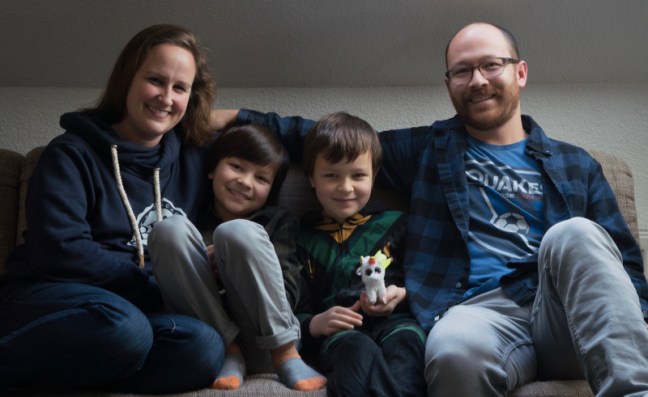
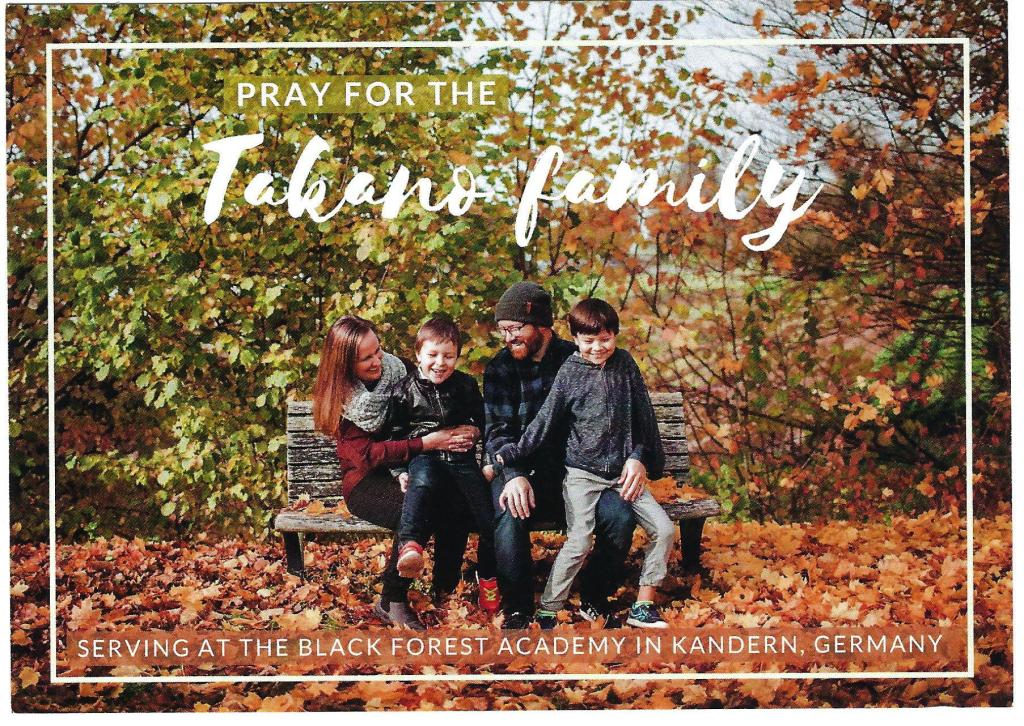
Recently we received a prayer card from Chris & Missy Takano, missionaries that we support as they teach and work at the Black Forest Academy in Kandern, Germany. They serve with a mission organization called Teach Beyond. Chris is the son of Shun Takano, who preaches on a monthly basis here at JCC. The card (see below) includes a couple of photos with their boys, Caleb and Eli, as well as contact information for them. Let’s support them in regular prayer…. and if you have a chance, why not send them a brief card or encouraging words via email?

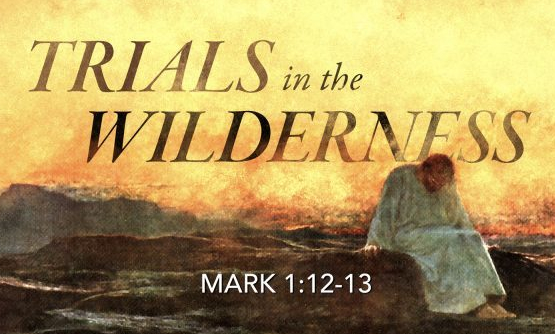
Thrown Into the Wilderness

Mark 1:9-15

At that time Jesus came from Nazareth in Galilee and was baptized by John in the Jordan.  As Jesus was coming up out of the water, he saw heaven being torn open and the Spirit descending on him like a dove. And a voice came from heaven: “You are my Son, whom I love; with you I am well pleased.” At once the Spirit sent him out into the desert, and he was in the desert forty days, being tempted by Satan. He was with the wild animals, and angels attended him. After John was put in prison, Jesus went into Galilee, proclaiming the good news of God. “The time has come,” he said. “The kingdom of God is near. Repent and believe the good news!” 

In these short verses we have Jesus’ baptism, his wilderness sojourn, John’s imprisonment, and the beginning of Jesus’ public preaching. While there is a lot of content in these few short verses, let’s take a look at Jesus’ wilderness experience in verses 12-13. Here are a few summary points to consider:

Jesus didn’t choose the wilderness… and neither do we

  • In our translation above, it says that Jesus was sent by the Holy Spirit into the wilderness. Other translations are a bit more graphic with the following words used in other English translations – driven, forced, chased, (even “thrown into the wilderness” in one translation). The Japanese – 追いやる – is usually translated as “chased away”. No matter which word we use it becomes clear that Jesus didn’t choose this sojourn so much as he was chosen for it. There was a need for this wilderness time of testing and trial.
  • In reflecting on our own wilderness experiences – of pain, ordeal, testing, sickness….we can recognize that we don’t volunteer or ask for those experiences either. They usually just come to us…. uninvited.
  • God is not anxious to make us suffer, but to help us grown strong in the wilderness.

The wilderness experience is usually longer than we would wish

  • Was it difficult for Jesus? Do we truly appreciate his humanity and the discomfort that 40 days of fasting and temptation from Satan would entail?
  • He had been affirmed by God’s loving words at his baptism. Did he still feel it now… throughout these 40 days? Were there times of doubt?  How about us? When we’re in the wilderness, do we sometimes doubt God’s love for us?
  • Sometimes it requires a long wilderness experience in order for us to learn that we’re truly loved, regardless of circumstances. We can be truly loved and uncomfortable at the same time. We can be truly loved and sick at the same time. We can be truly loved and food-insecure at the same time.  Do we truly understand this? God’s love for us is real whether we are “feeling it” or not.

The angels were with Jesus… have you ever experienced this?

  • Even when things were the toughest , or maybe especially then, God was present. We don’t know what Jesus’ angels looked like – or how they appeared to him. Maybe they served him through the physical world – as a soothing drink of water – or as a gentle breeze, or some other encouraging sign. Maybe they actually appeared as a companion? We, too, in our toughest moments, if our hearts and eyes are attuned, can see how God’s angels often bring relief, healing, help, etc. Maybe help comes in the form of a friend, or a card, or a phone call. Scripture doesn’t say a lot about angels. But it’s comforting to know that Jesus was protected from wild beasts and desert dangers by angels… and so are we.
  • In Luke, Jesus also experienced the support of an angel as he prayed in Gethsemane.
  • Last Sunday I challenged each of you to call or reach out to someone – perhaps we could become angels to others?

Jesus must have taken comfort many times from the audible words of his father on his day of baptism: “You are my Son, whom I love; with you, I am well pleased.” Those words may have given strength and endurance during the 40 days of testing that followed. Can we hear those words spoken to us today as well… in our time of pandemic or other wilderness trial? “You are my daughter, you are my son, whom I love; with you, I am well pleased.” 「あなたは、わたしの愛する子、わたしはあなたを喜ぶ。」

During Lent, we don’t want to rush to resurrection. Contemplating our spiritual lives, imagining what Jesus went through for us, thinking deeply on our need for humility and repentance – are all crucial. But we don’t have to be dark and gloomy throughout. We can do all of that with the end result – resurrection and new life – in mind!

(the above is a summary of the message shared during our zoom worship time on February 21st.)

Prayer for Ash Wednesday

You shall call, and the Lord will answer; You shall cry for help, and he will say, Here I am.  

Isaiah 58:9   


Will You Meet Us?

Will you meet us 
In the ashes,
Will you meet us 
in the ache
And show your face
Within our sorrow 
And offer us 
Your word of grace:

That you are life
Within the dying
That you abide
Within the dust,
That you are what
Survives the burning,
That you arise
To make us new.

And in our aching, 
You are breathing;
And in our weeping, 
You are here
Within the hands
That bear your blessing,
Enfolding us
Within your love.


By Jan Richardson
janrichardson.com

from "Circle of Grace" -  by Jan Richardson


What Shall We Do?

Acts 2:37-47 / 使徒の働き2:37−47

37Now when they heard this, they were cut to the heart and said to Peter and to the other apostles, “Brothers, what should we do?” 38Peter said to them, “Repent, and be baptized every one of you in the name of Jesus Christ so that your sins may be forgiven; and you will receive the gift of the Holy Spirit. 
39For the promise is for you, for your children, and for all who are far away, everyone whom the Lord our God calls to him.” 40And he testified with many other arguments and exhorted them, saying, “Save yourselves from this corrupt generation.” 41So those who welcomed his message were baptized, and that day about three thousand persons were added. 42They devoted themselves to the apostles’ teaching and fellowship, to the breaking of bread and the prayers.
43Awe came upon everyone, because many wonders and signs were being done by the apostles. 
44All who believed were together and had all things in common; 45they would sell their possessions and goods and distribute the proceeds£ to all, as any had need. 46Day by day, as they spent much time together in the temple, they broke bread at home£ and ate their food with glad and generous hearts, 
47praising God and having the goodwill of all the people. And day by day the Lord added to their number those who were being saved.

使徒の働き2:37-47

37 人々はこれを聞いて心を刺され、ペテロとほかの使徒たちに、「兄弟たち。私たちはどうしたらよいでしょうか。」と言った。 38 そこでペテロは彼らに答えた。「悔い改めなさい。そして、それぞれ罪を赦していただくために、イエス・キリストの名によってバプテスマを受けなさい。そうすれば、賜物として聖霊を受けるでしょう。 39 なぜなら、この約束は、あなたがたと、その子どもたち、ならびにすべての遠くにいる人々、すなわち、私たちの神である主がお召しになる人々に与えられているからです。」 40 ペテロは、このほかにも多くのことばをもって、あかしをし、「この曲がった時代から救われなさい。」と言って彼らに勧めた。 41 そこで、彼のことばを受け入れた者は、バプテスマを受けた。その日、三千人ほどが弟子に加えられた。 42 そして、彼らは使徒たちの教えを堅く守り、交わりをし、パンを裂き、祈りをしていた。

43 そして、一同の心に恐れが生じ、使徒たちによって、多くの不思議なわざとあかしの奇蹟が行なわれた。 44 信者となった者たちはみないっしょにいて、いっさいの物を共有にしていた。 45 そして、資産や持ち物を売っては、それぞれの必要に応じて、みなに分配していた。 46 そして毎日、心を一つにして宮に集まり、家でパンを裂き、喜びと真心をもって食事をともにし、 47 神を賛美し、すべての民に好意を持たれた。主も毎日救われる人々を仲間に加えてくださった。

In the first part of the chapter, we are told about how the Holy Spirit came upon the disciples, giving them the ability to speak in languages they did not know.  Emboldened, they spoke about the mighty deeds of God, and Jews from everywhere were hearing the message in their own languages.  The people were amazed, although some scoffed and claimed that they were drunk.

Peter stands and explains that this is the fulfilment of what the prophet Joel wrote over 400 years in the  past — That before the Lord’s judgement comes, everyone who calls on the name of the Lord shall be saved.  Peter goes on to explain that Jesus of Nazareth was the long-awaited Messiah and that as proof, He performed great deeds of power, wonders and signs, and yet the Jews handed Him over to the Romans to have Him killed.  But God raised Jesus from death and he now sits on the right hand of God.

Coming to today’s passage, upon hearing Peter’s message, people realized what they had done, and ask the disciples what they should do.  Peter’s response was to repent and be baptized and they will be forgiven and receive the gift of the Holy Spirit.

Those who welcomed this message were baptized — there were about three thousand of them.  They devoted themselves to the apostles’ teaching, fellowship, breaking of bread and prayers.  They took care of each others’ needs and had glad and generous hearts, and praised God.

It is clear that the Holy Spirit is that one empowered and emboldened the disciples, as well as creating an opportunity for bringing the good news to the people.  The actions of the Holy Spirit made some to wonder if the disciples were drunk, which in turn gave Peter the opportunity to address the crowd, and for the crowd to respond.

There are points that Peter makes that are also useful for us when given the opportunity to share the gospel of Jesus Christ:

  • The kingdom God was ushered in through the ministry, death and resurrection of Jesus
  • Because of the resurrection, Jesus sits at the right hand of God as the head of the new Israel
  • The Holy Spirit enables us to see and hear about Christ’s power and glory
  • The messianic age will reach its end when Jesus returns
  • Forgiveness, the Holy Spirit, and salvation come with repentance

In the last section, we see how a community of believers behaves:

  • Devotion to the Lord’s teachings 
  • Fellowship with believers 
  • Unselfishly helping with each other’s needs 
  • Worshipping and praising God 
  • Partaking of communion 
  • Living with glad and generous hearts 

The message Peter gave was not only to those who were there and witnessed the power of the Holy Spirit.  In v. 39 Peter says, “For the promise is for you, for your children, and for all who are far away, everyone whom the Lord our God calls to him.”

Although we live in a different time and place than is described in Acts 2, the same Holy Spirit is with us and the same message is still relevant, and the same way to live is still how we as believers can witness to the world about Jesus Christ.

(the above is a summary of the message shared with us by Shun Takano during our zoom worship session on February 14th.)

Work, Pray, Move On…

Mark 1:29-39

Our text this week is a continuation from last week’s account. After Jesus teaches in the synagogue (v. 21-28), he enters the home of Peter and Andrew. Peter’s mother-in-law is sick with a fever. He heals her and she immediately gets up and begins to serve them. At evening time, the people of Capernaum gather at the door. He heals many and exorcises evil spirits – probably late into the night. Sometime in the early morning, while it’s still dark, he finds a quiet place to pray and re-charge. When his disciples come looking for him, he states that they need to move on, preaching the good news of the kingdom in other towns and villages as well.

Jesus has had an intensely full day of teaching, healing, and ministering to the needs of the sick. This is followed by his “disappearance” to a quiet and lonely place in order to pray. Finally, the next day, we see his surprising conclusion to “move on” to other towns and locations – rather than to stay and continue to serve in this community where people are still in need and there’s an obvious clamor for his attention.

What should we make of this?

Although I’ve titled our meditation for today “Work, Pray, and Move On”, what I’m trying to see in this extremely busy day of ministry for Jesus is a kind of rhythm, or possibly a balanced, healthy view of time management. How does Jesus deal with both the demands and the constraints of this suddenly exploding work load?

The need to follow intense activity with rest and re-charging is a rhythm that I’ve found difficult to maintain and balance in my own life. The need (and command!) for such a life rhythm goes all the way back to the very model set for us by God in the creation story; six days of good work, followed by a day of rest. Or, as it became part of the rhythm and life code for all the people of Israel, the 4th of 10 commandments – to keep and maintain the Sabbath day as a holy day of rest. As a missionary in Japan, I can remember any number of pastor and leader gatherings where we would exchange comments such as, “It’s been so busy recently – I haven’t had a day off in months.” These comments, or similar ones, would often be shared with almost no awareness that, if true, would be a complete breach of our promise to accurately teach scripture, and would represent an open refute of at least one of God’s holy commandments! So at least one obvious take-away from today’s account is the fact that Jesus needed and made space in his daily rhythm for quiet prayer and re-connection with his heavenly Father.

In my own ministry I’ve often jumped into the work and found that part easy. It was more difficult to stop and truly rest and pray…. and finally, it was MOST difficult to change gears and move on. As I got “into” a task and had more and more of my own time and energy invested in it, it became more difficult to switch gears and start something new. Perhaps in a natural way, it was harder to see the ministry as “God’s” and easier and easier to see it as a work that “I needed to direct.” While there’s honor in “sticking to things, even when they get difficult”, I wonder how many times I’ve missed the clear leading of the Holy Spirit to “move on”.

And that’s the final part of the rhythm that stands out to me today when I ponder Jesus. Activity – followed by rest and prayer – often produces the kind of flexibility and clarity that we see in Jesus. It would have been so easy to “set up shop” in Capernaum; to rent some space, build a center, start a “seminary” for training, write a best-selling book, etc. etc. That’s what everyone was clamoring for. But instead, Jesus comes away from his time of prayer with a clarification of his call. “We must also go to other towns and villages to preach this gospel, because that’s the reason I have come (been sent).”

  • How about you? Are you keeping a healthy rhythm? Are you working hard? Are you taking time to rest and pray? Are you flexible and open to new directions?
  • How about us as a church? Maybe this time of pandemic has seemed like a long, enforced period of rest and “pause”. If so, are we taking advantage of this time to re-connect with our Master, to re-charge our depleted batteries…. to spend time with God?
  • Are we able to contemplate “moving on” , to leave what’s been comfortable and consider completely new activities and ministries as a church?

(The above is a summary of the message shared during our zoom worship session on Sunday, February 7th.)

Free Help for your Taxes!

I recently received this note from a volunteer at the King County United Way. Check out their poster below if you know of any folks that could use this free service.

My name is KG and I am volunteering with United Way of King County on their free tax preparation program. This program helps families get their Earned Income Tax Credit back from the 2020 tax season which could help them immensely. All of our volunteers are advanced tax certified and our services are offered in multiple languages to be accessible to many people. This year, we will be almost 100% online this year due to the Covid-19 pandemic. The program is free of charge and we believe it could benefit many people who attend your church.

Our website and some flyers may say we start preparing sometime in January, however, we will begin the preparation services on February 8th due to the delayed start of this year’s tax season. If you would be willing to help with outreach, we have both physical and digital flyers that need to be distributed to the community.

Please let us know if this is something you are interested in and feel free to reach out if you have any questions!

KG Brake
Volunteer
United Way of King County
Americorps NCCC

Amazed at His Authority!

Mark 1:21-28

Jesus goes to the synagogue on the Sabbath in Capernaum with his disciples.  He teaches… and everyone is amazed and surprised because he speaks with authority – and not like the other scribes and teachers.

How do you think this authority displayed itself? How was his teaching different? Some commentators refer to the fact that often the scribes and teachers of the law would interpret the text and spend time giving examples of tradition, etc. Jesus, on the other hand spoke directly – as if HE were the authority, as if HE himself could explain the text. Something about his delivery, presence, confidence – was very different than what they had seen and heard from their other teachers.

A man with an unclean spirit suddenly cries out “What do you want with us, Jesus of Nazareth? Have you come to destroy us? I know who you are – the Holy One of God!”

Jesus answers him “Be quiet! Come out of him.” And the evil spirit shakes the man and comes out of him with a scream. The man is set free, liberated, apparently healed.

And once again it says that the people are amazed at his authority. “Is this a new teaching? Even the demonic world answers to his authority!”

And finally, we read that news of Jesus spread rapidly in the neighboring areas.

So what can we learn? How can we apply this text to our own lives?

  • The story may challenge some of our assumptions about healing, or the spirit world where demons exist.  We see right away in this account that there is a description of a man that is a prisoner, his life diminished, in chains of some kind … due to the work of the demonic. As Christians, we may even interpret this in different ways – some accepting demon possession literally – some understanding it more as an historical way of describing mental or emotional illness, or even seeing it as an account to be taken metaphorically. I personally find it compelling to take this case literally – but regardless of where you stand, we need to understand the context of this story and how it may have been understood by Mark’s readers.
  • Just prior to this story, Jesus has been baptized (v. 9-12). At his baptism, the heavens open, the Holy Spirit descends on Jesus and enters him and a voice from heaven announces his identity. Jesus is, in a sense, possessed by the Holy Spirit of God.  And now in Capernaum, Jesus – for the first time – encounters someone who has an unclean or demonic spirit. The unclean spirits recognize right away who Jesus is, and that Jesus possesses the very power of God. Throughout the gospel of Mark the authority of Jesus becomes an important theme. Later, we will see Jesus speaking to the winds and the waves in the same way that he spoke here to the unclean spirits. “Be Quiet!” Thus according to Mark, Jesus has authority – not only over the spirit and demonic world, as in this case – but over the physical world as well.
  • The good news for us  – is that in Jesus, the power of God, through the Holy Spirit, has entered into our realm and all of the demonic powers in our world (all of the evil) are no threat or match for that power! If thinking of an exorcism seems like a stretch for you then you might want to see these demonic powers as any evil or negative power that diminishes, or takes away from the abundant and full life that God intends for us; anything that can take us captive and diminish our spiritual vitality. Unhealthy religious institutions, corrupted governmental powers, racism, twisted ideologies such as white supremacy, an unfair economy, broken relationships, family members that are abusive, addictions of various kinds – all of these may fit into this category.
  • Jesus speaks about his authority directly to his disciples in the final chapter of Matthew’s gospel.

“Then Jesus came to them and said, “All authority in heaven and on earth has been given to me. Therefore go and make disciples of all nations, baptizing them in the name of the Father and of the Son and of the Holy Spirit, and teaching them to obey everything I have commanded you. And surely I am with you always, to the very end of the age.” Matthew 28:18-20

Jesus, in this great commission and sending out of the disciples is saying – “I have authority and I give it to you. Go… and do these things… and I will be with you!” Can we believe that Jesus, in the Holy Spirit, has the power to enter our lives and heal? Do we believe that we, through the Holy Spirit, have also been given authority to work for the healing of others? The text says “Be amazed!! Jesus has that authority!”.

Let’s trust in the power and authority of the Holy One of God that can bring healing and wholeness to the world around us. If you’re like me, you’re often more prone to focus on our own smallness and lack of power. Maybe it’s time once again to look clearly at the authority we have been entrusted with…. and to be amazed!

The above is a summary of the message shared during our JCC worship time (via ZOOM) on Sunday, January 31st.